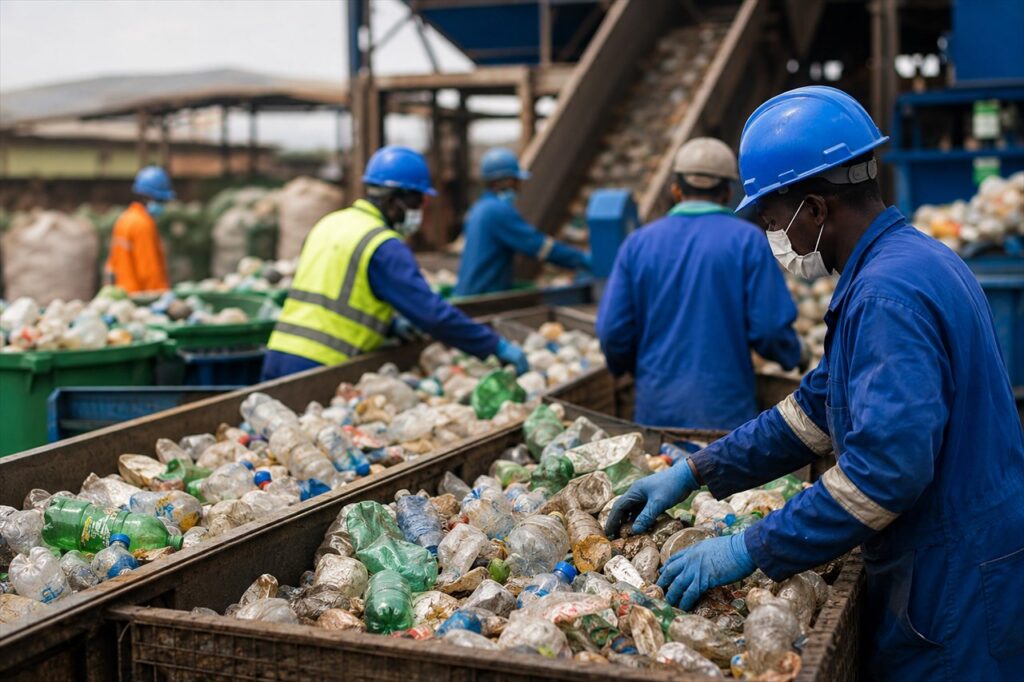
The green shift: Cameroon targets 2% of state budget for circular economy by 2030
In a strategic move to modernize its economic model, Cameroon has unveiled a sweeping plan to channel up to 2% of its national budget into the circular economy by the end of this decade. This vision is outlined in the National Roadmap for Circular Economy 2025-2035, developed by the Ministry of Economy, Planning and Territorial Development, which outlines a sustainable approach to resource management and waste valorization.
According to the plan, circular economy expenditures are projected at 62.8 billion FCFA in 2025, with annual waste management costs approaching 30 billion FCFA—a combined total of 92.8 billion FCFA, or 1.27% of the state budget. The government aims to progressively increase this investment to 2% of the budget by 2030, which would represent an additional commitment of over 53 billion FCFA compared to current levels, based on the 2025 budget.
Growing waste challenges demand urgent action
Cameroon currently generates around 6 million tonnes of waste annually, primarily from households, markets, public services, and businesses. Yet, the existing waste management system remains largely underdeveloped, with a heavy focus on collection and limited capacity for processing and recycling.
Official data reveals that only 50% of waste is collected, while recycling rates hover below 10%. In the country’s two largest cities, Yaoundé and Douala, annual waste production is expected to exceed 2.8 million tonnes by 2040, further straining an already inadequate infrastructure network.
Key obstacles identified include the lack of source separation, minimal waste valorization, insufficient collection and treatment facilities, gaps in data collection, and weak institutional capacity. Plastic pollution is a particularly pressing concern, with nearly 1,300 tonnes of plastic waste being released into the environment daily. Of this, only 250 tonnes are collected each month, and a mere 180 tonnes are recycled—highlighting the scale of the challenge.
Reforms and investments to rebuild the waste management chain
To address these gaps, the government plans a comprehensive overhaul of waste management policies and infrastructure. Proposed measures include a Prime Ministerial decree embedding circular economy principles into value chains, a review of environmental legislation, and stronger enforcement agencies. The plan also suggests clarifying roles between sectoral ministries and local governments, and potentially establishing a National Waste Management Agency.
On the infrastructure front, the roadmap calls for the construction and modernization of sorting centers, transfer stations, and sanitary landfills, alongside expanded collection equipment. It also envisions deploying biogas digesters and composting units to convert organic waste into valuable resources.
Public awareness campaigns on source separation and illegal dumping, along with support for community recycling initiatives and vocational training in recycling, are also part of the strategy. Additionally, the plan promotes innovation in the recycling sector to spur new economic opportunities.
Blending public and private finance for sustainable growth
The financing strategy relies on a mix of public and private resources. It includes reforming municipal waste-related taxes, implementing a mandatory Extended Producer Responsibility (EPR) system to fund collection and recycling, and enhancing the National Waste Exchange platform—a digital marketplace already in operation that connects buyers and sellers of recyclable materials.
This platform is designed to attract private investment, stimulate demand for recyclables, and help build a robust market for secondary raw materials. International partners such as the African Development Bank (AfDB), African Circular Economy Facility, World Bank, Japan International Cooperation Agency (JICA), and various United Nations agencies are seen as key contributors to financing this transition.