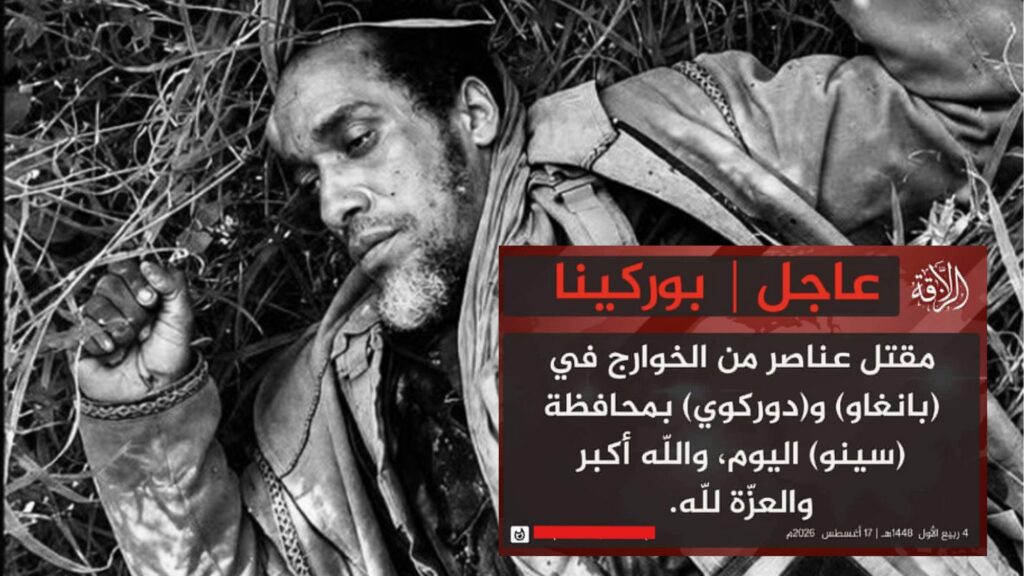
The death of Abou Zeid Al-Burkinabi, a senior leader of the Islamic State in the Sahel (EIS), on August 17, 2026, has sent shockwaves through the region’s security landscape. Far from being neutralized by Burkina Faso’s armed forces, the jihadist commander fell in fierce clashes with members of the Jama’at Nasr al-Islam wal-Muslimin (JNIM), an Al-Qaeda-affiliated group. This deadly confrontation underscores the escalating violence tearing apart the Sahel’s jihadist factions.
Contrary to initial claims circulating in pro-government channels, Abou Zeid Al-Burkinabi was not killed in a military operation. Instead, his demise unfolded in the villages of Bangao and Dorkoye, within the Séno province—a border region with Niger that has long been a hotspot for armed insurgencies. Local and security sources confirm that the clash erupted between rival factions, with the JNIM emerging victorious. This internal strife reveals the deep-seated fractures within the Sahel’s extremist networks.
Abou Zeid Al-Burkinabi: a pivotal figure in the EIS’s decline
Abou Zeid Al-Burkinabi was no ordinary militant. Hailing from Burkina Faso, he rose through the ranks to become one of the EIS’s most influential operational and propaganda leaders in the tri-border zone, spanning Burkina Faso, Mali, and Niger. His intimate knowledge of the terrain and extensive recruitment networks in the Séno and neighboring provinces made him a linchpin for the group’s expansion. As a regional commander, he orchestrated ambushes against defense forces, terrorized civilian populations, and extorted resources through forced zakat collections. His death deals a severe blow to the EIS’s already strained command structure, weakened by relentless military pressure and fierce competition from the JNIM.
The fog of war: misinformation and shifting narratives
The announcement of Abou Zeid Al-Burkinabi’s death triggered a flurry of conflicting claims. Pro-government influencers and propaganda channels swiftly attributed his elimination to a precision strike or an ambush carried out by Burkina Faso’s defense and security forces, possibly with support from the Volunteers for the Defense of the Homeland (VDP). This narrative served the transitional authorities’ agenda to highlight the army’s growing capabilities. However, ground-level reports and rival jihadist channels quickly corrected the record. The Burkina Faso military, while active in the area, played no direct role in this confrontation. Abou Zeid Al-Burkinabi’s fate was sealed not by government forces, but by the brutal infighting consuming the Sahel’s jihadist landscape.
JNIM vs. EIS: a bloody feud rooted in ideology and power
The clashes in Bangao and Dorkoye are the latest chapter in a protracted conflict between the JNIM and the EIS, which began in 2019. Despite sharing a common goal of establishing a salafist-jihadist state, the two groups are locked in a bitter ideological and strategic rivalry.
- Ideological divide: The JNIM, loyal to Al-Qaeda’s central leadership, pursues a pragmatic approach, often negotiating with local leaders to embed itself in communities. In stark contrast, the EIS enforces a brutal doctrine marked by takfirism—mass excommunication—and indiscriminate violence against civilians deemed disloyal.
- Battle for resources: Control over smuggling routes, artisanal gold mines, and transhumance corridors is critical for funding. Both groups fiercely contest these financial lifelines, fueling violent clashes.
- A history of bloodshed: Since 2020, violent confrontations have erupted in Mali’s Gourma and Burkina Faso’s Liptako regions, leaving hundreds dead. In 2022 and 2023, battles in Mali’s Ménaka region and northern Burkina Faso escalated to large-scale engagements involving hundreds of fighters and heavy weaponry.
The August 17 confrontation proves that despite relentless pressure from government forces, the hatred between these factions remains unabated. The Sahel’s jihadist landscape continues to be shaped as much by internal strife as by external military campaigns.
Security repercussions for the Séno province
The JNIM’s elimination of Abou Zeid Al-Burkinabi may temporarily shift the balance of power in the Séno province. By removing a top EIS commander, the JNIM aims to solidify its territorial dominance and push its rival out of key border zones. However, for civilians in the Séno, this internecine war offers little respite. While these clashes may weaken both groups, they also expose communities to retaliatory violence and chronic insecurity. The fact that jihadist leaders are being purged by their own peers highlights the Sahel’s complex security puzzle, where the downfall of one faction often paves the way for another equally dangerous group.
The death of Abou Zeid Al-Burkinabi marks a significant moment in the attritional war between terrorist factions in Burkina Faso. It serves as a stark reminder that the Sahel’s security challenges extend beyond government-led operations. The internal fractures within jihadist groups are just as critical to understanding the region’s volatile trajectory. For analysts and stakeholders, monitoring these divisions remains essential to anticipating the Burkina Faso’s security outlook.