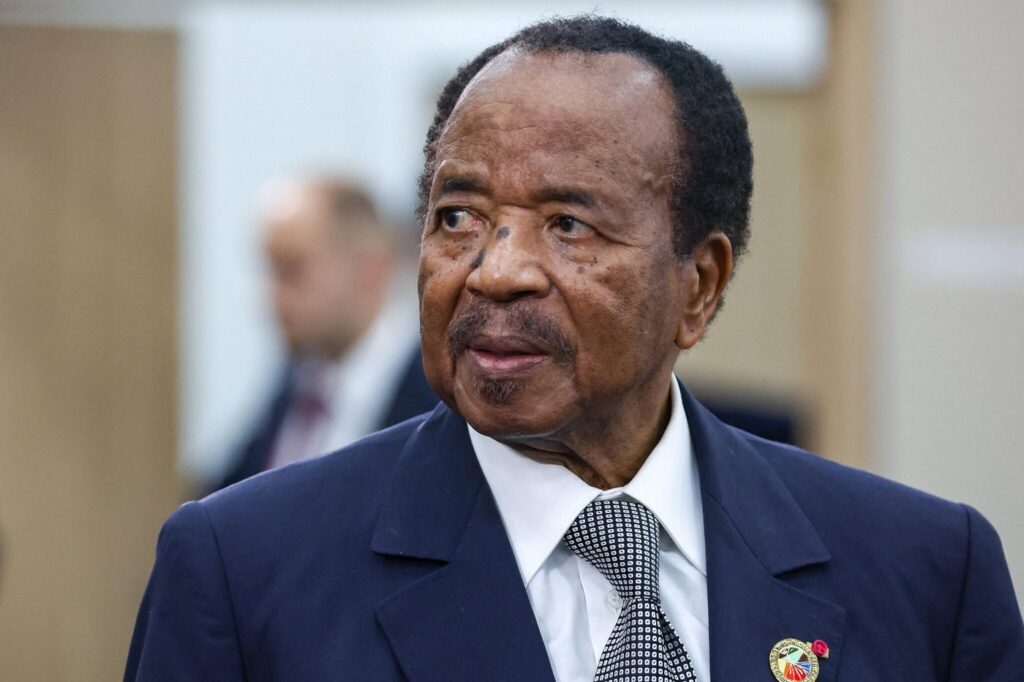
©KIRILL KUKHMAR / TASS HOST PHOTO AGENCY/ HANDOUT/EPA/MAXPPP - epa10774383 A handout photo made available by TASS Host Photo Agency shows Cameroonian President Paul Biya meeting with Russia's President Vladimir Putin, during the Second Summit 'Russia-Africa' Economic and Humanitarian Forum in St.Petersburg, Russia, 28 July 2023. The Second Summit Economic and Humanitarian Forum 'Russia-Africa' takes place from 27 to 28 July at the Expoforum congress-exhibition center in St.Petersburg. EPA-EFE/KIRILL KUKHMAR / TASS HOST PHOTO AGENCY/ HANDOUT --MANDATORY CREDIT-- HANDOUT EDITORIAL USE ONLY/NO SALES (MaxPPP TagID: maxnewsfrfive208493.jpg) [Photo via MaxPPP]
Paul Biya, who has served as Cameroon’s president since 1982 and holds the distinction of being the world’s longest-serving head of state, made his return to Yaoundé on Thursday, August 20. His arrival followed an absence exceeding two months, reigniting a fervent national discussion regarding his ongoing capacity to govern the country.
The Cameroonian leader, aged 93, departed Yaoundé on June 7 for what the presidency described as a “short private stay in Europe.” Reports from the Cameroonian press indicated his presence in Geneva, Switzerland, accompanied by his family and a select group of close collaborators.
After 73 days away from the nation, Paul Biya was seen leaving Yaoundé airport, acknowledging the crowd with a wave through the slightly open window of his vehicle. He was en route to his residence, the Etoudi Palace, alongside his wife, Chantal Biya. Several dozen supporters of the presidential party, some adorned in fabric bearing the president’s image, had gathered at the airport to welcome him in a celebratory atmosphere.
The health of Paul Biya, a frequent visitor to Geneva, has been the subject of persistent rumors, occasionally refuted by the government. On June 18, Communication Minister René Emmanuel Sadi publicly denied claims of the Cameroonian leader’s hospitalization in a Geneva clinic, responding to various press articles.
This unusually long period of absence has intensified the debate surrounding the perceived inertia of the Cameroonian government. It drew sharp criticism from the opposition, which decried an “institutional vacuum” and described the country as being on “autopilot,” particularly as the appointment of a new government and a vice-president had been anticipated for several months.
A “spectacle”
“For a democracy like ours, it is natural for a president’s prolonged absence to raise questions. However, it did not alter the country’s operations, which continued to function,” asserted Gilles Owono, a 30-year-old teacher who was present at the airport to greet the head of state.
James Fame Ndongo, a senior figure in the presidential party and Minister of Higher Education, dismissed accusations of a power vacuum in late July. He argued that “wherever he is, the head of state meticulously reviews the files submitted to him by… his collaborators.”
Nevertheless, these repeated absences over more than two decades continue to fuel frustration among many Cameroonians. “It makes no difference whether he is here or not. When he is here, he does nothing. Therefore, I do not believe it is necessary to participate in this spectacle,” decried Prosper Nkou Mvondo, leader of the opposition Univers party.
His re-election for an eighth term in October 2025 had previously led to demonstrations that were violently suppressed, with the government acknowledging “several dozens” of fatalities without providing an exact count. The results, disputed by the opposition, also prompted a degree of reservation from Western diplomatic missions.
This extended stay outside Cameroon also fueled speculation about the post-Biya era, accelerating the race for his succession, though the path forward remains shrouded in uncertainty. In the absence of a vice-president, the responsibility would fall to the President of the Senate, Aboubakary Abdoulaye, to assume leadership in the event of a power vacancy, until a presidential election could be organized.