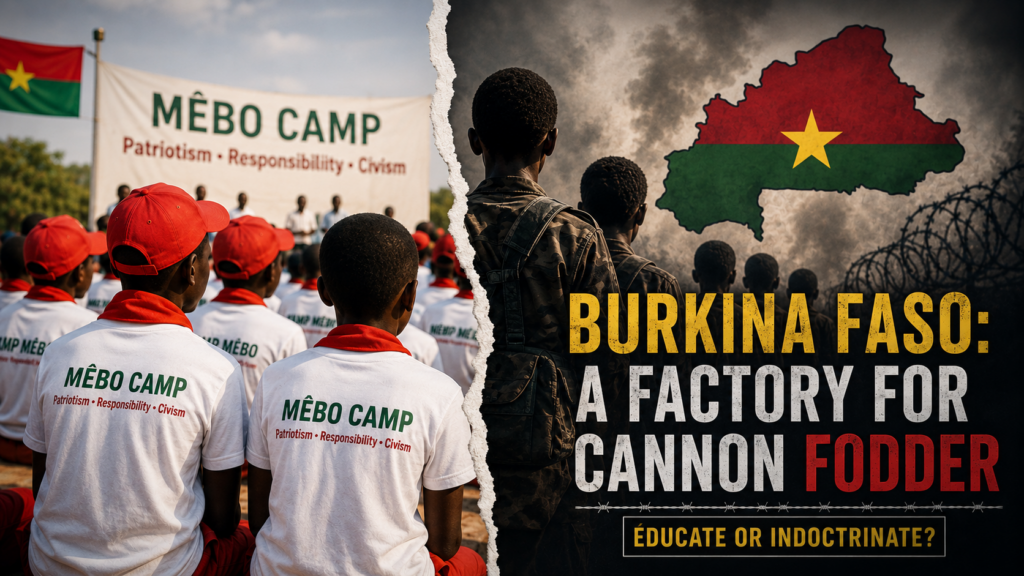
Patriotic education or subtle militarisation?
The Mêbo holiday camp in Burkina Faso has drawn thousands of young participants to cultural, athletic, and community activities, framed as a civic initiative by national authorities. Its stated goal: fostering patriotism, responsibility, and civic engagement from an early age. Yet beneath the official rhetoric of virtue and national pride, a more troubling question emerges: could these large-scale gatherings be the first steps toward a gradual militarisation of the country’s youth?
The issue is not the value of civic education itself. Instilling a sense of duty, respect for institutions, and solidarity among young citizens is fundamentally positive. The concern arises when patriotism shifts from a constructive civic value into a tool of political mobilisation when critical thought gives way to unquestioning obedience, and national defence is framed not as a responsibility but as an ever-present obligation.
Historical precedents in Africa
Such strategies are not new on the African continent. Similar patterns of early indoctrination, recruitment, or ideological mobilisation have appeared across West and Central Africa, from Sierra Leone to Liberia and parts of the Democratic Republic of the Congo. In each case, the line separating patriotic awareness, ideological influence, and involvement in conflict has often proven dangerously thin. When state power leverages national sentiment among an impressionable young audience, the risk is real: civic education risks morphing into a mechanism for mobilisation rather than enlightenment.
Language that shapes perception
The vocabulary used in these programmes is equally telling. When concepts such as homeland, sacrifice, enemy, national defence, and commitment are repeatedly paired in messages directed at youth, they risk normalising the idea that military service is the natural destiny of young citizens. Yet a child or teenager’s first duty is to learn, to reflect, to debate, and to create not to prepare for sacrifice in a political or military cause.
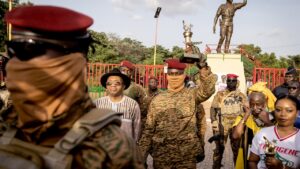
In the current volatile security climate of the Sahel, Burkina Faso’s leadership under Ibrahim Traoré faces heightened scrutiny. The nation is embroiled in a conflict that has uprooted communities, displaced millions, and elevated national defence to the forefront of public discourse. Within such a charged environment, patriotic mobilisation can easily take on a more intense and potentially dangerous form. The central question becomes one of boundaries: how far can a state go in instilling a defence mindset in its youth without overstepping into indoctrination?
Risks to critical thought and civic maturity
By moulding a youth deeply aligned with official narratives, the government intentionally or not risks narrowing the space for dissent and independent thought. A truly civic-minded youth is not one that blindly approves of authority. It is a youth capable of defending its country while questioning its leaders, of honouring the nation without conflating it with the regime, and of serving the community without becoming a political tool.
Another danger lies in the early normalisation of sacrifice. When combat death is framed as the ultimate expression of patriotism, a perilous perception takes root: one that equates love of country with a child’s willingness to embrace violence. Yet national pride should never be measured by a young person’s capacity to accept war, but by their commitment to education, health, agriculture, innovation, social cohesion, and sustainable development.
Uniforms, symbols, and the language of war
Individually, uniforms, military symbols, and martial rhetoric may not indicate militarisation. But when these elements converge in a context of ongoing conflict and sustained national mobilisation, they demand close scrutiny. It is in these grey areas that the distinctions between civic education, patriotic propaganda, and psychological conditioning for military enlistment can quietly dissolve.
The issue of age is equally critical. An adult can weigh political and military choices with informed judgment. A child, however, lacks the maturity and discernment to make such decisions. Institutions must therefore act as protective guardians, ensuring that education serves as a path to emancipation—not a vehicle for shaping compliant citizens conditioned for confrontation.
Confronting the cycle of violence
In the face of acute security crises, the temptation to militarise young minds is strong. Yet responding to military threats by ideologically preparing an entire generation for war risks creating a dangerous feedback loop. The more society conditions its youth to see enemies and sacrifice as inevitable, the more violence becomes normalised as a response to political and social disputes.
Genuine patriotism should offer an alternative to this cycle. To love Burkina Faso is not merely to be willing to die for it. It is to strive for a nation stable enough that its children can learn, work, and build their futures without constant exposure to war. It is to accept that citizens can support their country while holding its government to account.
Demanding clarity and safeguards
Before endorsing uncritically the rhetoric of patriotism and youth mobilisation, it is essential to demand transparency. What are the pedagogical goals of these camps? How much space is given to critical thinking? Are participants free to voice disagreement? Do activities include military or paramilitary elements? Most importantly, where does the line lie between nurturing responsible citizens and conditioning a generation to accept war as inevitable?
Burkina Faso needs an engaged, educated, and responsible youth. But it must also preserve their autonomy. Preparing tomorrow’s citizens to build their nation is a noble aim. Preparing them to serve as cannon fodder in future wars is something entirely different and must be avoided at all costs.
The question remains unanswered: are these children being prepared to build Burkina Faso’s future, or to become expendable tools in the conflicts of tomorrow?