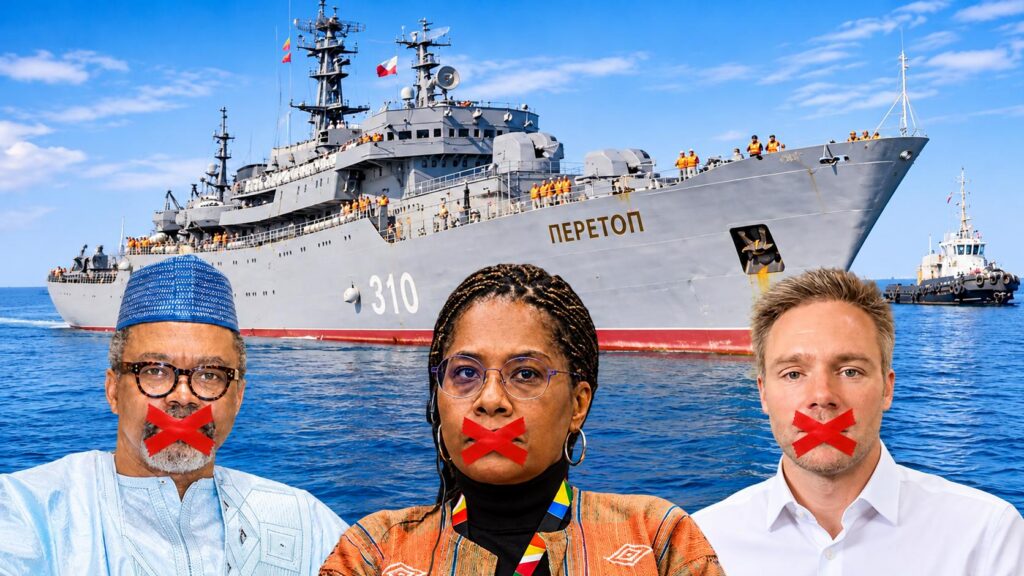
The arrival of a French warship in Benin’s waters months ago sparked fierce debates, accusations, and even disinformation campaigns in certain media circles. Critics swiftly framed the visit as a threat to national sovereignty, amplifying suspicions about France’s intentions without waiting for official clarifications. Yet when a Russian naval vessel docked in Cotonou recently, the response was markedly different almost silent. The contrast raises pressing questions about selective scrutiny in the country’s maritime diplomacy.
From outcry to indifference: the shifting narrative on foreign ships in Benin
In the first half of the year, a French military vessel’s stopover in Cotonou became a lightning rod for controversy. Media personalities aligned with the Alliance of Sahel States (AES) portrayed the visit as an ominous sign, casting doubts on Benin’s autonomy and its partnerships. Social media platforms and commentary spaces were flooded with interpretations, many of them speculative, that painted France as an overbearing or untrustworthy partner. Little attention was paid to the ship’s humanitarian or logistical mission, which included delivering medical supplies a detail often omitted in the rush to condemn.
Fast forward to last week, when a Russian warship anchored in the same port. This time, the reaction was subdued. Few voices questioned the visit, no campaigns of misinformation emerged, and the same commentators who had once warned of sovereignty violations remained conspicuously quiet. The silence was deafening, especially given the vessel’s military profile and the geopolitical weight of its flag. Why does the origin of a ship’s flag determine the intensity of public scrutiny and why does Russia’s presence escape the harsh lens applied to Western nations?
Geopolitical bias: when maritime cooperation becomes a matter of allegiance
The divergence in responses reveals a troubling pattern in how Benin’s partnerships are perceived. When the ship bears a Western flag, the default reaction is suspicion; when it flies under a Russian banner, the narrative shifts to acceptance or even indifference. This inconsistency extends beyond individual opinions; it reflects a broader media discourse that often prioritizes geopolitical narratives over factual reporting. The result? A skewed perception of sovereignty, where the same standards are not applied uniformly.
Sovereignty, by definition, is indivisible. It does not fluctuate based on the nationality of a visiting vessel or the preferences of external commentators. Benin, as a sovereign state, has the right to engage with any partner that aligns with its national interests whether that partner is France, Russia, or another nation. The government’s role is to assess each partnership on its merits, not to kowtow to the sensitivities of foreign observers or domestic critics. Meanwhile, the media’s responsibility is to report events with impartiality, ensuring that the public receives balanced information regardless of the ship’s flag.
What’s at stake for Benin’s international image
The double standards in how foreign vessels are treated do more than expose inconsistencies they risk undermining Benin’s reputation as a pragmatic and independent actor on the global stage. When criticism is applied selectively, it sends a message that the country’s choices are not its own but rather shaped by external pressures. This perception can deter potential partners, who may question whether Benin is a reliable host or merely a stage for proxy disputes.
For Benin’s citizens, the stakes are equally high. Tourism, trade, and maritime security depend on a stable and predictable environment. If foreign visitors are met with hostility based on their nationality rather than their actions, the country’s appeal as a destination for cooperation could wane. Already, some analysts warn that the current discourse could discourage future port calls, leaving Benin isolated in a region where diplomatic flexibility is increasingly valuable.
The path forward: consistency over convenience
To restore confidence, both in the eyes of its people and the international community, Benin must insist on a single standard for evaluating foreign partnerships. This means holding all visits to the same level of scrutiny regardless of the country the vessel represents and rejecting the notion that sovereignty is a concept that can be bent to fit a geopolitical narrative. The media, too, must play its part by prioritizing facts over allegiances, ensuring that every docking ship is judged on its own merits rather than the flag it carries.
The quiet arrival of a Russian warship in Cotonou should serve as a wake-up call. It is not the presence of the ship that demands scrutiny, but the uneven standards that either amplify or ignore it. For Benin, the choice is clear: will it let external biases dictate its maritime diplomacy, or will it assert its sovereignty with the uncompromising clarity it deserves?
By Rose Njoya — Journalist





