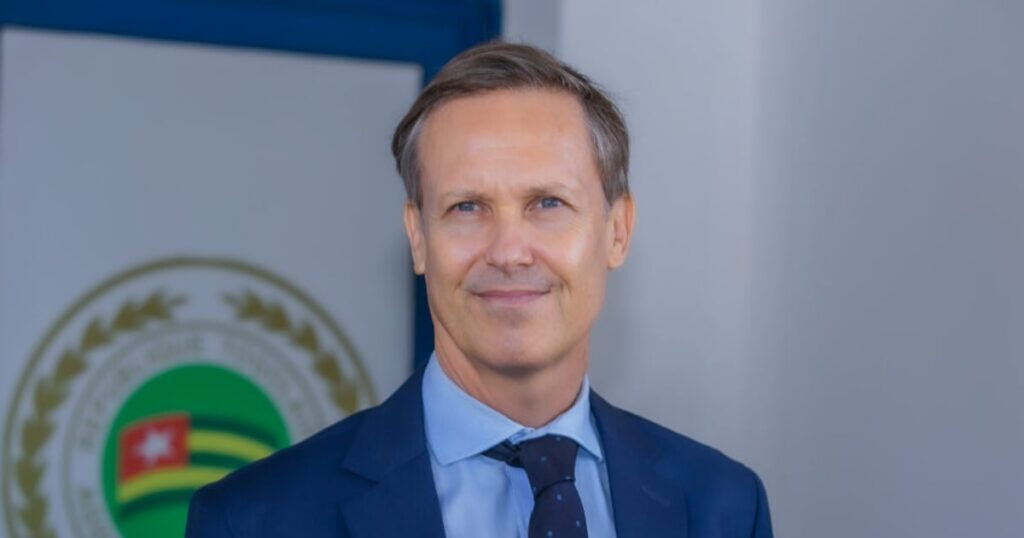
The European Union (EU) has reaffirmed its commitment to strengthening its partnership with Togo, as global tensions continue to escalate. This pledge was made in Lomé by Gwilym Ceri Jones, Head of the EU Delegation to Togo, during Europe Day celebrations on May 9, with a focus on both European achievements and the geopolitical and security challenges facing the world today.
You might also like:
Amid escalating conflicts, rising geopolitical tensions, and global economic strain, the European diplomat underscored the EU’s determination to remain a trusted partner for African nations, particularly Togo.
«In these turbulent and uncertain times, the EU stands as a steadfast and dependable partner, fostering cooperation rooted in international law,» Jones stated. He highlighted the tangible progress achieved through EU-Togo collaborations, including development aid programs, economic support initiatives, and social development projects.
The EU’s contributions have made a significant impact: over 1.3 million Togolese now have access to electricity thanks to European-funded electrification programs. More than 2.5 million people benefit from improved waste collection and treatment systems, while the rehabilitation of the RN2 highway (connecting Lomé, Aného, and the Bénin border) is underway.
You might also like:
The EU is also poised to support a 18% increase in Togo’s electricity production through renewable energy initiatives, as noted by Jones.
Beyond infrastructure and energy, the EU praised Togo’s role as a host to 60,000 refugees in the northern regions, its mediation efforts in the Sahel and Great Lakes regions, and the vigilance of Togolese defense and security forces in combating terrorism.
By positioning itself as a «strong and reliable partner» grounded in international law, the EU is drawing a clear line in the sand. The timing is deliberate: as neighboring Sahel nations grapple with instability and regional powers increasingly distance themselves from Western influence, Brussels is reinforcing its alliance with Togo—a country that serves as both a shield and a mediator.
You might also like:
The EU’s emphasis on development aid is not merely symbolic—it reflects a mutual interdependence. Electrification for 1.3 million Togolese and waste management systems for 2.5 million are not just humanitarian gestures; they are tools for social pacification in a country where access to basic services can prevent public resentment. The pledge to boost renewable energy production by 18% signals a push for low-carbon development, a narrative critical to the EU’s global image. Yet, the rehabilitation of the RN2—a vital trade corridor linking Lomé to the Bénin border—reveals a strategic interest: keeping economic arteries open is as vital for European markets as it is for local economies.
However, the cornerstone of this relationship is security. By commending Togo’s refugee hosting capacity and its mediation role in the Sahel, the EU is effectively outsourcing stability. Though not directly on the frontline of jihadist threats, Togo absorbs both migratory and diplomatic pressures, serving as Europe’s final bulwark against instability spreading toward the Gulf of Guinea. The praise for Togolese defense forces underscores their role as an indispensable local law enforcer. This is far beyond mere cooperation: Brussels is purchasing geopolitical credibility for itself in Africa, positioning Togo as the linchpin of its containment strategy amid Sahelian turmoil.