Massive sell-off triggers global panic as AI and chip stocks collapse
Wall Street executives arrived to work this morning to witness a financial earthquake unlike anything seen in nearly two years. The Nasdaq Composite, long regarded as the bellwether for America’s technology-driven economy, suffered a catastrophic plunge that vaporized over $2.5 trillion in market capitalization across AI, semiconductor, and data infrastructure stocks in a single catastrophic trading session. The fallout extended far beyond corporate balance sheets, threatening jobs, innovation pipelines, and the very foundation of the digital economy that has powered growth since the pandemic era.
When pillars crumble: Nvidia, AMD, and the chip industry’s meltdown
The collapse was led by the very companies that had become symbols of America’s AI revolution. Graphic chip giant Nvidia—once the darling of Wall Street—saw its stock plunge by 6 to 9%, erasing upwards of $40 billion in shareholder value in a matter of hours. The stock, which had soared on the back of surging demand for AI accelerators, now faces questions about whether its astronomical valuation could ever be justified by actual returns.
AMD, Nvidia’s closest rival in the AI processing race, saw its shares tumble between 6% and 17% across different trading segments. The company, which had positioned itself as a lower-cost alternative to Nvidia’s monopoly on high-end chips, now finds its growth narrative under severe scrutiny. The broader semiconductor sector fared no better: Micron Technology lost between 10% and 17%, Western Digital fell 13%, and SanDisk plummeted by up to 22%, signaling a wholesale exit from data center supply chains that have fueled the tech boom. The Philadelphia Semiconductor Index (SOX) collapsed by more than 12%, wiping out nearly all gains accumulated over the past six months.
From tech giants to panic buttons: broader market carnage
The sell-off was not confined to Silicon Valley. The contagion spread across the entire U.S. market, dragging all major indices deep into negative territory:
- S&P 500: Dropped over 2.6% to 4.3%, recording its worst single-day performance of the year.
- Dow Jones Industrial Average: Fell more than 3%, dragged down by heavyweights in both technology and industrial sectors.
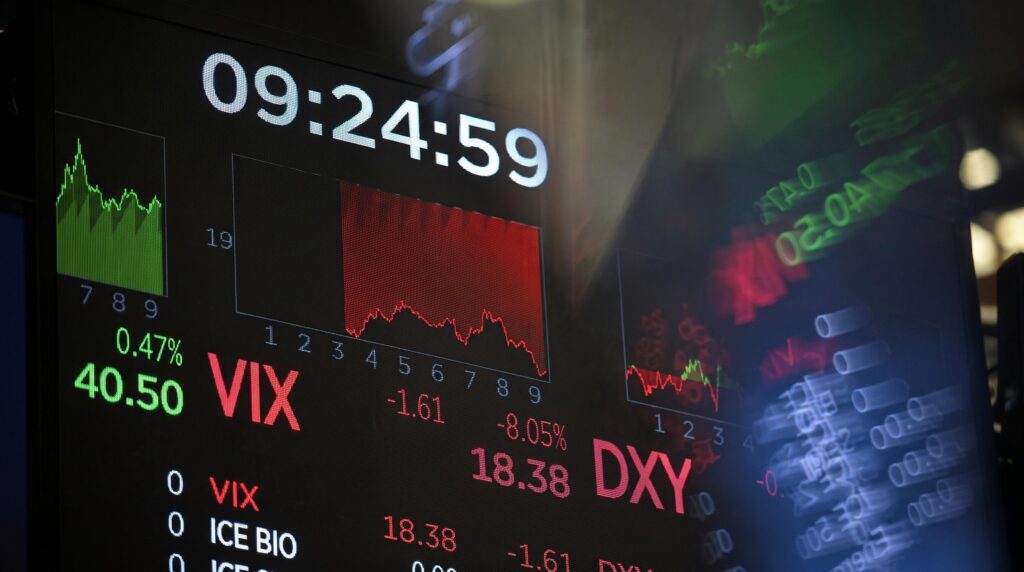
- VIX (Fear Index): Skyrocketed 33% to climb above 60, a level not seen since the early days of the COVID-19 pandemic, reflecting extreme investor anxiety and systemic risk aversion.
What lit the fuse? Three triggers behind the collapse
The rout was not random. It was the culmination of simmering tensions that finally erupted into open panic. The first and most damaging trigger was a growing disillusionment with the return on investment in AI infrastructure. After pouring hundreds of billions into data centers, AI servers, and energy-hungry computing hubs, investors are now questioning whether these massive upfront costs will ever translate into sustainable profits. With no clear path to monetization for most AI applications beyond cloud services and enterprise tools, the market is realizing the hype may have outpaced reality.
The second catalyst was regulatory uncertainty. Recent policy discussions in Washington about restricting or slowing the expansion of data centers—due to concerns over energy consumption and strain on the power grid—sent shockwaves through the chip sector. Major players like Nvidia, AMD, and Broadcom, which rely on exponential growth in data infrastructure, now face the prospect of slower demand growth just as supply chains are already stretched thin.
The final spark came from automated trading systems and hedge funds. After months of uninterrupted gains, algorithmic trading models triggered mass sell orders once key technical support levels were breached—especially the 200-day moving average. What began as a healthy correction quickly spiraled into a liquidation cascade, with leveraged portfolios forced to dump shares at any price to avoid margin calls.
Aftershocks hit global markets: Asia reels under wave of selling
The crisis on Wall Street did not stay confined within U.S. borders. Stock markets across Asia reacted with alarm. In Tokyo, the Nikkei 225 dropped nearly 6%, while Seoul’s Kospi collapsed by more than 8% as chip giants Samsung Electronics and SK Hynix led the declines. European markets opened sharply lower, with major indices down 3% to 4%, and futures markets suggest a global rout may be unfolding.
Analysts are divided over whether this is a temporary “correction” or the beginning of a deeper unwinding of the tech bubble that has inflated since 2020. What is clear, however, is that the ripple effects will be felt far beyond Wall Street. Startups that depend on AI infrastructure funding may see their lifelines cut. Entire city blocks of new data centers—planned with billions in private and public investment—now face delays or cancellations. Thousands of engineers, data scientists, and chip designers may face layoffs as companies tighten spending. The tech-driven economy, which has been the engine of U.S. growth for years, is suddenly running on empty.
As the dust settles, one question looms over the markets: Will the fallout from Wall Street’s $2.5 trillion meltdown force a reckoning with the sustainability of the AI boom—or just mark the beginning of an even more volatile chapter in the digital revolution?





