Traditional Chiefs: Pillars of Bénin’s Cultural Identity
In Bénin, traditional leaders occupy a central position in the social and cultural fabric, serving as guardians of the nation’s heritage and identity. Their roles extend beyond ceremonial duties—they are recognized by the state as moral and cultural authorities, responsible for preserving customs and fostering community cohesion. This recognition is enshrined in the 2025 Legal Framework for Traditional Chieftaincy, which grants formal legal status to 16 kingdoms and 90 traditional chefferies, underscoring their contributions to socio-economic development and cultural preservation.
The legislation categorizes these institutions while reinforcing their legitimacy in conflict resolution and social harmony. However, as their influence grows, questions arise about their evolving role in the public sphere and the need to maintain a clear separation from partisan politics.
Citizens’ Trust Meets Political Ambitions
Despite their deep-rooted presence, traditional leaders have long been entangled in the political landscape. Parties often seek their endorsement, sometimes offering material or financial incentives—a practice that has sparked concerns over integrity and impartiality. To curb these practices, Bénin has enforced a ban on traditional rulers engaging in partisan politics, a move aimed at preserving their moral authority and neutrality.
Recent surveys reveal that nearly a quarter of Béninois have interacted with traditional leaders in the past year, reflecting their enduring relevance. A majority of citizens express trust in these leaders and believe they positively influence local governance. Yet, this confidence is tempered by growing skepticism: three-quarters of respondents suspect at least some traditional leaders of corruption—a concern that has intensified since 2022. Trust levels have also declined compared to 2020, highlighting a need for greater transparency.
Public Opinion: Keep Tradition Out of Politics
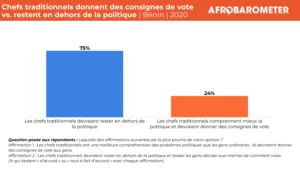
While traditional leaders are revered for their cultural significance, the majority of Béninois insist they should refrain from political involvement. Citizens overwhelmingly believe that political decisions—especially voting—should remain free from external influence, emphasizing the importance of fair electoral processes. This sentiment reflects a broader desire for institutional integrity, where traditional leaders serve as cultural custodians rather than political actors.
The evolving dynamics between tradition and governance in Bénin underscore a delicate balance: honoring heritage while ensuring that public trust is not compromised by political entanglements. As the nation continues to navigate this balance, the role of traditional leaders remains a subject of both admiration and scrutiny.