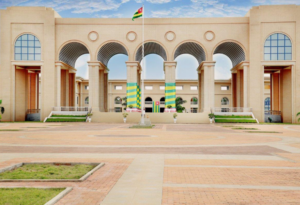
The newly tabled 2 684.1 billion FCFA draft budget for Togo in 2027 is framed as a driver of national security, economic transformation and social cohesion. Yet beneath the headline figure lies a pressing question: how will the allocated funds translate into tangible improvements for citizens, businesses and the wider economy?
Approved by the Council of Ministers on 22 October 2026, the finance bill aligns with the government’s 2026–2031 roadmap. Set against a backdrop of global economic uncertainty, geopolitical tensions and tighter financing conditions, it promises fiscal discipline. The true test, however, will be whether the promised revenue streams materialise, and whether every franc spent delivers measurable gains on the ground.
Shrinking budget, growing concerns
The 2027 budget balances at 2 684.1 billion FCFA (roughly USD 4.6 billion), marking a 2.5 % drop from the initial 2026 budget of 2 751.5 billion FCFA. Even when compared to a revised 2026 collective budget of 2 744.2 billion FCFA, the decrease remains at about 2.2 %. While the exact comparator shifts the percentage slightly, the downward trend is clear.
What remains uncertain is where the axe will fall. Which programmes will be preserved, and which will face cuts, delays or redesign? A smaller overall envelope could signal efficient rationalisation—or it could mean vital public services take a hit. Only a line-by-line review of each ministry’s allocation can reveal the real-world consequences for schools, hospitals, roads and small businesses.
490 Billion FCFA in investments: where the money flows
To fund its roadmap, the government earmarks 490 billion FCFA for investment. The largest slice—227.2 billion FCFA—goes to the Protect pillar, with Transform receiving 143.5 billion and Unite 97 billion. Cross-cutting programmes share the remaining 22.4 billion FCFA.
Nearly half the investment pot is devoted to security. While regional threats justify strong defence spending, lasting security also depends on educating youth, strengthening local services and shoring up vulnerable economies. Without complementary investment in these areas, the gains may prove fragile.
The Transform pillar aims to boost agriculture, industry and infrastructure. The challenge will be ensuring that funds actually help local processors add value, connect farmers to markets and support small enterprises.
For the Unite pillar, the 97 billion FCFA must reach health, education, water and sanitation. Success hinges on transparent territorial allocation and clear, measurable outcomes—otherwise the impact risks being uneven or invisible.
Financing and debt: balancing act under scrutiny
A balanced budget on paper does not guarantee a balanced budget in practice. Sustainability depends on projected tax and non-tax revenues, foreign aid, new borrowing and debt servicing costs.
In 2026, the revised budget foresees a deficit of 247.6 billion FCFA—3.4 % of GDP. While this offers a baseline, it does not automatically predict the 2027 shortfall. Authorities must clarify next year’s financing needs, the deficit trajectory and how much revenue will go toward repaying debt.
With global borrowing conditions tightening, higher debt costs could squeeze the funds available for public services and productive investments. Mobilising domestic revenue is therefore critical. Expanding the tax base, cracking down on fraud and reviewing unjustified exemptions can increase state income—but only if the burden does not fall disproportionately on low-income households and small firms. Fair, predictable and transparent taxation is essential to sustain both public finances and economic vitality.
Social spending: from promises to progress
Social cohesion, access to essential services and job creation are all touted as 2027 priorities. The proof will be in the execution.
How many classrooms will be built or refurbished? What resources will go to health facilities, essential medicines and medical staff? Which investments will improve access to clean water? What schemes will help unemployed youth and job-creating enterprises?
The total budget figure gives no answers. Only detailed sectoral credits, physical targets tied to expenditure and a track record of past performance can provide clarity. Moreover, voted budgets often differ from actual disbursements. Administrative delays, procurement hurdles or poor project preparation can dilute impact. Hence, the execution rate will be just as important as the initial allocations.
Transparency and oversight: non-negotiable safeguards
Ultimately, the budget’s credibility rests on open, accountable execution. Regular disclosure of public procurement data, payment flows, project milestones and deviations from forecasts would enable better assessment of how public money is used.
Digitalising public finances can enhance traceability—provided data is accessible and oversight is robust. Parliament, audit institutions, civil society and the media each have a role in tracking government commitments.
The parliamentary review of the finance bill must therefore probe the economic assumptions, sectoral choices and financing risks. Above all, it should establish measurable goals and credible monitoring mechanisms.
Beyond the numbers: the test of delivery
With 2 684.1 billion FCFA on the table for 2027, Togo has a financial framework intended to advance national priorities. Yet the sheer size of the budget is no guarantee of progress.
The real test lies in the state’s ability to raise revenue sustainably, manage debt responsibly, shield social spending and turn planned investments into accessible services and infrastructure. In the end, the 2027 budget will be judged not by the billions written into official documents, but by the improvements it brings to everyday life: better living standards, reliable public services, new jobs and a stronger national economy. The central question remains: beyond the figures and the pledges, what will each public franc actually achieve?