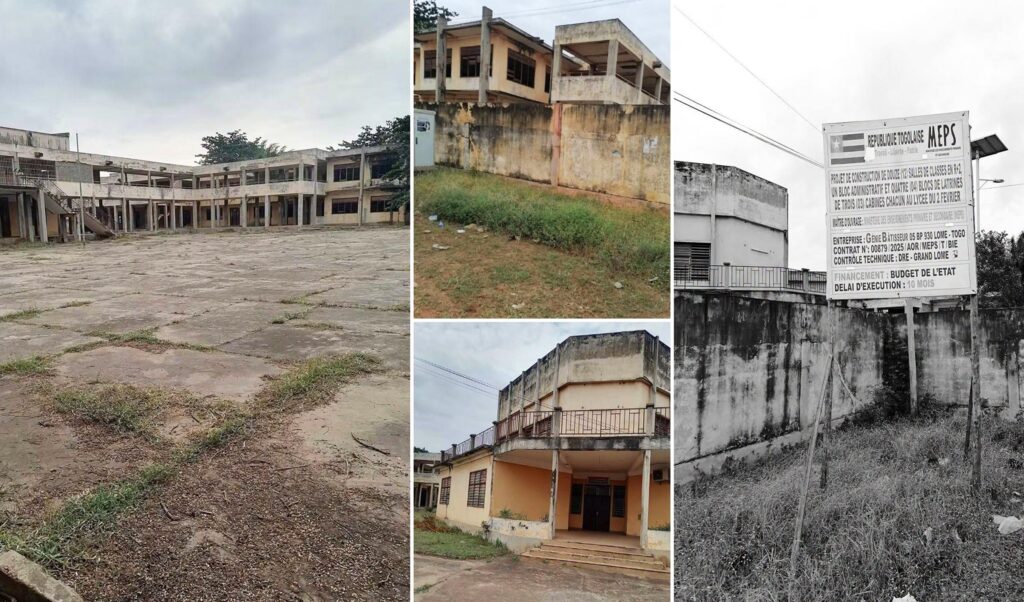
A meticulous adjustment of geographic boundaries on a map cannot compensate for structural failures in physical infrastructure. By championing a new cartographic projection that accurately depicts the true scale of the African continent, the Togolese administration has executed a highly successful public relations campaign. While this symbolic gesture carries a powerful and appealing pan-African message, it stands in stark contrast to a grim domestic reality: the nation’s largest public secondary school is currently deteriorating in near-total neglect.
The strength of a sovereign state is not determined by its representation on a planisphere, but rather by the integrity of its educational institutions, the safety of its classrooms, and the working conditions of its teaching staff. This discrepancy exposes a profound administrative failure. Correcting continental proportions on a map requires mere hours, whereas rehabilitating a failing school demands concrete financial commitments, structured budgets, and genuine political determination.
On the ground, grand ideological narratives clash directly with the daily hardships of a neglected youth. Every morning, thousands of students crowd into dilapidated classrooms, lacking basic learning materials and studying under structurally compromised roofs that threaten to collapse during inclement weather. For these children, the crisis is not an abstract debate; it is an immediate threat to their physical safety, the quality of their instruction, and their future prospects.
The true foundation of pan-Africanism lies in the classroom
Genuine pan-African progress must begin within the school system. The empowerment of African youth will not be achieved merely by expanding the continent’s visual footprint on a map. True dignity is restored when students are provided with secure learning environments, up-to-date textbooks, functional science laboratories, libraries, digital resources, and adequately supported educators.
This stark divergence raises critical questions regarding state priorities. It is contradictory to claim the restoration of national pride on the international stage while simultaneously depriving the domestic youth of basic learning conditions. An ambitious diplomatic narrative loses all credibility when the very institutions tasked with preparing the next generation of leaders are allowed to fall into ruin.
A crisis of budgetary priorities and political will
The decay of public infrastructure is a direct consequence of deliberate fiscal choices, administrative negligence, and policy decisions. When a major educational institution serving thousands of citizens deteriorates to a hazardous level, the issue extends beyond simple maintenance; it reveals a systemic failure to anticipate and plan for public investments.
Education represents the primary investment for any nation seeking sustainable development. Years spent in substandard facilities lead to lost learning opportunities, diminished student morale, and widening social inequalities. Children from economically disadvantaged backgrounds suffer the most, as they lack alternative educational options when public services fail.
This issue ultimately undermines the social contract between the state and its youth. A government cannot credibly ask its younger generation to build a prosperous future while forcing them to study in conditions that belong to a bygone era.
Effective governance must be evaluated by tangible improvements in the daily lives of citizens. While political narratives are sustained by high-profile inaugurations, symbolic maps, and eloquent speeches, families and students are ultimately left to confront the physical reality of their classrooms, desks, and textbooks.
Advocating for a geographically accurate representation of Africa and investing in public education are not mutually exclusive. A responsible administration can champion continental pride while simultaneously upgrading its domestic school network. Symbolism should never serve as a screen to obscure infrastructural neglect.
Redrawing a map requires minimal effort and resource allocation. Conversely, providing thousands of children with dignified educational facilities demands substantial funding, rigorous planning, and sustained political commitment. This fundamental difference highlights the true nature of the challenge.
Ultimately, national greatness is reflected in the quality of a country’s schools, the protection of its children, and the resources allocated to youth development. By prioritizing symbolic victories over critical educational needs, the administration risks compromising the long-term prospects of the nation. The real struggle for the future of the continent is fought far from the spotlight, within the classrooms where the next generation is shaped.