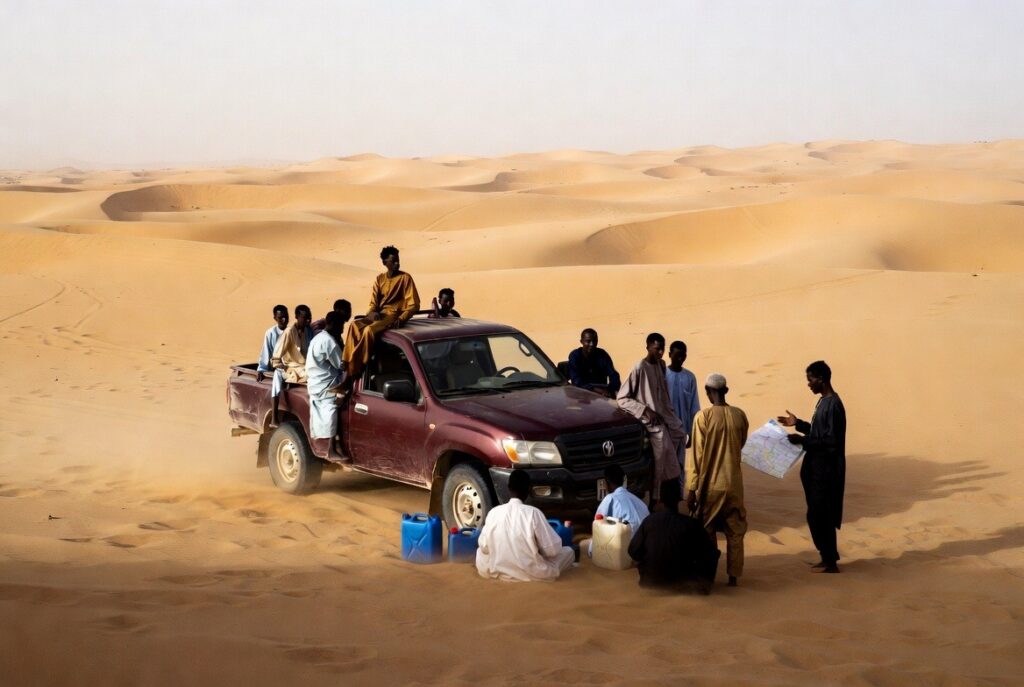
The Ténéré, a vast and seemingly endless sea of sand, conceals a grim reality beneath its stark beauty. In the northern reaches of Niger, this desert landscape has become yet another open-air graveyard for migrants attempting perilous journeys toward Europe. While the world’s focus often lingers on the tragedies unfolding in the Mediterranean, the Sahara’s deadly crossing claims lives each year with disturbing regularity.
Data from 2025 reveals a sobering toll: at least 35 individuals perished within Niger’s desert expanses over the past year. Humanitarian workers on the ground warn that this figure is almost certainly an underestimation, as the sheer scale of the terrain makes accurate accounting nearly impossible. The true number of victims may never be known.
a journey fraught with peril
For migrants from Mali, Guinea, Senegal, and Burkina Faso, the city of Agadez marks the final urban outpost before the harrowing trek into the Ténéré. From there, the path ahead is unforgiving, with hazards as old as the desert itself.
The recurring causes of these tragedies include:
- Mechanical failures: Overloaded and poorly maintained pickups frequently break down in the middle of nowhere, leaving passengers stranded.
- Abandonment by smugglers: Under pressure from military patrols, some smuggling networks leave migrants behind to evade detection, condemning them to the elements.
- Extreme conditions: Temperatures soaring above 50°C, combined with severe dehydration and exhaustion, can claim lives within hours.
« The desert shows no mercy, » remarked a local activist, who requested anonymity. « When a vehicle fails and water supplies run dry, survival is measured in mere hours. Many bodies are buried by the wind before anyone can raise the alarm. »
the unintended consequences of security policies
Human rights advocates link this silent catastrophe directly to the criminalization of migration routes. Although Niger’s ruling junta repealed the 2015 anti-smuggling law in late 2023, the pathways remain clandestine and increasingly perilous. To evade surveillance by Niger’s security forces, smugglers now favor remote detours, exponentially increasing the risk of getting lost.
a call to action from civil society
In response to the crisis, groups such as Alarme Phone Sahara work to document these tragedies and issue alerts, relying on local networks to rescue stranded travelers. Yet their efforts are hampered by limited resources and restricted access to military zones. Without addressing the root causes of migration—or opening legal pathways—the sands of Niger will continue to conceal the human cost of the search for a better life. For families left in limbo, the Ténéré remains an open wound, a place where loved ones vanish without a trace.