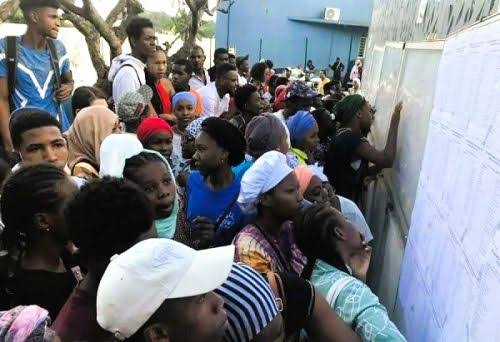
N’Djamena — The announcement of the 2026 baccalaureate results has stirred mixed emotions across Chad. While some students celebrate their hard-earned success, others face the bitter disappointment of not securing the coveted diploma. For these candidates, the journey toward higher education must continue despite the setback.
Chad’s baccalaureate 2026: key figures and trends
The National Office for Higher Education Examinations and Competitions has released the final statistics. Out of 106,231 candidates who sat for the exam across all streams, only 27,872 secured direct admission, accounting for a 26.24% success rate. An additional 30.80% (32,722 candidates) were deemed eligible for supplementary oral exams.
However, 45,637 students—nearly 42.96% of all candidates—did not pass this initial stage. These numbers underscore the highly competitive nature of the baccalaureate, with significant disparities between academic streams. The DA series led performance with a 79.28% direct admission rate, followed by the AB series at 73.42% and the CA series at 60.87%.
In stark contrast, the G2A series recorded the lowest success rate at just 11.76%, while the D series—despite having the highest number of candidates (25,952)—saw only 23.32% secure direct admission.
Behind the statistics: the human factor
Failure in the baccalaureate is never just a number. Behind every unmet score lie complex challenges: inadequate preparation, economic hardship, limited access to learning materials, overcrowded classrooms, or interrupted schooling. The results reflect not only individual effort but also the broader educational environment.
For those who did not pass, this moment should be seen as a call to reassess their approach rather than a final verdict. History is filled with stories of determined individuals who overcame academic setbacks through resilience and hard work. The path to success is rarely linear, and a single exam does not define one’s future.
Pathways to improvement: support and preparation
Education authorities, schools, and families play a crucial role in guiding students through these challenges. Targeted interventions—such as tutoring, regular progress tracking, and tailored academic support—can make a significant difference. Candidates who qualified for supplementary exams must remain focused, as a second opportunity still awaits them.
The baccalaureate results of 2026 in N’Djamena are not the end of the road but a stepping stone. As the African proverb reminds us: “The fall is not the end of the journey; it is the refusal to rise that halts the path.” A temporary setback today can lead to greater achievements tomorrow with determination and perseverance.