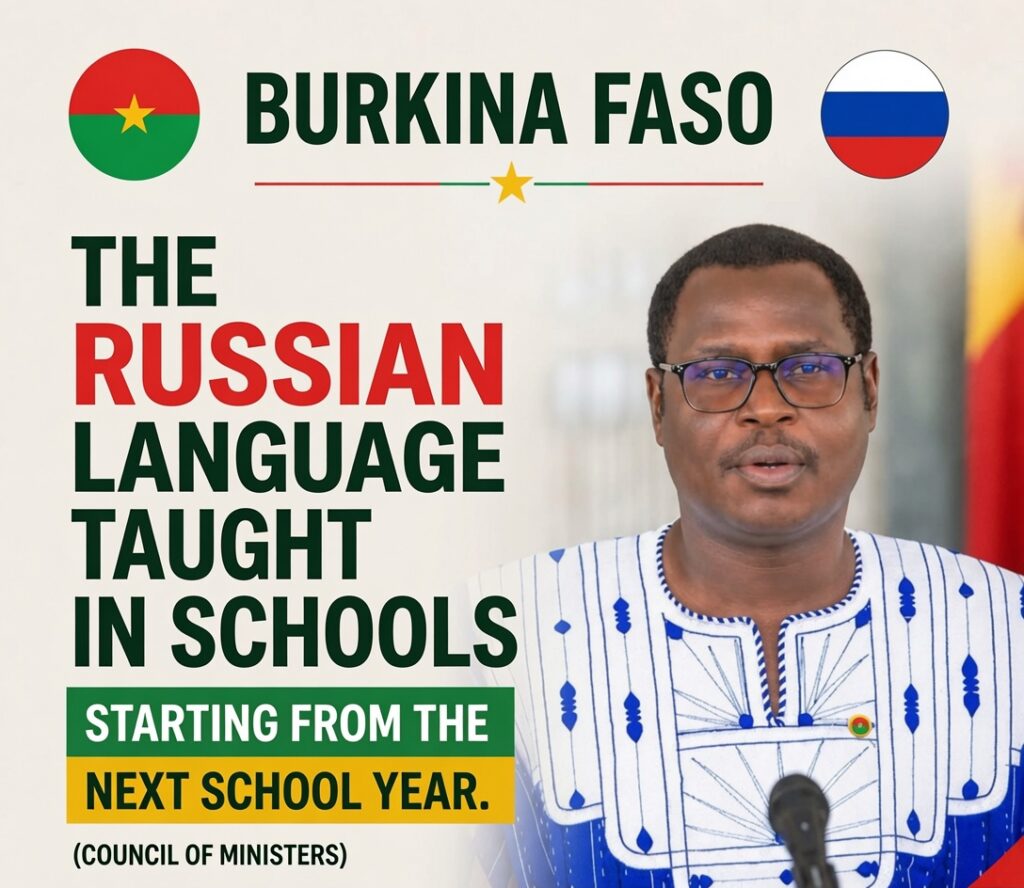
The government of Burkina Faso has taken a decisive step in reshaping its strategic alliances by introducing Russian language instruction in public schools starting next academic year. This move, formalized through a decree approved in a council of ministers meeting, has sparked intense debate over its true motivations and long-term implications.
Proponents argue that the decision reflects a forward-thinking approach to global engagement. In an era of shifting geopolitical dynamics, they contend that equipping students with Russian language skills will enhance future trade, technological, and academic exchanges with Eurasian partners. Given Russia’s role as a key military ally in the fight against terrorism, officials frame this initiative as a natural extension of a vital partnership for national stability.
However, critics warn that beneath the surface of educational cooperation lies a more complex agenda. The rapid expansion of Russian influence—spanning military, economic, and now educational domains—raises concerns about a subtle form of dependency. While Burkina Faso seeks to break free from historical colonial ties with France and Western paternalism, the question arises: is this merely a trade of one external influence for another? True sovereignty demands independence, not the replacement of one guardian with another.
the mechanics of cultural influence
Language is far more than a tool for communication; it is a vehicle for cultural penetration and ideological alignment. History demonstrates that state-sponsored language education programs are rarely neutral. The introduction of Russian in Burkinabè schools mirrors strategies employed during the Cold War, where linguistic assimilation served as a mechanism for political control. By fostering familiarity with Russian media, propaganda, and worldview among the youth, Moscow could be laying the groundwork for a long-term, ideologically aligned elite.
a one-sided partnership
Genuine educational collaboration thrives on reciprocity, yet Burkina Faso’s current vulnerability paints a starkly asymmetrical picture. The country’s heavy reliance on Russian military and logistical support for territorial security casts doubt on the voluntariness of this initiative. In such a context, prioritizing Russian language education appears less like a strategic choice and more like a political concession to a powerful benefactor.
cultural erasure vs. national identity
Burkina Faso is home to a rich tapestry of indigenous languages, many of which struggle for recognition and resources within the national education system. The sudden emphasis on an extraneous language, so distant from local realities, raises serious questions about priorities. Rather than decolonizing minds, this decision risks replacing one form of dependence with another, further marginalizing local cultures under the guise of modernization.
As the lines between military support, economic concessions, and cultural assimilation blur, Burkina Faso stands at a crossroads. The path it chooses today will determine whether its hard-won independence evolves into a new, more insidious form of subjugation. The vigilance of its citizens and the wisdom of its leaders will be critical in ensuring that the nation’s future remains firmly in its own hands.