The Russian military footprint in Libya is expanding
Recent developments in Libya reveal a growing Russian military presence across six key air bases, raising concerns about Moscow’s strategic ambitions in North Africa. These bases, located in Al-Joufra, Al-Khadim, Al-Qardabiyah, Brak Al-Shati, Maaten al-Sarra, and Tamenhant, serve as critical hubs for arms transfers, mercenary deployments, and logistical operations.
Each of these bases hosts a mix of military hardware, including air defense systems, MiG-29 fighter jets, and drones, alongside Russian military personnel and mercenaries. Reports indicate that Russia is also investing in the infrastructure of Tobruk’s port and air base, further consolidating its influence in the region.
From Syria to Libya: A strategic shift
Before 2024, Russia relied on Syria as a transit hub for weapons, personnel, and military operations in the Middle East. However, following the fall of the Syrian regime in late 2024, Moscow redirected its focus to Libya, where it initially struggled to secure a foothold but later advanced into the country’s interior.
The air base at Maaten al-Sarra, situated near the borders of Chad and Sudan, exemplifies this shift. Once abandoned in 2011, the base was restored by Syrian troops deployed by Russia in late 2024. Analysts warn that this strategic location enables Russia to supply arms directly to conflict zones in Burkina Faso, Mali, and Sudan without detection.
Maaten al-Sarra: A gateway for destabilization in the Sahel
Frank Talbot, a senior fellow at the Atlantic Council’s Rafik Hariri Center for the Middle East, highlights the role of Maaten al-Sarra in Russia’s regional strategy. He states, “This base provides a crucial staging ground for destabilizing operations in the Sahel, facilitating covert arms shipments into neighboring countries.”
Analyst Andrew McGregor, writing for the Eurasia Daily Monitor, adds that a Russian presence in Maaten al-Sarra would allow Moscow to clandestinely arm factions in Sudan and Chad, further complicating regional security.
Al-Khadim: A hub for arms trafficking and paramilitary operations
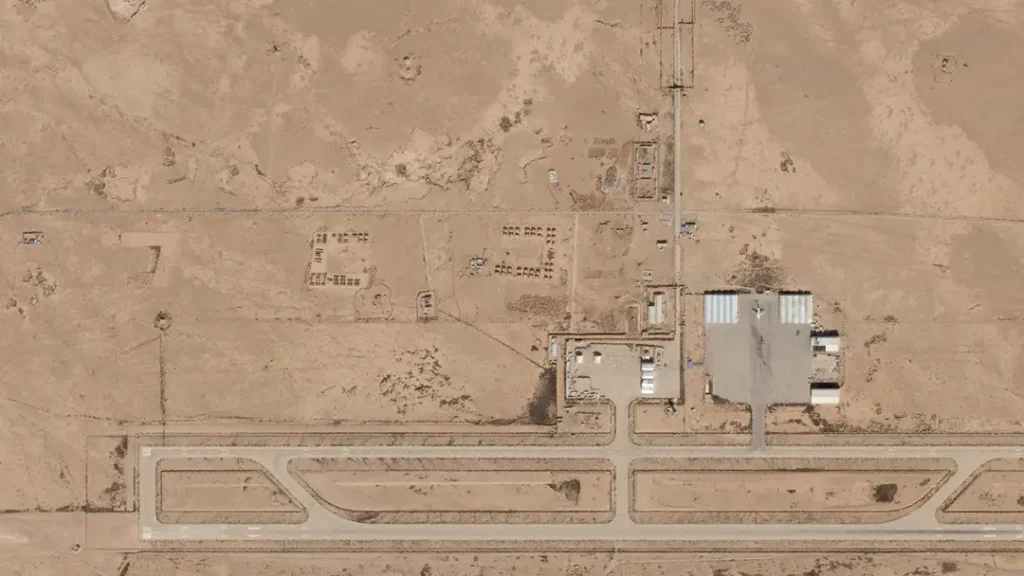
The air base at Al-Khadim, located about 100 km east of Benghazi, has become a focal point for Russian military activities. Recent upgrades include three new hangars, a recreational facility, and what appears to be communication towers and temporary housing. By 2026, a barracks was reportedly added to the site.
Open-source investigations revealed that a Gazprom employee traveled from Al-Khadim to a Russian-controlled mine in the Central African Republic in 2023, documenting the journey on social media. Geolocation tools confirmed the presence of Russian officers, including a lieutenant from the 102nd Motorized Rifle Division, at the base.
Al-Joufra: A longstanding Russian stronghold
Al-Joufra, located in central Libya, has hosted Russian paramilitary forces since 2019. Recent enhancements include refurbished hangars, small buildings, barriers, and storage facilities, reinforcing its role as a logistical and operational center.
Al-Qardabiyah: Military upgrades and new defenses
Russian forces first appeared at Al-Qardabiyah in 2022, leveraging its proximity to the Syrte International Airport. Since then, the base has undergone significant upgrades, including refurbished runways, new perimeter defenses, and a repaired hangar in 2025.
Brak Al-Shati: Expanding infrastructure and personnel
Since March 2024, Russia has expanded its operations at Brak Al-Shati in southwestern Libya. Recent construction includes at least one new hangar and two buildings likely used for aircraft maintenance. Russian personnel numbers at the base have increased from 300 to 450 since late 2024.
Tamenhant: A launchpad for regional conflicts
By mid-2023, mercenaries from the Wagner Group—now succeeded by the Africa Corps—were using the Tamenhant air base in southern Libya to launch military operations and facilitate arms deliveries to Sudan. Recent reports indicate ongoing expansion efforts, including new buildings, a renovated road connecting the runway to hangars, and runway modifications.
Obstacles to peace and regional stability
Russia’s military footprint in Libya is not only reshaping the country’s security landscape but also hindering the fragile unification process in Tripoli. Analyst Ali Bin Musa, from the Middle East Council on Global Affairs, notes that foreign-backed factions are resisting peace efforts, prolonging instability in the region.