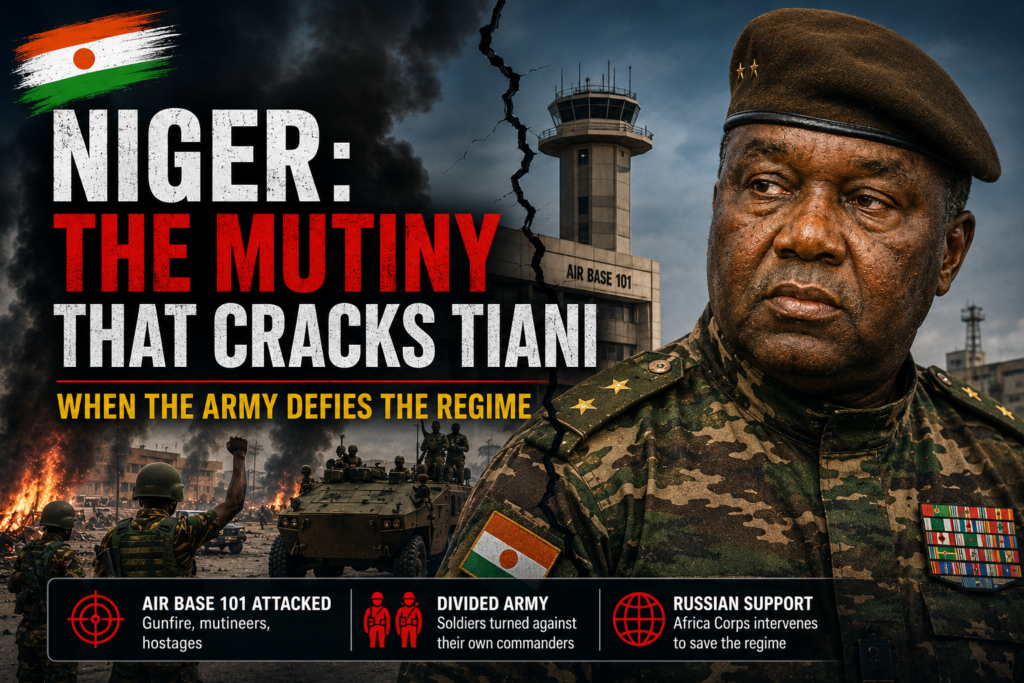
On Saturday, August 29, 2026, Niger’s capital, Niamey, witnessed an unprecedented episode that transcends mere political rhetoric. The assault on Air Base 101 and multiple sensitive sites by a faction of soldiers represents a critical inflection point in the nation’s recent political trajectory. Official acknowledgments confirm that a group of servicemen detained several comrades before engaging in armed confrontation at strategic locations across the city.
An institutional fracture rather than a political outburst
The magnitude of this event extends far beyond what could be dismissed as a fleeting display of dissatisfaction. When military dissent targets a core defence installation in the heart of the capital with sustained gunfire reported near the presidential palace and airport, and state media temporarily silenced it signals a fundamental challenge to the foundations of governance. Reports indicate that firefights persisted for hours in these areas, underscoring the gravity of the confrontation.
The erosion of military cohesion
The narrative framing the mutineers as merely impatient reformers fails to account for the precision of their targets. When soldiers turn their weapons against their own institutions and clash with loyalist forces, the issue transcends ideology and becomes structural. The viability of any military apparatus hinges on its ability to manage internal disagreements without resorting to armed confrontation. The fact that this occurred among personnel of the same national institution raises urgent questions about command integrity and operational cohesion.
The mutineers were not isolated individuals devoid of access to security infrastructures. Evidence suggests that participants originated from multiple regions, including Ouallam, Téra, and Dosso, and succeeded in seizing control of a facility as critical as Air Base 101.
The paradox of a regime built on security
Since assuming leadership in July 2023, the administration led by General Abdourahamane Tiani has positioned itself on pillars of sovereignty, national security, and military reorganization. Yet, three years later, that very apparatus has become the source of a direct challenge to its authority.
This paradox is stark: a government that claims full control over state institutions restructuring the defence sector and reinforcing national sovereignty has now faced an armed uprising originating from within its own security ranks. The mutineers’ ability to seize a vital military site, detain colleagues, and engage in prolonged combat before loyalist forces regained control demonstrates a critical vulnerability in the chain of command.
Sovereignty tested by external intervention
Another layer of complexity emerges from the reported involvement of elements of the Africa Corps in retaking Air Base 101. While external support in crisis management is not unprecedented, its occurrence in this context carries profound symbolic weight.
The Tiani regime has consistently framed sovereignty as the cornerstone of its legitimacy. The necessity to enlist foreign military assistance to secure a strategic asset within the capital contradicts this narrative. The message is clear: the regime’s claim of restored national defence capabilities is undermined by its reliance on external partners at a moment of internal crisis. This reliance risks fostering resentment among domestic soldiers who may question their own role in national defence when foreign forces assume such prominent positions in security operations.
A tactical victory, not a resolution
The recovery of Air Base 101 and the surrender of several mutineers mark a tactical success for the authorities. Yet, military containment does not address the underlying causes of the uprising. Authorities can restore order, detain participants, and reassert control over installations but none of these actions erase the fundamental question: why did soldiers from the defence apparatus choose to turn against their own command?
This question will persist long after the smoke has cleared. Repression may prevent an immediate power seizure, but it does not rebuild trust within the armed forces or heal the divisions exposed on August 29.
Security remains the unmet promise
This crisis unfolds against a backdrop where restoring security was the regime’s central pledge. General Tiani positioned the fight against jihadist groups and the reassertion of national security as pillars of his leadership. Yet, despite these assurances, violent attacks continue to plague Niger, including multiple assaults on military and airport facilities in 2026.
The irony is stark: while the government promotes its security strategy as a break from past failures, the threat of armed insurgency persists externally, and now, an internal threat has emerged within the very institution tasked with protecting the state.
The myth of unity shattered
For years, the military leadership portrayed itself as a unifying force against both domestic political elites and foreign influence. The August 29 mutiny dismantles that illusion. The National Council for the Safeguard of the Homeland (CNSP), once presented as a monolithic body, has revealed internal fissures. The dissent is no longer external; it has emerged within the ranks of the institution sworn to uphold the regime’s stability.
This development is deeply unsettling for General Tiani’s administration. While a regime may withstand political opposition or international criticism, it cannot easily survive when its own military turns against it. The stakes are existential: the loyalty of the armed forces is not a negotiable asset it is the foundation of any government’s survival.
A warning, not an end
It would be premature to interpret the mutiny as the regime’s downfall. Loyalist forces have retaken key installations, and authorities have declared control restored. Yet, dismissing the episode as a routine disciplinary matter would be equally shortsighted.
For the first time since the 2023 coup, General Tiani’s government faced a military challenge of such scale that it resulted in armed clashes across critical zones of Niamey. The mutiny failed militarily, but it succeeded in exposing a critical weakness: beneath the image of an impenetrable regime lies a fractured institution.
The lesson of August 29 may be this: victory in Niamey does not equate to safety. The greatest threat to Tiani’s rule may no longer come from outside but from within.