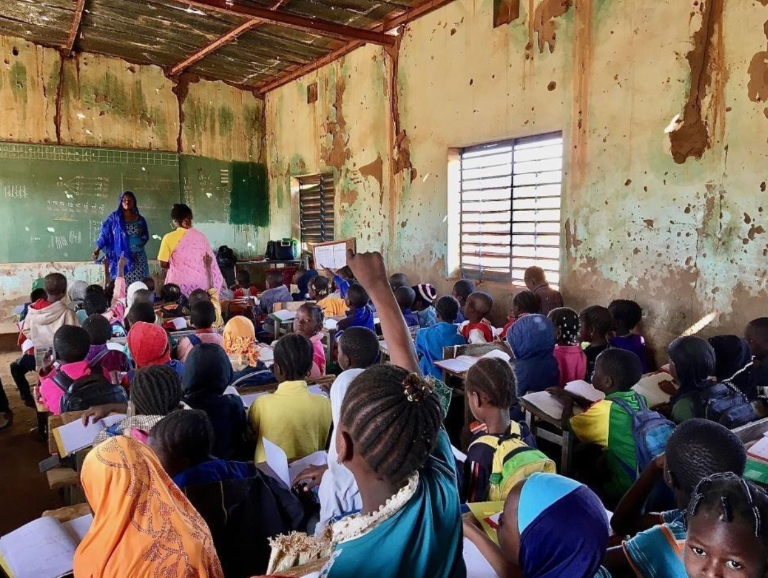
The first-ever education ministers’ conference of the Alliance of Sahel States (AES) has opened in Niamey under the weight of a sobering reality. From dawn to dusk, the streets buzz with policymakers and educators, but the classrooms across Niamey and beyond remain shockingly empty. Behind the polished speeches and diplomatic handshakes lies a crisis threatening to derail the future of nearly five million children in Niger alone.
The human cost of a broken education system
At the center of the crisis is a severe shortage of qualified teachers. In Niger’s public primary schools, the student-to-teacher ratio stands at 43 to 1 — a figure that obscures the true struggle of educators underpaid and overworked. Nearly 79% of public school teachers are contract workers, many without formal pedagogical training. When Minister Élisabeth Shérif highlighted this gap in 2026, she wasn’t just stating an academic concern — she was exposing a system at risk of producing generations of students without foundational skills in reading, math, or critical thinking.
But the deficit of teachers is only half the problem. Across the Sahel, classrooms are shutting down under the shadow of armed violence. In Burkina Faso, over 5,300 schools closed in 2024, displacing over 820,000 children. In Mali, more than 2,400 schools remain non-functional, leaving 730,000 students without a place to learn. In Niger, nearly 1,100 schools are closed, affecting nearly 100,000 children — over half of them girls. These aren’t just statistics; they represent broken dreams, lost years, and a widening gap in social mobility.
Forced displacement deepens the learning crisis
Violence has forced millions to flee their homes — over 548,000 in Niger, 414,000 in Mali, and 2 million in Burkina Faso. As families relocate, so do their children’s educational prospects. Schools in safer areas are overwhelmed, struggling to absorb new students with limited space and resources. Many displaced children abandon their studies entirely, while others fall years behind, their futures slipping through the cracks of a system already stretched too thin.
For girls, the stakes are even higher. When a school closes, a girl’s chance to attend often disappears first. Cultural pressures, early marriage, and household labor take priority over learning. In Tillabéri, where over 1,000 schools sit shuttered, 48% of affected students are girls — a silent but devastating loss for communities already reeling from insecurity.
Sovereign education in name only? The gap between ambition and action
The AES conference in Niamey was meant to chart a bold new path: a sovereign, unified education system built to withstand the Sahel’s storms. The vision is compelling — harmonized curricula, shared teacher training, recognized diplomas, and stronger technical education. Yet, as delegates gather in air-conditioned rooms, the reality in the bush is far grimmer. How can sovereignty be claimed when classrooms are bombed, teachers are absent, and children are driven from their desks?
To make the promise real, Niamey’s plan must go beyond declarations. It needs urgent, on-the-ground solutions: reopening closed schools, hiring and retaining teachers in high-risk zones, creating temporary learning centers, and building pathways for displaced learners. It requires a radical shift from policy papers to action — and fast.
Priorities that can’t wait
- Recruit and train locally: Accelerate the certification of teachers through intensive, community-based programs that can bring qualified educators to remote and conflict zones within months, not years.
- Protect schools, not just students: Implement low-cost security measures like community patrols and temporary fencing around school perimeters to deter attacks and reassure parents.
- Bring learning to the displaced: Expand mobile classrooms, digital learning hubs, and accelerated catch-up programs tailored to children who’ve missed years of schooling.
- Put girls first: Launch targeted programs to re-enroll and support girls in school, offering stipends, mentorship, and safe transportation where needed.
The price of delay
Every day that passes without action deepens the damage. A generation of Sahel children is growing up without the skills to build their own future — or their country’s. Without a functioning education system, the region risks not only economic stagnation but a loss of cultural and political autonomy.
The AES conference has the chance to turn rhetoric into rescue. In the classrooms of Niamey and beyond, the test of sovereignty isn’t in declarations — it’s in the voices of children opening their books, not closing their doors.





