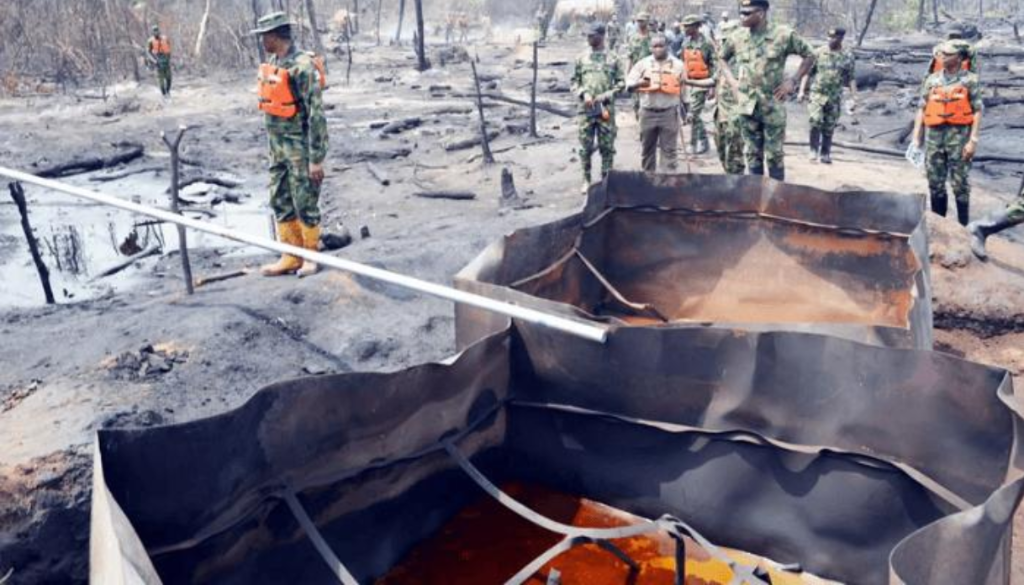
The unearthing of a massive underground oil refining operation in Nigeria’s Ogun State has exposed the alarming scale of illegal petroleum activities plaguing Africa’s largest oil producer. Authorities dismantled the clandestine facility, revealing a sophisticated network that exploited weak regulatory oversight to siphon off national wealth while fueling environmental and economic damage nationwide.
Clandestine facility reveals gaping holes in Nigeria’s oil governance
The discovery in Ogere, Ogun State, marks another blow to Nigeria’s attempts to regulate its vast hydrocarbon sector. Nigerian authorities, acting through the Economic and Financial Crimes Commission (EFCC), uncovered a sprawling industrial site spanning over three hectares. Investigators found substantial infrastructure, including underground storage tanks with a capacity of 90,000 litres, heating systems, separation units, and cooling installations—all used to convert crude oil residues into what was being marketed as diesel, known locally as AGO.
The operation relied on illegal feedstock sourced from Warri (Delta State) and Port Harcourt (Rivers State), transported hundreds of kilometers under the radar. No permits were held for the site, and when security forces arrived, the premises stood abandoned, leaving authorities scrambling to trace the network’s financiers, suppliers, and buyers.
Supply chains and black-market fuel: who profits and who pays?
The logistics behind such an operation—procuring raw material, transporting it undetected, and processing it without oversight—point to a deeply embedded underground economy. Investigators face the daunting task of mapping the entire pipeline: from the origin of the crude residues to the final sale of adulterated fuel.
Unanswered questions linger: which local intermediaries enabled the flow of illegal inputs? Who provided financing for equipment and operations? Where were the finished products ending up? Answers could reveal whether officials, security personnel, or business figures were complicit in facilitating the trade. Without concrete evidence, any claims of institutional involvement remain speculative.
Environmental and economic fallout from illegal refining
Beyond legal and security concerns, the site’s operations posed severe risks. Artisanal refining often releases toxic fumes, contaminates soil, and poisons water sources. The absence of proper safety systems raises the danger of explosions and fires, endangering nearby communities.
Economically, the unregulated operations deprive the Nigerian government of tax revenue and distort the fuel market. Uncertified diesel sold through unofficial channels can damage vehicles and industrial equipment, raising maintenance costs for businesses and households. The competition also undermines licensed refiners and fuel retailers who comply with environmental and fiscal regulations.
China-linked operations highlight foreign oversight challenges
As Nigeria deepens trade ties with China, this incident has drawn attention to the oversight of foreign economic actors in strategic sectors. While this particular facility is linked to Chinese nationals, authorities have not attributed the operation to state policy or official entities in Beijing. Instead, the focus remains on enforcing Nigerian law uniformly, regardless of the operators’ nationality.
The broader question, however, is whether such cases signal systemic vulnerabilities in Nigeria’s ability to protect its natural resources from exploitation by both domestic and foreign actors.
Sovereignty at stake: can Nigeria reclaim control of its oil wealth?
The dismantling of this facility is more than a law enforcement success—it’s a test of Nigeria’s capacity to assert sovereign control over its most valuable natural asset. To prevent recurrence, authorities must not only dismantle existing networks but also plug regulatory loopholes that allow illegal refining to thrive.
The next phase of the investigation will be critical: tracing financial flows, identifying owners, and bringing all responsible parties to justice. This case underscores a harsh reality: vast oil reserves alone do not guarantee economic sovereignty. Without effective monitoring, enforcement, and governance, Nigeria continues to hemorrhage wealth—and risk—through black-market operations.





