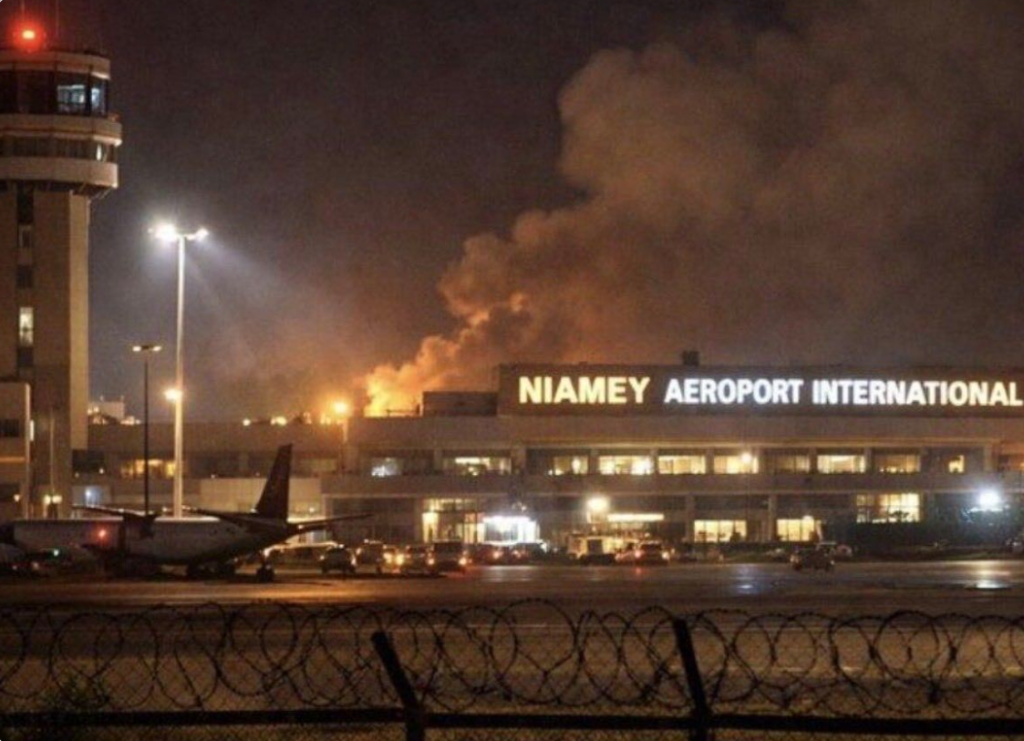
Niamey has been shaken by a night of intense gunfire and explosions, raising serious questions about the stability of Niger’s political and security landscape. Reports of heavy gunfire, blasts, and military vehicle movements emerged from key areas of the capital, including the vicinity of the 101st Air Base adjacent to Diori-Hamani International Airport, as well as near the presidential palace and administrative center. As dawn broke, no official explanation had been provided regarding the source of the clashes or the identities of those involved.
The silence from authorities has fueled widespread speculation. Was this another jihadist assault on a critical site? An attempt at infiltration? Or, more alarmingly, could it signal an internal power struggle within the armed forces—a coup within a coup?
While no concrete evidence points to an imminent overthrow of General Abdourahamane Tiani, the pattern of gunfire and military movements across multiple districts of Niamey has intensified concerns about possible infighting. Witnesses described armored vehicles patrolling neighborhoods and exchanges of fire, while military barracks were reportedly placed on high alert.
Niamey’s fragile security under scrutiny
This latest bout of violence arrives at a particularly volatile moment. Since the ousting of President Mohamed Bazoum in July 2023, General Tiani’s regime has framed its legitimacy on two core promises: restoring national sovereignty and combating terrorism. Yet, nearly three years after the coup, the results remain far from convincing.
Western allies have been systematically sidelined, while Niamey has deepened ties with Moscow and fellow Alliance of Sahel States members Mali and Burkina Faso. The withdrawal of French and American forces was supposed to herald a new era of self-reliance in security matters. Instead, the reality has been marked by persistent jihadist threats and audacious attacks on state infrastructure.
The paradox is stark: a government that positioned itself as the vanguard of security recovery has struggled to prevent high-profile assaults, even within the capital itself.
Diori-Hamani Airport: a glaring vulnerability
The repeated targeting of Diori-Hamani International Airport underscores the regime’s persistent security failures. In late January 2026, the airport and its adjacent air base were struck in an unprecedented assault. Less than five months later, another attack targeted the airport entrance and nearby military installations. The June operation was claimed by the Group for the Support of Islam and Muslims (JNIM), an Al-Qaeda affiliate, resulting in the deaths of eleven soldiers and two civilians, along with the neutralization of twenty-two assailants.
Two major attacks in such a short span against one of Niger’s most fortified sites raise urgent questions. How were armed groups able to plan and execute operations against a location with heightened security measures, including extended fencing, hundreds of surveillance cameras, and clearance operations around the perimeter?
The recurrence of these strikes points not only to gaps in physical defenses but, more critically, to deficiencies in intelligence gathering and early warning systems. If militants can repeatedly infiltrate a site of such strategic importance, it suggests systemic weaknesses in the state’s ability to anticipate and neutralize threats.
Russia’s security partnership under the microscope
The regime’s pivot toward Moscow was framed as a solution to the security vacuum left by departing Western forces. Russian military advisors, including elements linked to the Africa Corps, have taken on roles previously filled by Western contingents. Yet, the repeated breaches at Diori-Hamani Airport challenge the narrative of enhanced protection.
Following the January attack, General Tiani praised the response of Nigerien troops and their Russian partners, while publicly accusing France, Benin, and Côte d’Ivoire of orchestrating the assault without presenting verifiable evidence. This pattern of deflecting blame outward rather than addressing internal shortcomings has become a recurring theme.
The question remains: if Russian-backed security assistance was meant to fill the void left by Western forces, why has the airport been targeted twice in recent months? And why do armed groups continue to exert pressure on the very heart of the capital?
The limits of nationalist rhetoric
Since 2023, the Tiani regime has cultivated legitimacy through nationalist and sovereignist discourse, emphasizing self-determination and rejecting foreign interference. While this message resonates with segments of the population, rhetoric alone cannot substitute for tangible results.
True security is measured by the state’s ability to protect its people, military personnel, and critical infrastructure—not by the volume of patriotic slogans or the number of external adversaries identified. The events unfolding in Niamey could prove politically devastating if they reveal either the continued reach of jihadist groups or, worse, fractures within the very institutions tasked with safeguarding the nation.
Is an internal power struggle unfolding?
At this stage, the possibility of a coup cannot be confirmed, but it cannot be dismissed either. The simultaneous occurrence of gunfire and military movements near strategic sites—including the airport, military installations, and the presidential zone—demands close scrutiny. In an army deeply politicized since the 2023 coup, internal divisions could swiftly escalate a crisis into a national emergency.
The regime’s stability hinges on a delicate balance between competing military and security factions. A fracture in this balance could unravel the fragile cohesion that has thus far underpinned Tiani’s rule.
One certainty endures: Niamey has endured another night of fear. This comes on the heels of two major assaults on its airport in under six months. The government may continue to point fingers at external enemies or foreign powers, but a single question now looms larger than any speech about sovereignty: if, after years of military rule and shifting security alliances, armed groups can still strike at the heart of the capital, where exactly does the failure lie?
The answer to this question may hold the key to Niger’s future—far more than any declaration of self-reliance.