Morocco and UAE deepen Atlantic-Gulf alliance amid Middle East crisis
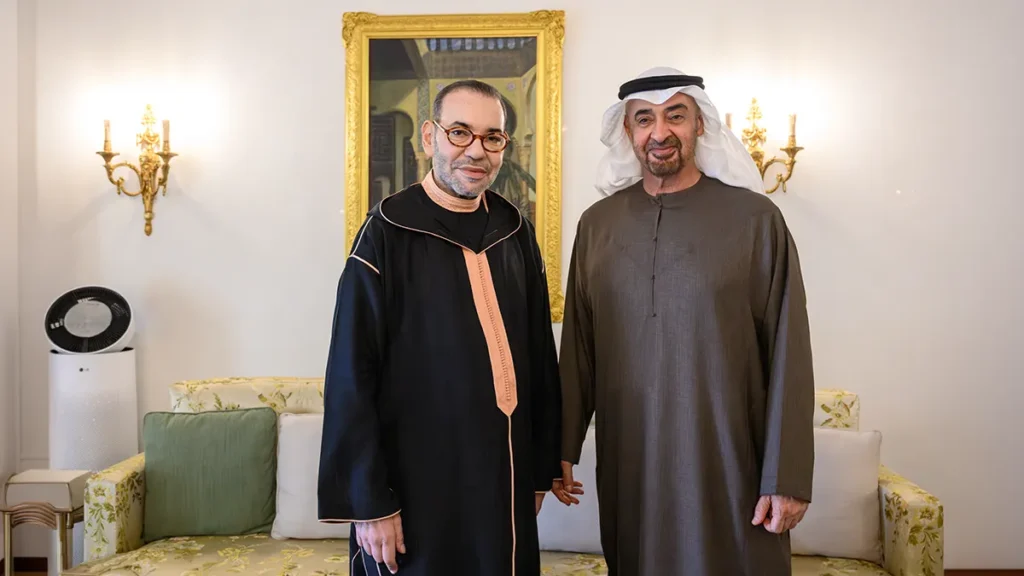
King Mohammed VI of Morocco and UAE President Sheikh Mohamed bin Zayed Al Nahyan consolidate a strategic partnership built on massive infrastructure investments and shared control of vital maritime routes, strengthening resilience against regional instability.
- Economic ties and major projects
- Geopolitical trade-offs and regional security
- Diplomatic strategies in an uncertain world
The Royal Palace in Rabat has become the center of strategic diplomacy connecting North Africa to the Gulf. This meeting between King Mohammed VI and UAE President Sheikh Mohamed bin Zayed comes at a critical moment as tensions in the Middle East threaten global trade and energy corridors.
With escalating conflicts involving Iran, Israel, and the United States risking disruption to critical maritime and energy routes, Morocco and the UAE are reinforcing their decades-long partnership in intelligence and political coordination. This alliance demonstrates that North Africa is no longer isolated from the Gulf’s security challenges.
Diplomatic teams from both nations share a clear objective: to develop a unified response preventing military escalation from crippling vital trade arteries. For Morocco, Gulf stability is a red line—more than just rhetoric.
King Mohammed VI has privately expressed Morocco’s active solidarity with Gulf partners facing attacks in strategic waters. From Abu Dhabi’s perspective, Morocco’s political influence in Africa and its access to both the Atlantic and Mediterranean make it an essential partner requiring absolute harmony.
Economic ties and major projects
This partnership isn’t built on empty promises but on a substantial financial and industrial foundation. The UAE has become Morocco’s top Arab investor, with over $30 billion committed to projects across the country.
The economic roadmap gained significant momentum with the signing of the Comprehensive Economic Partnership Agreement (CEPA). Energy sector developments include confirmed UAE funding for the Africa-Atlantic Gas Pipeline (AAGP), a $25 billion project spanning 5,600 kilometers to transport Nigerian gas to European markets.
The UAE’s investment footprint extends to modernizing Morocco’s transportation infrastructure. New funding will expand the Al Boraq high-speed rail network, currently linking Tangier to Casablanca, to reach Marrakech. Institutional agreements with ONDA (National Airports Authority) include investments in strategic terminals at Casablanca, Nador, and the new logistics hub in Dakhla, highlighting Morocco’s Atlantic coast as a Gulf priority.
Geopolitical trade-offs and regional security
The bilateral relationship operates on clear geopolitical reciprocity. The UAE was among the first capitals to openly support Morocco’s position on the Western Sahara conflict by opening a consulate in Laayoune—a crucial diplomatic endorsement reciprocated by Morocco through military and institutional support on the eastern flank.
Abu Dhabi requires influential Arab allies with modern militaries and diplomatic clout to counter Iranian regional ambitions and its proxy militias. Discussions in Rabat revealed complete alignment on territorial integrity defense and rejection of external interference destabilizing legitimate governments.
However, this mutual shield raises concerns in neighboring Algeria, which views Gulf monarchies’ financial and political expansion along its western border with growing suspicion.
Morocco’s diplomacy strategically leverages UAE investment not only to modernize critical infrastructure but also to solidify its regional leadership position in North Africa.
Diplomatic strategies in an uncertain world
International observers agree this meeting’s true value lies in its anticipatory nature. Rather than reacting to fait accompli situations, King Mohammed VI and Sheikh Mohamed bin Zayed aim to define a common position before crises in the Levant or Red Sea reach a tipping point.
Both delegations publicly emphasize diplomatic dialogue to curb military escalation, but behind-the-scenes discussions focus on pragmatic cooperation: direct intelligence service collaboration to monitor extremist movements and security in conflict zones.
Official communiqués from Morocco’s Foreign Ministry and the UAE’s WAM news agency clearly indicate that security is no longer viewed in regional isolation. The interconnected nature of current crises demands rethinking traditional alliances, with the Rabat-Abu Dhabi axis emerging as one of the Arab world’s most stable partnerships.
In a global context where Western powers appear distracted or divided, consolidating a stability pole along the Atlantic-Gulf axis grants both countries crucial strategic autonomy for the coming years.