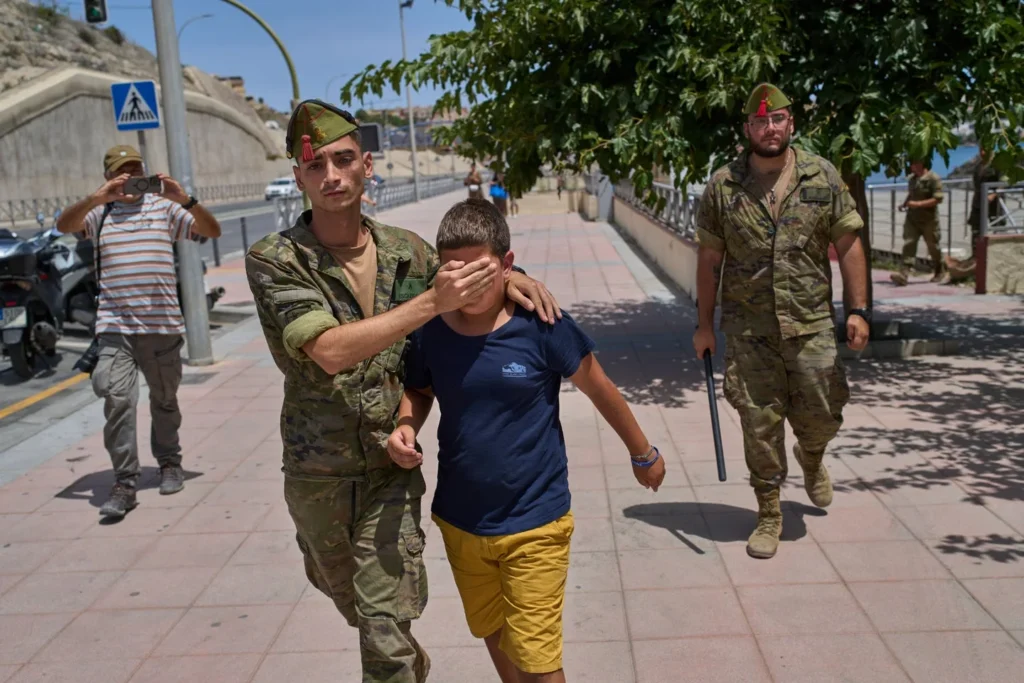
Morocco’s Call for the Return of Its Minors from Ceuta
Morocco’s Minister of Justice, Abdellatif Ouahbi, has urged the repatriation of Moroccan minors currently in Spain, including those who arrived in Ceuta during the recent migration surge. This plea follows directives from the Moroccan monarchy, aimed at expediting the identification and return of these minors to their home country.
Uncertain Numbers and Pre-Existing Cases
The exact number of Moroccan minors in Ceuta remains unclear. Spanish authorities reported 1,527 unaccompanied minors in the enclave after the crisis, though this figure includes some who were already present before the late July migration wave.
A Decade-Old Agreement Guides the Process
Contrary to misconceptions, Spain’s legal framework does not prohibit the return of Moroccan minors to Morocco. Since 2007, Rabat and Madrid have maintained a bilateral agreement focused on preventing irregular migration by unaccompanied minors, ensuring their protection, and facilitating their organized return. The agreement emphasizes cooperation in tracing the minors’ families and, when feasible, reuniting them with relatives or transferring them to Moroccan authorities.
However, the agreement does not authorize collective or automatic repatriations. Spanish law mandates a case-by-case assessment to determine if returning a minor aligns with their best interests. Authorities must investigate family circumstances, consult Moroccan counterparts, and allow the child to express their views. The public prosecutor’s office also plays a critical role in overseeing the process.
The 2021 Crisis Casts a Long Shadow
This rigorous approach stems from the aftermath of the 2021 Ceuta migration crisis. Following the mass arrivals that summer, hundreds of minors were repatriated to Morocco in a swift operation. However, Spanish courts later ruled the returns illegal in January 2024, citing violations of legal safeguards—particularly the lack of individualized assessments for each minor.
The 2021 ruling has since become a major hurdle. While both Morocco and Spain seek a resolution—whether through repatriation or alternative arrangements—Spanish authorities must rigorously comply with legal requirements to avoid further judicial challenges.
Spain’s Alternative: Distributing Minors Across the Country
With repatriation processes pending, Spain faces an immediate challenge: the overcrowding of Ceuta. To address this, the government has activated protocols to relocate some unaccompanied minors to other autonomous communities. This strategy does not conflict with potential repatriations to Morocco; rather, it serves as a temporary measure to alleviate pressure on the enclave.
The decision has sparked political debates. While the central government advocates for regional distribution to ease Ceuta’s burden, opposition figures and local leaders, including Juan José Imbroda, President of Melilla, argue for prioritizing returns to Morocco under the 2007 agreement.
The current impasse is not rooted in Spain’s refusal to cooperate but in the legal complexities of repatriation. Morocco has made it clear that it is prepared to receive the minors, but Spain must navigate the process meticulously—case by case—to ensure compliance with its own laws.
What Lies Ahead: Cooperation and Legal Safeguards
The coming weeks will test the effectiveness of Morocco-Spain cooperation in identifying minors’ families and meeting the conditions for their return. The 2021 precedent serves as a stark reminder: hasty collective operations risk legal repercussions. For now, the focus remains on balancing humanitarian concerns with the strict legal frameworks that govern child protection.