
An explosive diplomatic incident in Dakar last July has thrust Mauritania’s delicate position on the Western Sahara dispute into the spotlight. Between maintaining positive neutrality, safeguarding economic interests, and asserting its sovereignty, Nouakchott’s carefully calibrated ambiguity has become its defining diplomatic strategy to avoid offending Morocco.
The controversy erupted during a high-profile event at the Moroccan embassy in Dakar, where former Senegalese Foreign Minister Cheikh Tidiane Gadio delivered a speech that sent shockwaves through the region. By suggesting in passing that, in Senegalese collective memory, Morocco was located “a few kilometers” from Senegal—a veiled reference to pre-colonial territorial claims—Gadio inadvertently reignited a historical dispute that Mauritania considers its own. The Mauritanian representative, Mohamed Ould Abdellahi Ould Ethmane, immediately cut short the address, accusing Gadio of attempting a “historical revisionism” that erased Mauritania’s very existence.
While Morocco’s ambassador, Hassan Naciri, swiftly stepped in to mediate the escalating tension, the episode laid bare the precarious tightrope Mauritania walks. The country finds itself compelled to justify its presence at an event glorifying Morocco’s claim to Western Sahara, all while officially maintaining strict neutrality in a decades-old conflict.
The fallout from Gadio’s remarks continues to spark strong reactions across Mauritania. Former Mauritanian Foreign Minister Isselmou Ahmed Izidbih took to social media to demand that Gadio be declared persona non grata in Mauritania’s territorial waters, airspace, and on its soil.
Nouakchott’s diplomatic tightrope
This incident in Dakar encapsulates the contradictions inherent in Mauritania’s public stance. On one hand, the country has officially recognized the Sahrawi Arab Democratic Republic (SADR) since 1984, maintains regular dialogue with the Polisario Front, and prioritizes its relationship with Algeria—a key security partner to the north.
On the other, Mauritania stops short of granting the SADR the full status of an embassy on its territory, a significant concession to Rabat, which views any recognition of the SADR as a direct provocation. By participating in Moroccan commemorative events, Mauritania signals respect to its northern neighbor, provided Rabat does not revive, even indirectly, the old “Greater Morocco” concept that once included Mauritanian territory.
Guerguerat: the lifeline of Mauritania’s economy
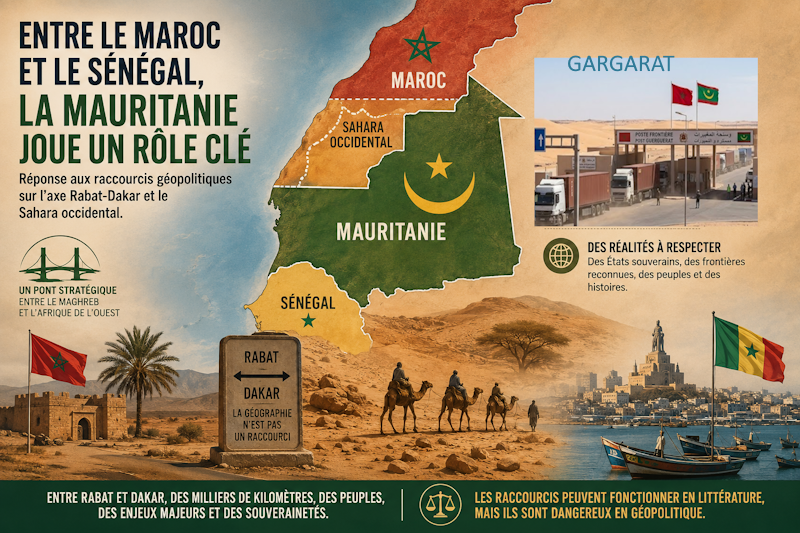
Beyond symbolic gestures, Mauritania’s diplomatic maneuvers are driven by hard economic realities. The border crossing at Guerguerat, situated between Western Sahara and Mauritanian territory, has become the economic artery linking Morocco to West Africa.
Daily, hundreds of Moroccan trucks transit through this zone, supplying Mauritanian, Senegalese, and Malian markets with agricultural and manufactured goods. For Nouakchott, blocking this flow would spell economic disaster. By keeping its borders open and securing this trade route, Mauritania effectively acknowledges Morocco’s operational control over the territory without granting it formal recognition.
A calculated ambiguity for survival
To regional observers, this policy of “having it both ways” is not indecision—it is survival. Sandwiched between Morocco’s economic ambitions and Algeria’s geopolitical vigilance, Mauritania cannot afford to take sides without risking economic retaliation or border destabilization.
The incident sparked by Cheikh Tidiane Gadio’s remarks serves as a reminder that this neutrality, though delicately balanced, remains highly volatile. Whenever Mauritania’s national identity or territorial integrity appears to be compromised by its neighbors’ ambitions, Nouakchott swiftly abandons its usual restraint to reassert itself as the indispensable—and sovereign—pillar of regional stability in the Maghreb.