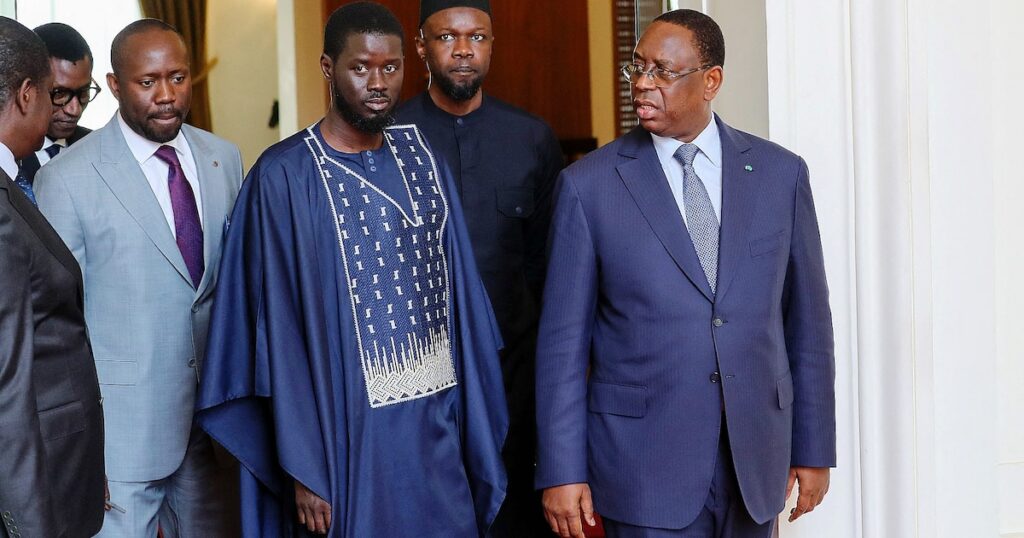
Macky Sall, Senegal’s former president who left office after his electoral defeat in 2024, is set to make a highly anticipated return to Dakar this Friday. His arrival at the Yoff military airport marks a significant moment in the nation’s political landscape, accompanied by a scheduled meeting with his successor, President Bassirou Diomaye Faye. The announcement has sent shockwaves through the country, reopening old wounds and reigniting debates about the past regime’s legacy.
A visit that divides the nation
The timing and circumstances of Sall’s visit are particularly contentious. Just months before the 2024 elections, Bassirou Diomaye Faye—then a political opponent—was imprisoned alongside hundreds of supporters from his Pastef party. Among them was activist Aly Coly, who recalls the harsh conditions of detention: “My wife and our three-month-old baby were jailed merely for supporting Faye and Sonko. Today, while I watch my son play, I see the man who orchestrated this horror being welcomed by our president. It’s unbearable.”
The repression during Sall’s final years in office was severe: over a thousand political detainees, dozens of fatalities during protests, and widespread accusations of human rights abuses. These events became central to Diomaye Faye’s election campaign, which promised a clean break from the old system. Yet now, Sall’s return raises uncomfortable questions about accountability and justice.
Global ambitions overshadow local grievances
Beyond domestic reactions, Sall’s visit is tied to a bold international ambition: his bid for the position of United Nations Secretary-General. In an official statement, he confirmed that his brief trip to Dakar would focus on “advancing his candidacy,” which he previously outlined before the UN General Assembly in April as a platform for multilateralism and neutrality. However, his campaign has so far lacked support from the African Union and his home country, leaving his prospects uncertain.
Sall’s critics are quick to dismiss his candidacy outright. Aly Coly questions how someone responsible for “60 deaths during protests” could lead an institution founded on human rights: “The UN’s purpose is to uphold justice—how can we imagine someone like him at its helm?”
Political chess moves in Dakar
For President Diomaye Faye, the meeting with his predecessor carries strategic weight. Political analysts suggest that mending ties with Sall could bolster his position amid growing tensions with Ousmane Sonko—his former mentor and current National Assembly president, whose influence threatens to undermine Faye’s authority.
Maurice Soundieck Dione, a political science professor at the Gaston Berger University, notes: “For Diomaye Faye, aligning with Sall may be a necessary move in a fragile political climate. But it risks alienating his base, which elected him on promises to dismantle the old regime.”
The visit has also sparked cultural concerns. In Senegal, betraying a mentor is widely condemned—a dynamic that adds another layer of complexity to Faye’s decision to host Sall. As the nation watches closely, the question remains: Will this encounter strengthen Faye’s leadership or further erode public trust?