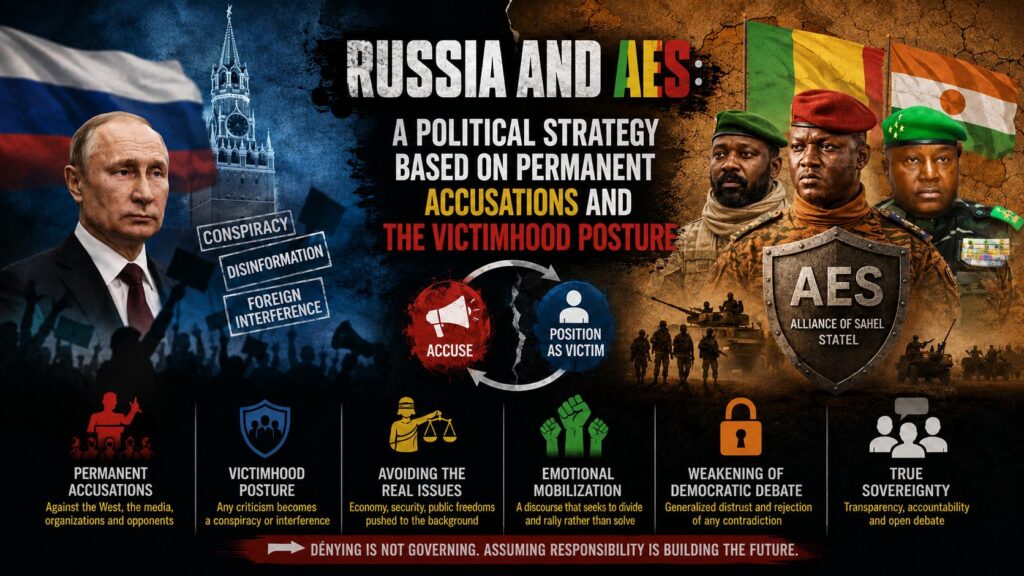
The prevalence of accusatory rhetoric in Sahel politics
The governments of the Alliance of Sahel States (AES) and Russia have increasingly relied on a recurring narrative in their political discourse: the perpetual denunciation of adversaries. This strategy, which targets Western powers, international media, regional bodies, and domestic opponents, has become a cornerstone of their communication. Yet, a striking inconsistency emerges when these same actors face criticism—they swiftly transition from accusers to victims.
This pattern of behavior has solidified into a systematic approach. Any challenge to their policies is met with claims of fabricated conspiracies, orchestrated disinformation campaigns, or foreign interference. Rather than addressing substantive issues, they frame criticism as a coordinated effort to undermine their governance or obstruct their pursuit of sovereignty. While this tactic serves immediate political purposes, it ultimately distracts from pressing national concerns such as economic instability, security threats, and eroding public freedoms.
Victimhood as a political shield in the Sahel
Within the AES, accusations against external entities—such as sanctions, former colonial powers, or foreign actors—are frequently cited to explain internal shortcomings. However, when citizens, journalists, or human rights organizations highlight internal failures, their concerns are dismissed as part of a broader destabilization plot orchestrated abroad. This selective engagement with criticism underscores a reluctance to engage in genuine accountability.
The same dynamic is evident in Russia’s international communications. When confronted with questions about its foreign interventions, military actions, or human rights violations, the official response often resorts to portraying the country as a perpetual target of Western hostility. By reframing valid concerns as evidence of an orchestrated smear campaign, the discourse shifts from substance to emotion, prioritizing mobilization over solutions.
The risks of a victim-centered political narrative
While the strategy of portraying oneself as a victim may offer short-term political advantages, it undermines long-term governance credibility. A robust political system thrives on the ability to engage with dissent, provide reasoned responses to criticism, and uphold transparency. By consistently dismissing dissent as a conspiracy, these governments risk eroding public trust and stifling democratic debate.
Accusations are a convenient tool; responsibility is far more demanding. The repeated reliance on victimhood narratives suggests an avoidance of accountability rather than a genuine effort to address governance challenges. Constructive criticism, when acknowledged, can serve as a catalyst for policy improvement and public confidence. Instead, the reflex to label all opposition as malicious undermines the very sovereignty these leaders claim to uphold.
True sovereignty is not merely the capacity to identify enemies—real or imagined—but the willingness to confront internal shortcomings with honesty and transparency. Without these principles, the narrative of perpetual victimhood risks being exposed as little more than a rhetorical device rather than a credible response to the complex challenges facing these nations.