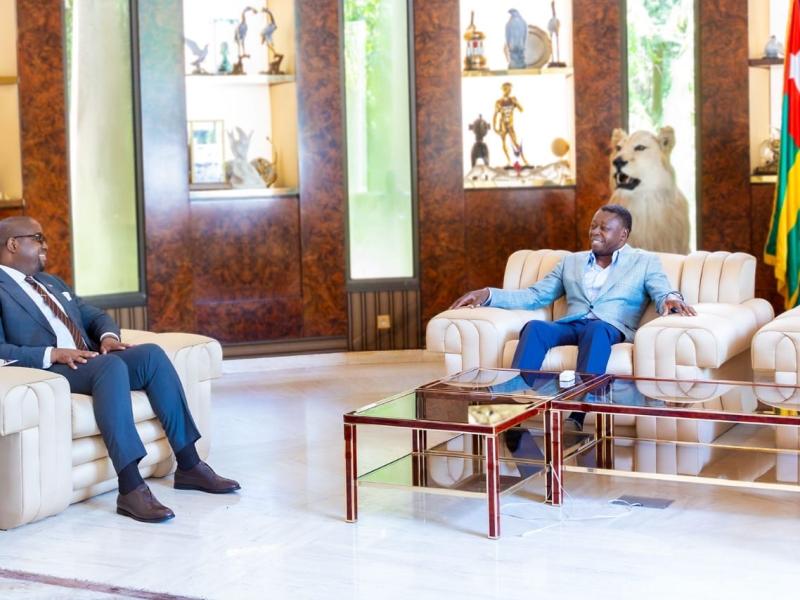
The capital of Togo, Lomé, was the setting for high-level discussions on Tuesday, July 14, 2026, when Faure Essozimna Gnassingbé, Togolese Prime Minister and African Union mediator for the Democratic Republic of the Congo (DRC) conflict, met with Floribert Anzuluni, the DRC’s Minister of Regional Integration, on a diplomatic mission.
The talks focused on strengthening bilateral cooperation between Lomé and Kinshasa, particularly regarding the persistent security challenges in eastern DRC and ongoing mediation efforts to restore lasting peace in the Great Lakes region.
The Togolese presidency confirmed that Floribert Anzuluni expressed gratitude for Faure Gnassingbé’s leadership in resolving the conflict that has plagued the region for over three decades. As the designated AU mediator, Gnassingbé is leading consultations with key stakeholders to achieve a peaceful and sustainable resolution to the crisis.
Key takeaway: The meeting underscores Togo’s pivotal role in regional diplomacy, with Faure Gnassingbé continuing to champion peace initiatives in the Great Lakes region.
Regional diplomacy intensifies amid ongoing conflict
Before arriving in Lomé, Floribert Anzuluni had traveled to Uganda, carrying a message from DRC President Félix Tshisekedi to his counterpart, Yoweri Museveni. These engagements follow the continued fighting in eastern DRC, where the M23 rebel group—allegedly backed by Rwanda according to Kinshasa and multiple international reports—has intensified its offensive against government forces.
The rebel movement now controls significant portions of North Kivu and South Kivu provinces, reinforcing its positions. Despite diplomatic efforts in Washington and Doha, a durable solution remains elusive.
These diplomatic exchanges coincide with heightened political discussions in the DRC, including debates surrounding a potential constitutional revision ahead of President Félix Tshisekedi’s mandate.
Lomé’s role in Africa’s peace mediation
The meeting in Lomé follows a recent six-month evaluation session of the peace process in eastern DRC, held in the Togolese capital from June 7–8, 2026. Faure Gnassingbé emphasized the need for greater coherence and coordination among regional mediation mechanisms to strengthen peace efforts.
The June session was part of a broader strategy initiated by Gnassingbé in January 2026, bringing together former heads of state, the Togolese Foreign Minister Robert Dussey, representatives from the East African Community (EAC) and the Southern African Development Community (SADC), as well as international partners. The goal was to foster trust, advance dialogue, and ensure compliance with commitments made by all parties involved in the peace process.
In his closing remarks, Gnassingbé stressed that only a unified and sustained effort by regional, continental, and international actors could consolidate progress and pave the way for lasting stability in the Great Lakes region.
Beyond Lomé: A web of diplomatic engagements
The diplomatic outreach extends beyond Togo. Kinshasa and Luanda have maintained regular exchanges on bilateral and security issues, while Burundi’s President Évariste Ndayishimiye—current AU chairperson—has consulted religious leaders and opposition figures in the DRC. Additionally, Félix Tshisekedi recently visited Brazzaville to confer with Congo’s President Denis Sassou Nguesso, following Ndayishimiye’s state visit to Kinshasa.
Days later, Denis Sassou Nguesso continued consultations, including a meeting with Cardinal Fridolin Ambongo to discuss the DRC’s political and institutional landscape.
These coordinated efforts reflect a growing regional consensus on the need for collective action to resolve the DRC’s prolonged crisis.
Why this matters for Africa’s stability
The eastern DRC remains a flashpoint, with far-reaching implications for regional security and economic stability. The M23 rebellion, its alleged foreign support, and the humanitarian toll of the conflict have drawn international concern. In this context, Togo’s mediation under Faure Gnassingbé positions Lomé as a crucial hub for diplomatic solutions.
The outcome of these talks could determine whether Africa’s regional bodies can effectively curb instability in one of the continent’s most volatile regions.
—Reporting from Lomé