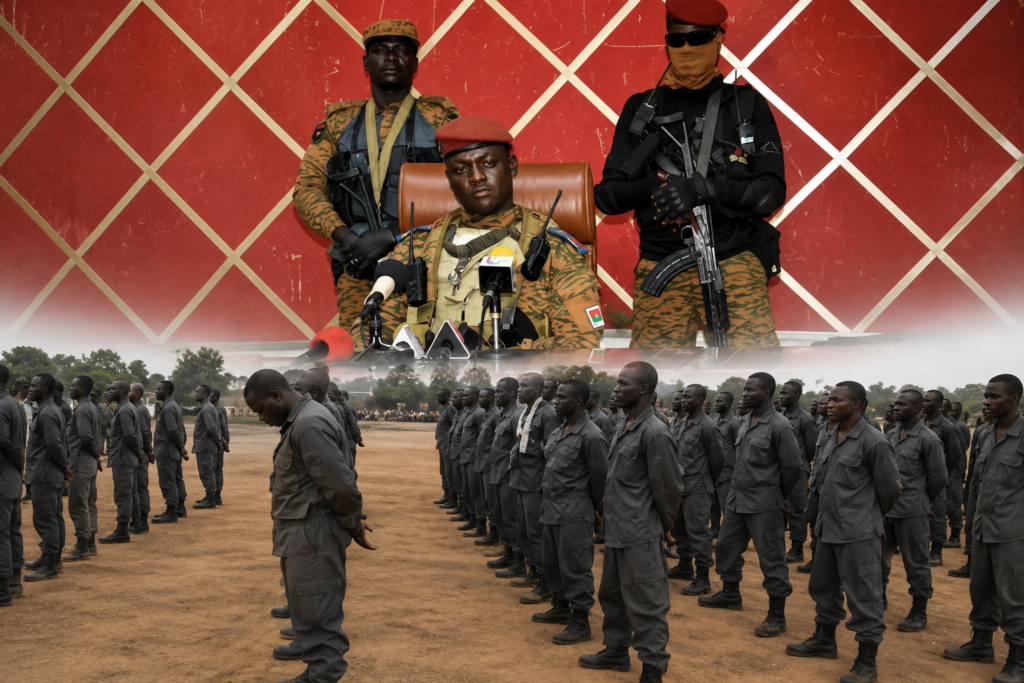
History has repeatedly demonstrated a harsh truth: authoritarian regimes, in their quest to silence dissent, often end up turning their repressive machinery against those who once championed them. Burkina Faso’s current leadership under Captain Ibrahim Traoré is no exception to this pattern. What began as a crackdown on traditional critics has expanded into a systematic erosion of trust, ensnaring former allies—including Muslim community leaders, civil society figures, journalists, influencers, and prominent commentators who once stood firmly behind the transition.
This shift is not the result of isolated incidents but reflects a deliberate transformation in how power operates. As the regime consolidates control, silences opposition, and equates criticism with national betrayal, it creates an environment where loyalty is no longer a shield but a provisional status subject to constant reassessment. The line between ally and adversary blurs when the sole criterion for safety becomes unquestioning obedience rather than past allegiance.
From loyal supporters to targets of suspicion
Ibrahim Traoré’s rise to power was fueled by a nationalist and security-driven narrative, amplified across social media by a wave of enthusiastic backers. This rhetoric framed dissent not as a democratic right but as a foreign-backed plot, a political trap, or an act of treason against the nation. In this climate, many public figures actively defended the regime’s actions: arbitrary arrests were justified as security imperatives, media closures celebrated as acts of sovereignty, and the forced conscription of journalists or lawyers applauded as patriotic duty.
Over time, this normalization of exception chipped away at public discourse. Nuance vanished, replaced by a binary logic: total support for the regime or immediate labeling as an enemy of the state. Criticism ceased to be seen as a democratic principle and became a political fault. Yet this strategy carries a dangerous risk. In a system demanding absolute loyalty, even the slightest reservation risks being reinterpreted as defiance. Yesterday’s staunch allies may find themselves tomorrow’s suspects.
Personalization of power and the spread of fear
A defining feature of Burkina Faso’s transition has been the intense personalization of authority around Captain Ibrahim Traoré. Public debate increasingly revolves not around policies but around the defense of the leader himself. Questioning a government decision is often interpreted as an assault on his personal authority. This personalization fosters a culture of perpetual suspicion. As security challenges persist—terrorist attacks, economic strain, social tensions, international criticism—the search for internal scapegoats intensifies. Failures are less attributed to flawed strategies than to imagined conspiracies, drawing an ever-widening circle of individuals under suspicion.
The first targets are traditional opponents. Then come independent journalists, human rights defenders, judges, academics, religious leaders, and eventually former allies whose influence is perceived as growing too independent or misaligned with the official line. In such a system, no one can be certain of remaining on the safe side indefinitely. Loyalty is not a one-time pledge but a continuous performance, and the bar for proving it keeps rising.
The psychology of control through fear
The regime’s tactics—high-profile arrests, public summons, social media smear campaigns, coercive conscription orders, and administrative sanctions—are designed not only to neutralize specific individuals but to broadcast a message to society at large. Each arrest serves as a warning. Each unexplained disappearance fuels unease. Every summoned individual is reminded that no one is immune. These actions collectively instill self-censorship: intellectuals hesitate to publish, journalists scale back investigations, religious leaders moderate their sermons, and citizens avoid public debate. A society governed by fear loses its capacity for innovation, self-correction, and collective problem-solving.
The erosion of institutional checks and balances
This transformation is all the more alarming because it occurs against a backdrop of weakened institutional safeguards. The independence of the judiciary is frequently questioned when legal procedures appear to serve political ends rather than justice. Independent media face suspensions or restrictions that shrink the space for pluralistic information. Civil society organizations operate under increasingly tight constraints. Political parties function in a climate of severe restriction. When no institution can effectively oversee executive power, the protections owed to citizens become dangerously fragile. The law no longer limits the state; the state limits itself, and only as much as it chooses.
A pattern repeated throughout history
Burkina Faso is not alone in witnessing this phenomenon. Across time and geography, regimes built on concentrated power tend to follow a similar arc: revolutionaries eliminate former comrades, military juntas turn on their own officers, political movements purge their founders, and ideologues are accused of betrayal. The underlying logic is clear: when loyalty replaces law as the foundation of political survival, no level of fidelity is ever sufficient. The pursuit of absolute ideological purity leads inexorably to purges, expulsions, and accusations. Fundamental rights are not privileges granted to the faithful; they are universal guarantees designed to protect every individual from state abuse.
Supporting the arbitrary detention of an opponent today paves the way for your own tomorrow. Injustice does not change its nature based on the identity of its victim. One of the most costly miscalculations made by Ibrahim Traoré’s early supporters was the belief that proximity to power would guarantee lasting protection. In authoritarian systems, loyalty is not a contract; it is a precarious relationship, constantly re-evaluated and revoked at will.
Security cannot justify the abandonment of the rule of law
Burkina Faso faces a real and urgent terrorist threat—one that demands a strong state response. But the effectiveness of counterterrorism cannot be measured solely by the number of coercive measures imposed. It also depends on trust between citizens and their institutions. When the public fears arbitrary state actions more than it trusts state protection, that trust erodes. History shows that no lasting victory over insurgency is possible when institutions lose credibility with those they are meant to serve. Security and the rule of law are not opposing goals; they are complementary pillars. A state that fights terrorism while upholding the law strengthens its legitimacy. Conversely, when emergency measures become permanent, the fight against the enemy risks becoming an excuse for total social control.
When the system consumes its own
The current predicament of once-loyal figures—now facing arrest, public denunciation, or forced withdrawal—illustrates a broader political reality. In a system where institutions are weakened and power is sustained by fear, no one enjoys lasting immunity. Today’s allies can become tomorrow’s suspects. Fervent defenders may be accused of insufficient loyalty. Communication channels can be shut down and their operators sidelined. Religious leaders may be reprimanded if their messages diverge from the official line. The watering can eventually waters itself.
Yet beyond individual fates, it is the entire society that bears the cost. When a regime extends suspicion even to its own supporters, it reveals that the core problem is not the people but the system itself. True national protection does not come from proximity to the head of state or ideological alignment, but from strong institutions, an independent judiciary, a free press, and laws applied equally to all. Only in such a framework can the fight against insecurity preserve both state authority and citizen freedoms.