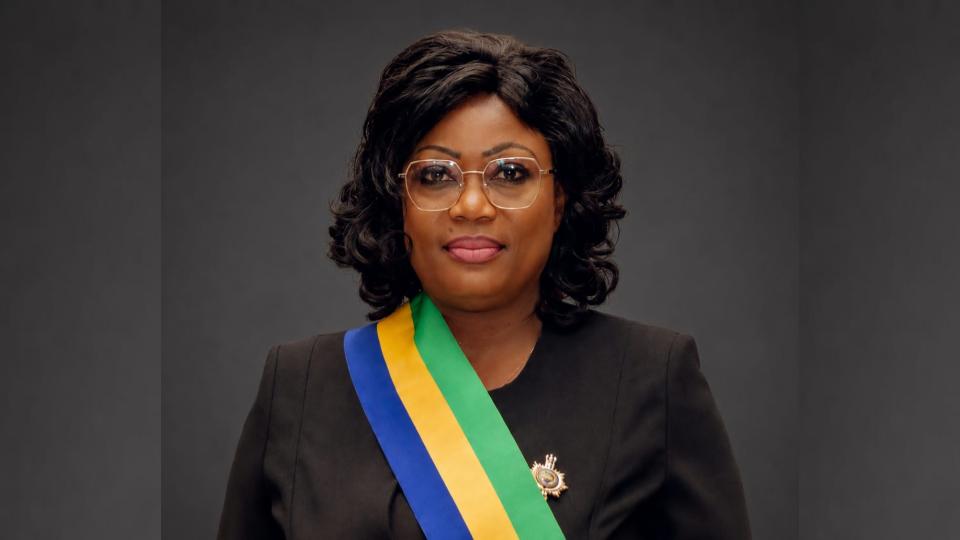
Gabon’s political landscape is heating up as deputy Daisy Léance Akinikoussou takes a firm stand against escalating personal attacks targeting the family of President Brice Clotaire Oligui Nguema. In a bold public statement titled “Time to say enough is enough,” the lawmaker from the Plateaux department slams what she describes as a dangerous shift from political criticism to outright assaults on human dignity.
Public discourse in Libreville has recently witnessed a surge in vitriolic remarks, particularly those attributed to activist Landry Mbeng, known online as “Lanlaire.” His statements, directed not only at the president but also at his spouse and mother, have drawn sharp condemnation from Akinikoussou, who argues that such attacks cross a critical ethical boundary.
Defending Dignity Beyond Politics
Akinikoussou, who also serves as Secretary-General of the National Network of Women Deputies (RENAFED), insists that the freedom to critique leadership does not extend to harming the private lives of public figures’ relatives. “A mother is first and foremost a mother, regardless of her child’s position,” she declares, emphasizing that the president’s mother cannot be held accountable for his governance. “We may challenge the President’s policies, oppose his decisions, and demand accountability—but his family’s dignity remains untouchable,” she asserts.
The lawmaker frames her argument as a defense of universal principles, not just the current administration. “Standing up for the President’s mother today isn’t about defending a regime—it’s about defending respect for every individual,” she notes. This stance places the debate firmly on the moral obligation to protect human dignity, irrespective of political affiliations.
Women’s Rights at the Heart of the Controversy
As Secretary-General of RENAFED, Akinikoussou ties the controversy to broader gender equality concerns. She argues that demanding respect for women’s rights while simultaneously endorsing their public humiliation creates a contradiction. “Women’s rights cannot be conditional,” she states. “We must defend all women, including those we disagree with politically or whose families are in power.” Her position reframes the issue as a collective responsibility to reject online harassment and personal attacks.
The Slippery Slope of Normalized Insults
Akinikoussou warns that tolerating these attacks sets a dangerous precedent. “Today, it’s the President’s mother. Tomorrow, it could be the mother of an opponent, a journalist, an activist, or an ordinary citizen,” she cautions. Her concern underscores the fragility of democratic discourse when personal attacks replace substantive debate.
While she fully supports robust political opposition, she draws a clear line: criticism must target policies and actions, not individuals’ families. “Being a determined political opponent doesn’t mean becoming an enemy of human dignity,” she asserts. Her message calls for restoring civility to public conversations, where ideas are debated fiercely—but never at the cost of basic respect.
Restoring Boundaries in Public Debate
The timing of Akinikoussou’s intervention coincides with growing unease among civil society leaders about the erosion of acceptable discourse standards. Her plea is simple: in a democracy, leaders must be held accountable—but their families deserve protection. “We can fiercely challenge ideas without stripping away people’s humanity,” she concludes. “Enough is enough.”