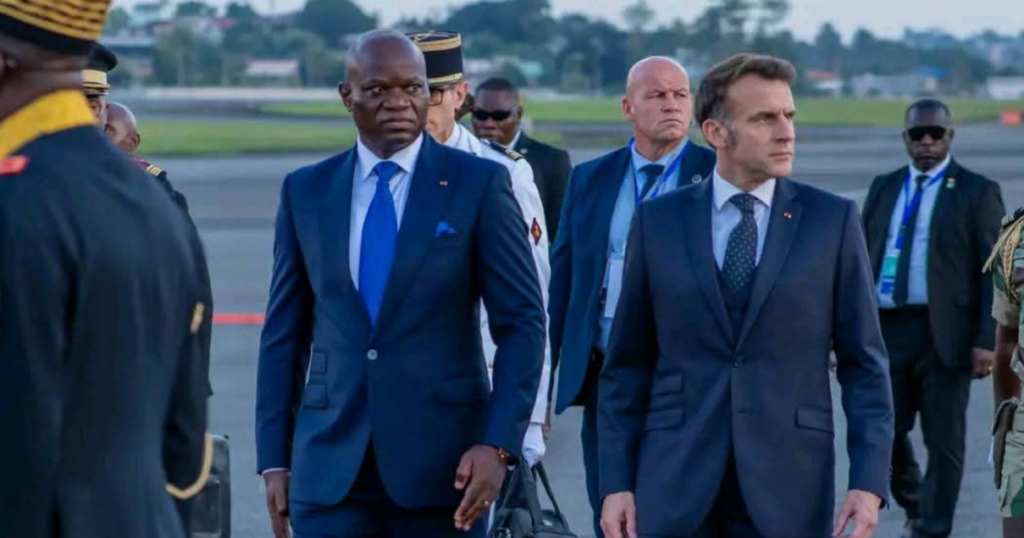
The President of Gabon, General Brice Clotaire Oligui Nguema, has concluded a landmark three-day state visit to France, where he reshaped the framework of cooperation between Libreville and Paris. The discussions centered on two critical pillars: redefining the military presence at Camp de Gaulle and accelerating Gabon’s transition toward local processing of manganese. This diplomatic maneuver reflects a calculated balance between asserting sovereignty and maintaining strategic alliances, offering a counterpoint to the confrontational approaches seen elsewhere in Africa.
Camp de Gaulle: From military legacy to shared strategic vision
The future of the Camp de Gaulle base, home to the French military detachment in Gabon, was a central topic during the talks at the Élysée Palace. Following France’s broader military repositioning across West and Central Africa, the Gabonese government is seeking to transform this historical site into a locally managed training center. Alternatively, Libreville proposes limiting the French military footprint to technical cooperation and anti-piracy operations in the Gulf of Guinea.
This approach underscores a deliberate strategy: neither an abrupt withdrawal nor blind submission, but a recalibration of defense ties. Gabon is determined to demonstrate restored sovereignty while safeguarding essential security partnerships that benefit both nations. For France, the challenge lies in adapting its military posture without alienating a key regional ally—a lesson drawn from recent setbacks in neighboring countries.
Manganese transformation: Gabon’s bold economic pivot
Economic negotiations during the visit were no less decisive. As the world’s second-largest producer of manganese, Gabon is pushing for an end to the extractive model that has long dominated its mining sector. Until now, the majority of manganese has been exported in raw form, depriving the country of higher-value industrial opportunities.
President Oligui Nguema made a clear demand to French industrialists and Eramet, the conglomerate operating Comilog in Gabon: the future of trade hinges on local processing. The Gabonese government insists on fairer profit-sharing, the creation of skilled jobs for young Gabonese workers, and financial and technical support to establish high-value processing plants. This stance aligns with the global energy transition, where manganese is essential for electric vehicle batteries—offering Gabon a chance to capitalize on its mineral wealth in a sustainable way.
A diplomatic middle path amid Sahel tensions
The Gabonese strategy stands in stark contrast to the confrontational rhetoric adopted by juntas in the Alliance of Sahel States (AES)—Mali, Niger, and Burkina Faso. While these governments have embraced public ruptures with former colonial powers, Gabon is pursuing a pragmatic path. Instead of isolation and instability, Libreville is diversifying its partnerships with China, Turkey, and India, all while maintaining a firm but constructive dialogue with France.
This Realpolitik approach highlights the limitations of the AES model, which has often traded one dependency for another, leading to economic isolation and heightened internal instability under the guise of anti-Western nationalism. Gabon’s method proves that asserting sovereignty does not require diplomatic collapse or a blanket rejection of Western cooperation.
Digital freedoms: The unresolved question in Gabon’s democratic pledge
Despite Gabon’s assertive international stance, concerns persist closer to home. Frequent internet restrictions and social media blackouts have raised alarms among civil society groups and opposition figures. The government justifies these measures as necessary to preserve public order and curb misinformation, but critics view them as signs of creeping authoritarianism that could undermine the country’s democratic image.During informal discussions, French officials quietly emphasized the importance of upholding fundamental freedoms and freedom of expression. For President Oligui Nguema, the challenge is delicate: balancing internal stability with the international credibility he has worked hard to build. The success of his vision will depend not only on successful negotiations in Paris but also on whether Gabon can foster an open and inclusive public discourse at home.
What’s next for Gabon’s balanced diplomacy?
The outcome of this state visit sets the stage for Gabon’s future foreign policy. By renegotiating military cooperation and spearheading local industrialization, Brice Clotaire Oligui Nguema has reinforced a foreign policy that is both sovereign and pragmatic. However, translating these agreements into tangible progress will require more than diplomatic finesse—it will demand real progress on democratic openness and digital freedoms.
Gabon’s path forward will be watched closely across Africa and beyond. If successful, it could serve as a model for other nations seeking to redefine their partnerships without resorting to isolation or confrontation. The stakes are high, but so are the opportunities for a nation determined to carve out its own future.