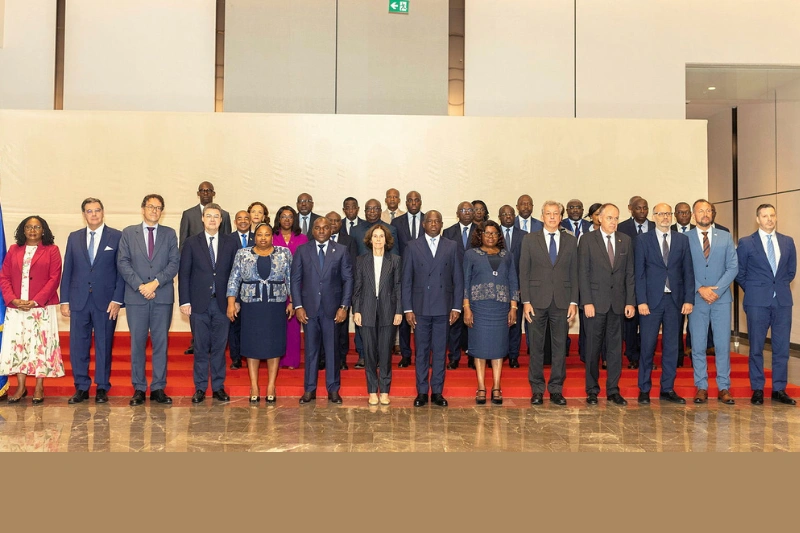
The Palais des Congrès Omar Bongo Ondimba, located within the Cité de la Démocratie, served as the venue for the second session of the strategic partnership dialogue between Gabon and the European Union (EU). This high-level meeting was led by the Vice-President of the Government, Hermann Immongault, alongside the EU Ambassador to Gabon, Cécile Abadie, following up on the initial discussions held in October 2024.
During the proceedings, Hermann Immongault highlighted that this dialogue is rooted in the Samoa Agreement. This legal framework serves as the foundation for relations between the EU and members of the Africa, Caribbean, and Pacific (ACP) states. He emphasized the pursuit of “a more balanced and operational partnership,” specifically designed to produce tangible results through public investment and effective policy-making.
Key pillars of the bilateral cooperation
The working session was organized around four primary themes:
- Governance and political reforms.
- Economic outlook and development.
- Environmental protection and sustainable management of natural resources.
- Regional and multilateral collaboration.
As the session concluded, both delegations expressed satisfaction regarding the institutional reforms implemented during Gabon’s current Transition period. The participants engaged in transparent discussions regarding fundamental freedoms and human rights. According to Hermann Immongault, no subject was considered off-limits, allowing both parties to clarify their positions and resolve any outstanding concerns.
Economic growth and investment climate
The talks also delved into Gabon’s economic future, focusing on structural reforms and initiatives aimed at refining the business climate to attract more international investors. In this context, the European Global Gateway strategy was identified as a significant tool for future development.
Environmental issues were a major priority during the exchange. Gabon and the EU reaffirmed their shared commitment to the sustainable management of forest ecosystems. Furthermore, they explored new avenues for cooperation in renewable energy, waste management, and sustainable fisheries.
Finally, both parties restated their dedication to multilateralism. There was a clear alignment of perspectives on international and regional challenges, particularly regarding maritime safety and the advancement of regional integration. Moving forward, Gabon and the EU aim to deepen their connection by maintaining a continuous dialogue on these shared priorities within an atmosphere of mutual trust.