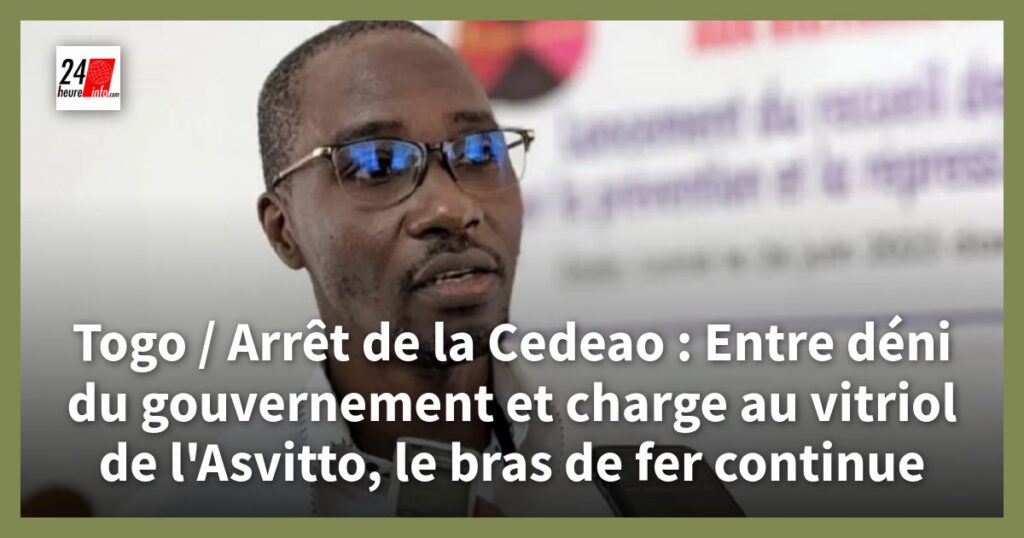
Togo’s government rejects ECOWAS court ruling amid growing tensions
Lomé remains embroiled in a heated dispute following the ECOWAS Court of Justice’s decision to invalidate Togo’s constitutional amendment. While government officials dismiss the ruling as legally unfounded, civil society groups are escalating pressure, accusing state authorities of orchestrating what they describe as an unconstitutional power grab.
Lomé’s legal counterattack
The Togolese government has launched a vigorous legal defense, arguing that the ECOWAS Court lacks the authority to review national constitutional matters. Authorities contend that the regional judiciary has no jurisdiction to rule on a sovereign nation’s constituent power, effectively rendering the decision void within Togo’s legal framework.
ASVITTO’s scathing response
The Association of Victims of Torture in Togo (ASVITTO) has mounted a fierce rebuttal, condemning the government’s stance as a desperate attempt to evade accountability. In a strongly worded statement, the organization branded the constitutional changes a constitutional coup and accused authorities of being trapped in their own fear while awaiting inevitable consequences.
Their consistent pattern of ignoring ECOWAS rulings speaks volumes about their disregard for regional judicial decisions.
ASVITTO highlighted the plight of political prisoners still detained in Lomé, despite multiple ECOWAS rulings demanding their immediate release. The organization views this as definitive proof of the government’s defiance of international commitments.
Direct appeal to ECOWAS for intervention
Calling for decisive action, ASVITTO has urged the ECOWAS Court to enforce its January 2026 ruling (ECW/CCJ/JUD/01/26), which declared Togo’s 2024 constitutional reform incompatible with the African Charter on Democracy, Elections, and Governance. The NGO warned that state-sanctioned gangsterism in the region must be brought to an end.
A standoff with human consequences
The political impasse shows no signs of resolution. On one side, the government clings to its legal arguments, while civil society groups, led by ASVITTO, demand adherence to regional judicial decisions. Meanwhile, detained activists remain incarcerated, their fate hanging in the balance as verbal confrontations overshadow their urgent need for justice.