Football unites a divided Congo: the Leopards’ World Cup journey
By reaching at least the round of 16 in the World Cup, the Democratic Republic of Congo is celebrating more than just athletic achievement. It is also revealing a political ambition: to use football as a force for national unity and a sign of the state’s resurgence. President Félix Tshisekedi has championed this strategy for years.
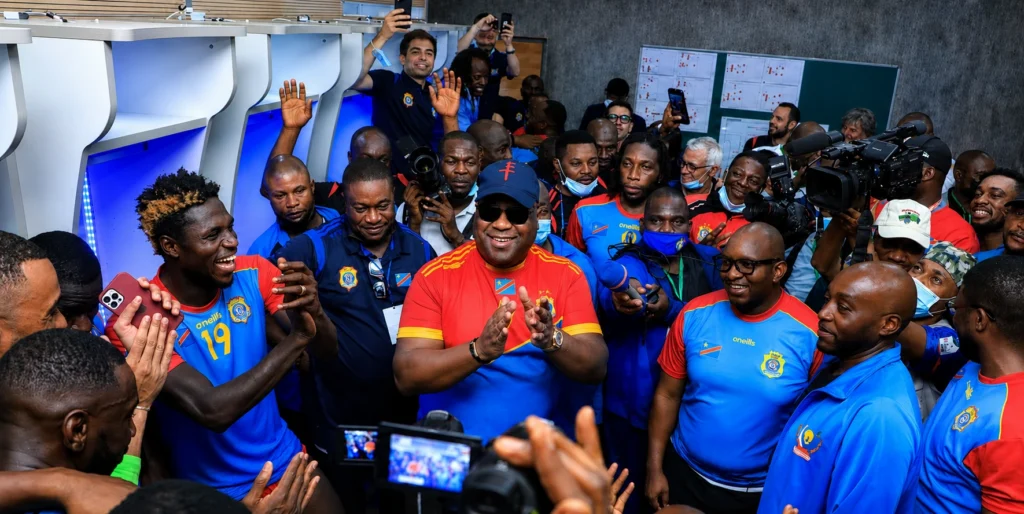
From Kinshasa to Lubumbashi, Kisangani to Mbuji-Mayi, and even in the war-torn eastern cities, Congolese people poured into the streets on June 28 to celebrate the historic qualification of the Leopards among the world’s best teams. For a few hours, political, regional, and communal divides gave way to a single flag.
In a nation long defined by security crises, this sporting saga tells a different story: one of a country regaining confidence. Football does not explain everything, but it acts as a mirror. Behind the Leopards’ performances lies a deeper desire: to rebuild national pride in a country that has faced decades of war, division, and foreign interference.
A vision outlined by the president in his December state-of-the-nation address
This interpretation is no accident. In his December 9 address, Félix Tshisekedi devoted a full passage to sports. He praised Congolese athletes, recalled the Leopards’ qualification, and stated that “every victory, every flag raised, builds our pride, our national identity, and the intangible foundation of our unity.”
That sentence sums up a political vision. For the head of state, football is not just popular entertainment; it contributes to national cohesion. It reminds us that beyond tensions, there is a shared Congolese destiny.
In the same speech, Tshisekedi emphasized a central idea: the Democratic Republic of Congo remains “one and indivisible,” despite external aggression, armed groups, and attempts to fragment the territory. In this light, each Leopards victory serves as a symbolic demonstration of that restored unity.
Sports as an instrument of sovereignty
For several years, the Congolese government has taken steps to give sports a strategic role. Hosting major continental events, reforming sports governance, supporting national teams, and promoting athletes are actions reflecting a simple belief: a country’s influence also comes through sports success.
The recent appointments of Véron Mosengo-Omba as head of FECOFA and Amadou Diaby as first vice-president fit this dynamic. Both advocate a modern vision of football where performance, professionalization, and international image go hand in hand. This new leadership accompanies a generation of players finally turning the immense potential of Congolese football into results.
Immense popularity: “Fatshi béton”
Amid ongoing security challenges in the east and profound government reforms, this sporting success also provides President Tshisekedi with a powerful political symbol. Not because he is directly responsible for the Leopards’ victories—those belong to the players, the coach, and the staff—but because he has consistently used sports as a tool for national cohesion.
The president is the team’s biggest fan, constantly sending encouragement. He accompanies this sporting adventure as part of a larger narrative: a DRC that aims to regain confidence in its future. The popular slogan “Fatshi béton” (Fatshi being short for Félix Tshisekedi, and béton meaning concrete, symbolizing unshakable strength) reflects this connection with a segment of the public beyond political divides.
A mirror of a new DRC
In the DRC, a recurring observation among political and economic leaders is that the country now wants to change its story. Long portrayed solely through conflict or resource exploitation, it now wants to be known for its restored stability, reforms, economic potential, and regional influence. The Leopards currently offer an exceptional showcase for this ambition.
Football will not solve security challenges or the immense development issues the DRC still faces. But it reminds us of an essential truth: when an entire nation celebrates the same team, when a victory unites people from Kinshasa to the most battered territories in the east, a whole country affirms its existence.