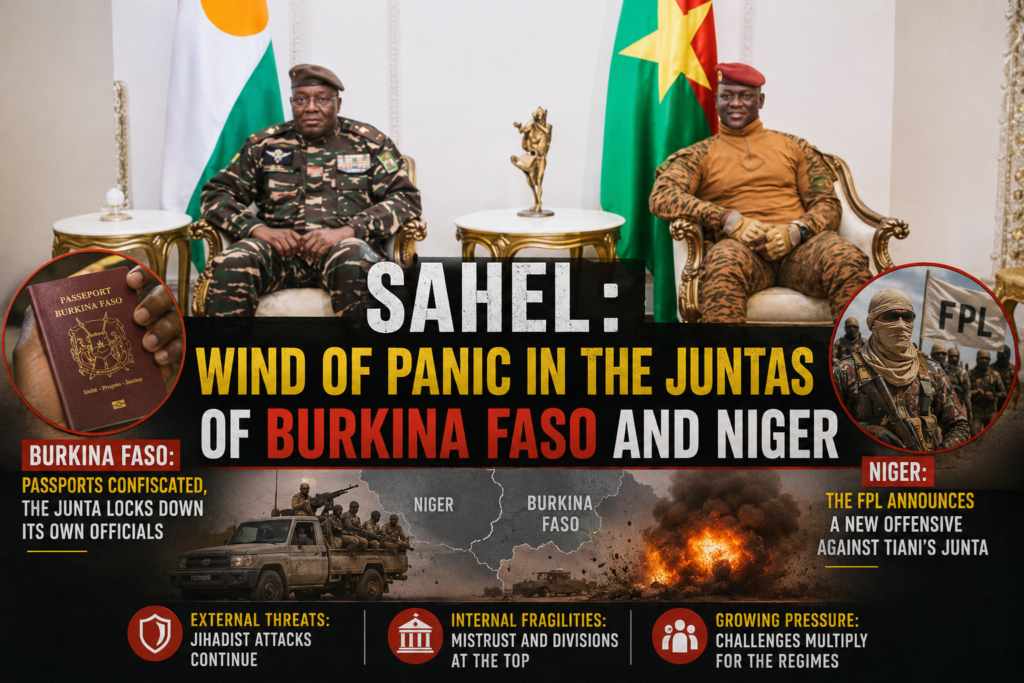
The security and political landscape in the Sahel continues to deteriorate, with the Alliance of Sahel States (AES) facing compounded challenges. Recent developments in Burkina Faso and Niger underscore the dual pressures confronting both military regimes: external threats from jihadist groups and internal instability within their own ranks. This convergence of crises is reshaping the dynamics of governance in the region.
Burkina Faso: tightening control over state institutions
In Ouagadougou, the military administration has adopted an unprecedented measure: the confiscation of passports belonging to government officials and senior military officers. This sweeping restriction signals a broader shift toward heightened surveillance within the highest echelons of power.
The decision reflects a strategic response to growing internal distrust. By restricting the movement of key figures, the regime seeks to mitigate risks of defection, unauthorized departures, or unauthorized disclosures of classified information. Such measures, while extreme, are often deployed when confidence within leadership circles erodes—particularly in contexts where cohesion is already fragile.
This policy unfolds against a backdrop of persistent insecurity. Despite intensified military operations and the mobilization of civilian defense volunteers, jihadist attacks continue to destabilize both security forces and civilian populations. The enduring security vacuum has exacerbated tensions within the government, reinforcing the authorities’ resolve to centralize decision-making and tighten control over all levers of power.
Analysts interpret these restrictions as evidence of the systemic challenges faced by military regimes in maintaining internal unity. As power becomes increasingly concentrated, the risk of internal rivalries, factionalism, or leadership splits intensifies—posing a direct threat to long-term stability.
Niger: armed opposition escalates against the Tiani regime
In Niger, the crisis has taken a more overtly military turn. Following his release in late June 2026—secured through a sensitive prisoner exchange involving Libyan factions—the Secretary-General of the Patriotic Front for Liberation (FPL), Mohamed Salah, has re-emerged with a bold declaration: a planned offensive to topple the regime of General Abdourahamane Tiani.
The exchange that secured his freedom saw the Nigerien authorities release Barkadine Mahamat Rifi, a commander of the Libyan armed group “Ahrar Fazzan,” sought by rival factions. With his return, Mohamed Salah has reframed the FPL as a vanguard of resistance, demanding the restoration of constitutional order and the immediate release of former President Mohamed Bazoum—whom the movement recognizes as the legitimate leader under universal suffrage.
This assertive stance marks a significant evolution in Niger’s political crisis. While the government remains focused on combating jihadist networks, it now faces an organized armed opposition openly advocating for regime change. The emergence of this new front further strains the country’s already stretched security apparatus, diverting critical resources from counter-terrorism efforts.
Dual crises expose structural fragilities in Sahel governance
The challenges confronting the military regimes of Burkina Faso and Niger extend far beyond jihadist insurgencies. In Ouagadougou, the focus is on preserving internal cohesion, while in Niamey, the threat stems from a resurgent armed opposition with a clear political agenda.
These intersecting pressures—ranging from jihadist violence and political dissent to economic strain and public discontent—highlight the profound instability of governments born from coups d’état. Despite their stated commitment to sovereignty and security, both regimes now face existential questions about their capacity to govern effectively and restore public trust.
As regional tensions intensify, the ability of these military administrations to navigate this multifaceted crisis will determine the trajectory of the Sahel in the coming months. The convergence of internal distrust, armed resistance, and persistent insecurity creates a volatile environment—one where the risks of further destabilization loom large.