Global supply chains brace for impact as China tests Taiwan blockade scenarios
The waters surrounding Taiwan have become a powder keg of geopolitical tension, with Beijing’s unprecedented naval exercise sending shockwaves through international trade networks and regional security frameworks. The unprecedented mobilization of over 100 Chinese naval and coast guard vessels in early November 2026 represents more than just military posturing—it threatens to redraw the economic and strategic map of the Pacific.
China’s coordinated naval exercise raises alarm bells in Taipei
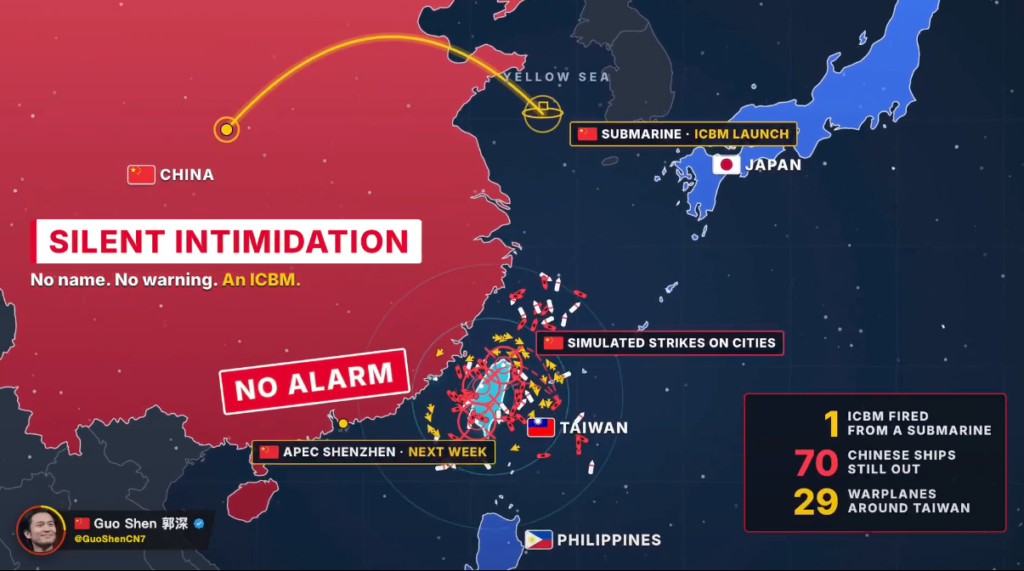
Taiwanese defense authorities reported an extraordinary convergence of Chinese naval forces that stretched beyond the Taiwan Strait to encompass vast swaths of the western Pacific. Unlike routine military drills, these operations involved coordinated deployments from all three of China’s naval commands—East, North, and South—creating what analysts describe as a ‘demonstration of unprecedented scale.’
The exercises included simulated attacks on both military installations and civilian infrastructure, according to officials familiar with the briefings. By November 13, approximately 70 vessels remained deployed along China’s so-called ‘first island chain,’ a critical maritime boundary that China seeks to control in any future conflict scenario.
Strategic isolation: the silent threat to Taiwan’s economy
Military observers warn that these maneuvers represent more than tactical training—they constitute rehearsals for potential blockades that could paralyze Taiwan’s economy. By controlling access to the island’s ports and airspace, Beijing could disrupt semiconductor shipments, which account for 90% of the world’s advanced chip production, triggering global supply chain disruptions.
The Institute for the Study of War highlighted in its November assessment that these drills align with historical patterns of China testing ‘anti-access/area denial’ strategies designed to prevent external intervention while exerting maximum economic pressure.
A mysterious reconnaissance flight adds another layer of tension
On November 15, reports emerged of an unusual aerial presence over the Taiwan Strait: a WC-135R Constant Phoenix, an American reconnaissance aircraft specially modified for detecting nuclear activity. The aircraft, which took off from Okinawa’s Kadena Air Base, followed a route south of Taiwan before approaching the southwestern approaches to the strait.
Nicknamed the ‘Nuclear Sniffer,’ the WC-135R is equipped with advanced atmospheric sampling technology capable of identifying trace amounts of radioactive materials. Its primary mission involves monitoring nuclear test sites and detecting radiological events, making its presence in these contested waters highly symbolic.
Unanswered questions cloud the mission’s true purpose
While the aircraft’s capabilities are well-documented, no official explanation has been provided regarding its specific objectives during this deployment. Military analysts caution against drawing premature conclusions, noting that the WC-135R could be conducting routine surveillance, monitoring environmental conditions, or gathering intelligence on potential radiological threats in the region.
The lack of transparency only amplifies concerns about Beijing’s long-term intentions and Washington’s response mechanisms in the event of a crisis.
Why Taoyuan’s geopolitical significance extends far beyond Asia
Taiwan’s strategic importance cannot be overstated. The island produces 60% of the world’s semiconductors and 90% of its most advanced chips, components critical to industries from smartphones to military technology. A prolonged disruption in shipping routes through the Taiwan Strait would send shockwaves through the global economy, potentially triggering recessions, supply chain collapses, and surging prices for electronic goods.
Beyond economic considerations, the region is home to critical undersea cables that transmit nearly all internet traffic between Asia and the Americas. Any military confrontation could disrupt communications, financial transactions, and data flows, with consequences felt worldwide.
The Pacific frontier: a new arena for superpower confrontation
The simultaneous deployment of Chinese naval forces and American reconnaissance aircraft underscores a dangerous new reality in the western Pacific. Both Beijing and Washington are testing each other’s resolve in a region where maritime borders, trade routes, and military dominance intersect.
For Tokyo, which shares maritime borders with Taiwan, the stakes are particularly high. Japan’s economic stability depends on unimpeded access to these critical shipping lanes, while its security alliance with the United States complicates any potential neutral stance in a conflict.
The current military buildup suggests that the region is entering a phase of protracted strategic competition. With both sides conducting high-stakes maneuvers, the margin for error—or miscalculation—has never been smaller.
What happens next? Navigating the uncertain waters of 2026
The coming months will be critical in determining whether these military activities escalate into open conflict or serve as a deterrent against further aggression. Taiwanese authorities are reportedly reviewing their defense strategies, with particular emphasis on protecting critical infrastructure from potential blockade scenarios.
International observers warn that any attempt to block Taiwan’s ports or airspace would violate international maritime law and trigger immediate responses from global powers. However, the absence of clear communication channels between Beijing and Washington increases the risk of unintended escalation.
As the world watches this unfolding drama, one thing remains certain: the Pacific’s strategic balance is shifting, and the consequences of miscalculation could reshape the global order for decades to come.





