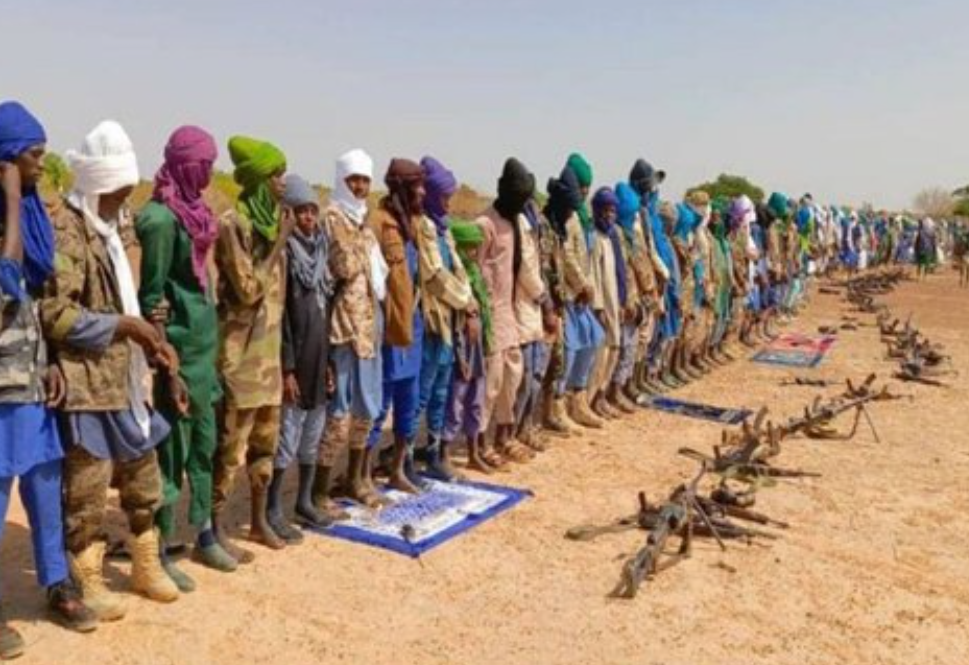
Mopti’s coordinated assaults underscore Mali’s spiraling insecurity
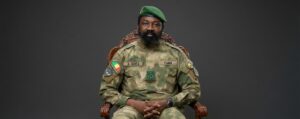
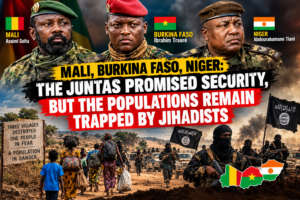
On Sunday, July 19, the Mopti region witnessed a wave of synchronized attacks orchestrated by the Group for the Support of Islam and Muslims (JNIM), an Al-Qaeda affiliate. The group claimed responsibility for four simultaneous assaults targeting Malian armed forces (FAMa), their Russian Africa Corps allies, and local militias, reaffirming its operational dominance across central Mali. Five years after Colonel Assimi Goïta seized power, the junta’s pledge to reclaim national sovereignty has collided with an unrelenting security and humanitarian collapse.
Coordinated strikes paralyze central Mali
The JNIM’s claims revealed a calculated campaign to disrupt military logistics and morale. In the Douentza district, the group detonated three improvised explosive devices (IEDs), striking a logistics convoy, a military truck, and a motorized soldier detachment—all while targeting both Malian troops and Russian mercenaries. Farther east, near Kansila, the insurgents launched a direct assault on the Dozo hunters militia, a traditional self-defense force allied with Bamako. According to the group’s tally, three Dozo fighters were killed in the ambush.
Goïta’s regime grapples with damning statistics
When the junta took control, its primary mission was to restore state authority and end the insurgency that Western partners, including the Barkhane operation, had failed to contain. Yet five years later, conflict monitoring data paints a starkly different picture. Fatalities from political violence and terrorist attacks have surged—doubling or tripling in key provinces compared to pre-coup figures. The emergence of the Africa Corps and its heavy-handed tactics have fanned interethnic tensions, inadvertently fueling jihadist recruitment. Meanwhile, the frequency of ambushes and IED strikes, like those on July 19, has become a daily reality, crippling critical road networks and isolating vulnerable communities.
State retreat and hidden humanitarian toll
Official narratives from Bamako often highlight symbolic victories, such as the recapture of Kidal in late 2023. However, the ground reality reveals a shrinking state presence. Central and northern Mali now resemble lawless gray zones, where government institutions have collapsed. United Nations agencies report that over 400,000 Malians have been internally displaced, fleeing both insurgent atrocities and the collateral damage of military operations. The blockade of entire towns by the JNIM or the Islamic State in the Greater Sahara (EIGS) has triggered acute food shortages. With roads unsecured, humanitarian convoys cannot reach besieged populations, transforming a security crisis into a silent humanitarian disaster.
Russia’s Africa Corps: a costly miscalculation
To fill the void left by departing French forces and the MINUSMA peacekeeping mission, Bamako turned to Moscow. Initially relying on the Wagner Group and now its successor, Africa Corps—a Kremlin-aligned paramilitary force—hundreds of Russian operatives were deployed. Yet their impact has been underwhelming. Human rights monitors have repeatedly accused Africa Corps of brutal tactics, including civilian casualties in incidents like the Moura massacre. Such violence drives locals toward insurgent groups, who position themselves as protectors. Militarily, the force has failed to curb the threat, suffering steady losses and lacking the manpower for effective counterinsurgency across Mali’s vast terrain.
Aerial strategy falters as insurgents adapt
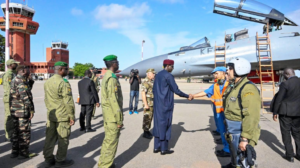
Facing a chronic shortage of ground troops, the Goïta regime invested heavily in aerial firepower, purchasing drones from Turkey and attack helicopters from Russia. While these assets initially enabled large-scale strikes, their limitations are now glaring. Maintenance hurdles—aggravated by sanctions and logistical bottlenecks—have grounded several aircraft, including L-39 Albatros jets and Mi-24 helicopters. Worse, insurgents have adapted. The JNIM and other groups now operate in smaller, dispersed units, blending into civilian cover or exploiting rough terrain. This shift has rendered air strikes ineffective, often resulting in civilian casualties and failing to degrade jihadist networks.
A dead-end military-first approach
The July 19 attacks in Mopti are not isolated events but symptoms of a systemic failure. Bamako’s reliance on a military-only strategy has reached its limits. By severing diplomatic ties, alienating regional allies, and entrusting security to profit-driven mercenaries, the junta has boxed itself into a corner. Without a holistic political solution—one that restores governance, revives public services, and shields civilians—the Malian state risks further territorial fragmentation under the relentless pressure of an emboldened Sahelian jihadism.