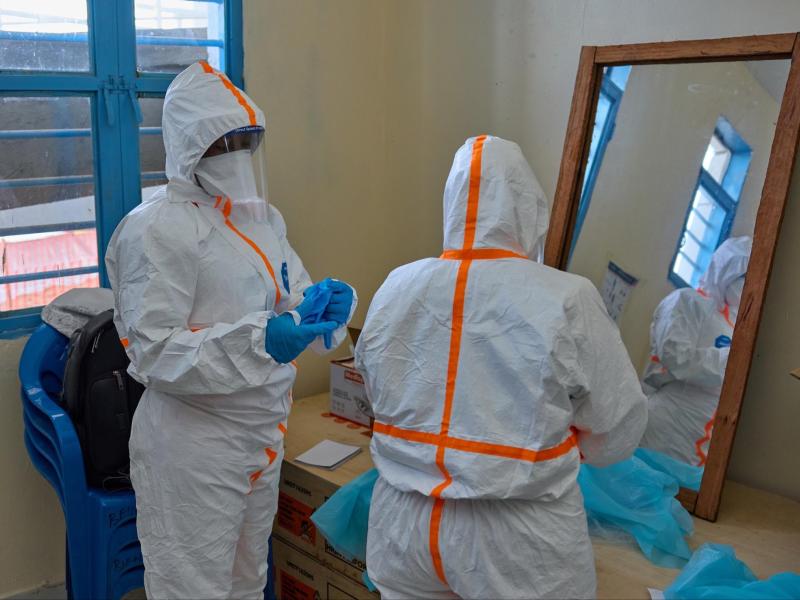
Five weeks after the initial declaration, the Bundibugyo Ebola outbreak in the République démocratique du Congo remains a significant threat. While the scale of the response has grown considerably, it is still struggling to contain a virus that continues to advance, cross national boundaries, and claim lives.
Scaling up infrastructure is not yet enough
There have been undeniable improvements in the local health infrastructure. Patient care capacity has seen a massive increase, growing from less than 10 beds to over 500 across 19 treatment centers in the affected regions. Diagnostic efforts have followed a similar path; from only 30 tests a day at the start, the RDC is now capable of processing over 2,000 daily samples across nine laboratories in three different provinces. Additionally, more than 100 people have been successfully treated and discharged, highlighting that early medical care is vital for survival.
Despite these gains, the toll is heavy: 1,094 confirmed cases and 277 deaths have been recorded to date. The epidemic continues to move faster than the interventions designed to stop it. Contact tracing remains insufficient, isolation facilities are stretched beyond their limits, and ensuring safe burials continues to be a daily struggle due to community mistrust or geographic isolation.
A virus crossing international lines
The health crisis has now expanded beyond the Congolese provinces of Ituri, Nord-Kivu, and Sud-Kivu. In neighboring Ouganda, 20 cases and two deaths have been confirmed, all linked to the strain originating in the RDC. Even more concerning is the arrival of the virus in Europe; France has identified its first case involving a humanitarian doctor who recently returned from a mission in the RDC. The patient is currently in stable condition at a specialized facility, while health authorities conduct an epidemiological investigation to monitor potential contacts.
This international case underscores the extreme risks faced by those working on the front lines. Nearly 80 health workers have been infected since the crisis began. There is an urgent need for states to ensure safe deployment conditions for humanitarian staff, including the guarantee of rapid medical evacuation if they become infected.
Structural hurdles and funding shortages
Beyond the medical challenges, the containment effort is being slowed by structural issues. Border closures are making it difficult for teams and equipment to move efficiently. Furthermore, security incidents are frequent in a region that has endured decades of armed conflict. Financial support is also lagging, as the international community has yet to fully fund the $518 million continental response plan.
However, a new phase of the fight is about to begin. A clinical trial testing two antiviral drugs, MBP134 and remdesivir, is scheduled to start next week in the RDC. This research initiative, involving a consortium of international scientists and health organizations, represents a critical hope for turning the tide against an epidemic that is still far from being controlled.