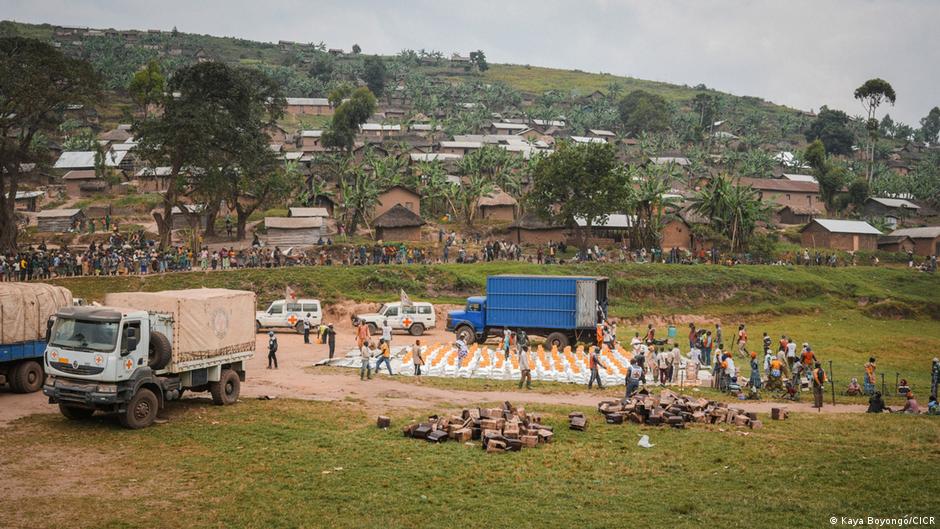
In eastern Democratic Republic of Congo (DRC), families face an unprecedented dual crisis. While the Ebola outbreak continues to loom over communities, persistent armed violence, frequent displacements, and shrinking agricultural opportunities are pushing millions into severe food insecurity. The International Committee of the Red Cross (ICRC) has recently resumed critical food and seed distributions, reaching over 80,000 people despite overwhelming logistical challenges. But how can aid organizations operate when communities are forced to choose between the fear of disease and the immediate threat of starvation?
Ebola’s arrival deepens existing struggles
Eastern DRC has endured years of conflict, displacement, and economic disruption, leaving communities already vulnerable. The emergence of Ebola has only compounded these hardships, further eroding the resilience of households that were barely holding on. With each new wave of violence, their ability to recover weakens, and the outbreak has intensified the strain on already fragile livelihoods.
Abdoul-Karim Diomande, Head of Programs for ICRC in the DRC, explains the compounded impact: “The Ebola epidemic compounds the devastating effects of years of conflict in eastern DRC, where communities have repeatedly faced displacement and loss. Every crisis chips away at their ability to cope, and this outbreak has pushed many to the brink. Restrictions on movement and disruptions to local markets have crippled economic activities, leaving the most vulnerable families with no safety net.”
Food insecurity worsens as agricultural livelihoods collapse
Access to farmland has become a growing challenge. Many households now cultivate only small plots near safer villages, leading to overuse of limited land and long-term soil degradation. Agricultural extension services, which are crucial for improving yields and resilience, are largely inaccessible due to ongoing violence and restricted movement in displacement zones.
The situation is most dire in border areas, where trade restrictions and closed crossings have severed vital supply chains. Communities that once relied on commerce for food and income now face empty markets and dwindling resources. With agricultural production faltering and trade routes severed, food shortages are becoming a daily reality for thousands.
Humanitarian aid as a lifeline
The ICRC’s recent intervention has provided essential support to over 80,000 people, offering food aid and agricultural supplies to help families survive. Yet, the scale of need far exceeds available resources. Diomande emphasizes the urgency: “We are racing against time to prevent a catastrophic food crisis. But without sustained access and security, our ability to reach those in need remains severely limited.”