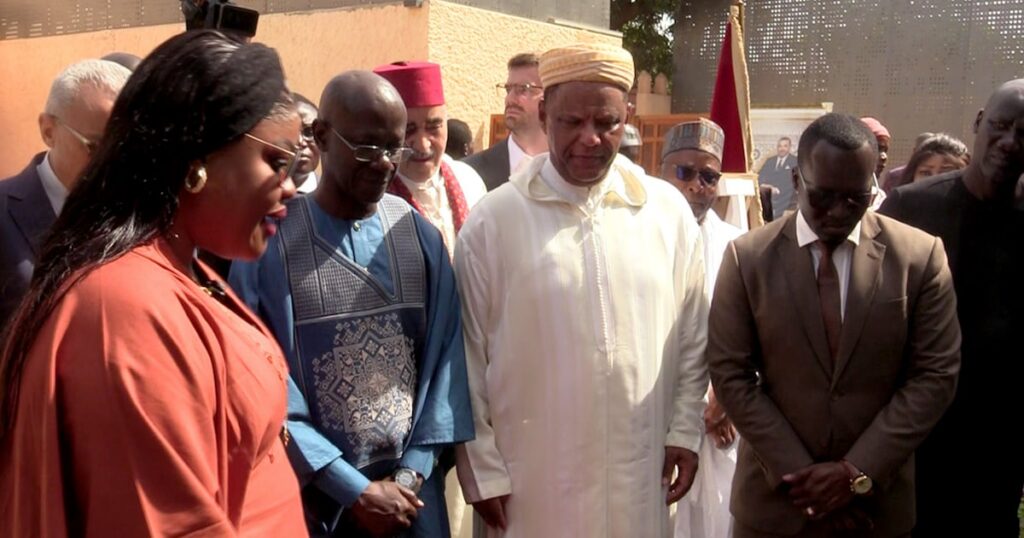
The residence of the Moroccan embassy in Dakar served as the prestigious venue for the unveiling of the photographic exhibition “Morocco–Senegal: A Shared History, A Common Destiny” on July 14. The event brought together key political, diplomatic, and media figures to celebrate the deep-rooted bonds between the two nations.
Among the distinguished attendees were the Senegalese minister of Communication and government spokesperson, Bakary Sarr, the presidential advisor Amadou Tidiane Wone, and the editor-in-chief of Le Soleil, Lamine Niang.
The exhibition showcased a curated collection of vintage photographs, archival press clippings, and historical documents—primarily sourced from Le Soleil’s archives—charting the evolution of cooperation between Dakar and Rabat over the decades. It revisits pivotal moments in a relationship forged on shared history, culture, politics, and faith.
Preserving a legacy for future generations
The Moroccan ambassador to Senegal, Hassan Naciri, emphasized that the exhibition transcends nostalgia, serving as a reminder of the shared responsibility to safeguard and pass down this legacy. “This exhibition allows us to revisit the defining chapters of an exceptional relationship, while also acknowledging our duty to preserve this common heritage and transmit it to the next generation,” he stated. He added, “It is our responsibility to nurture this bond, enrich it, and ensure its continuity—a legacy entrusted to us by our monarchs, Senegalese presidents, and all those who contributed to its foundation.”
A living testament to Senegal-Morocco cooperation
Lamine Niang, the editor-in-chief of Le Soleil, highlighted the exhibition’s significance as a symbol of enduring partnership. “This relationship demonstrates that authentic African solidarity is achievable when rooted in trust and shared vision, beyond mere interests,” he noted. “Today, thousands of Senegalese students pursue higher education in Moroccan universities, while Moroccan students contribute to the vibrancy of Senegal’s academic institutions.”
The exhibition not only serves as a visual narrative of the past but also stands as a commitment to strengthening future collaboration between the two countries.