politics
Cameroon’s football obsession: a distraction from deeper crises?
In a nation where months-long government reshuffles remain pending, public discourse risks being hijacked by sporting controversies rather than addressing real challenges.
Cameroonian commentator Jean Rodrigue Atemengue argues that in a country where months-long government reshuffles remain pending, public debates should focus on governance rather than sports.
Here is his open letter:
« Cameroonians,
The national team has failed to qualify for the upcoming World Cup. Our Indomitable Lions won’t grace the global stage this time. Yet once again, public discourse is dominated by football controversies, federation disputes, and debates about matches we won’t even play. Meanwhile, genuine national wounds remain unaddressed.
Where are our priorities?
Even football, long seen as a unifying force and a distraction from deeper issues, is no longer the same. The very tool of diversion is now in crisis.
Once Africa’s football pride and a symbol of the nation’s ability to compete globally, Cameroonian football today stands diminished. Contested management, personal conflicts, repeated scandals, a federation mired in controversy, crumbling infrastructure, and abandoned young talent paint a bleak picture. The non-qualification merely confirms the depth of the malaise.
We aren’t at the World Cup. Yet public debate still revolves around this failing football system as if nothing has changed. The irony is striking: we’re asked to rally around a sport many now see as declining.
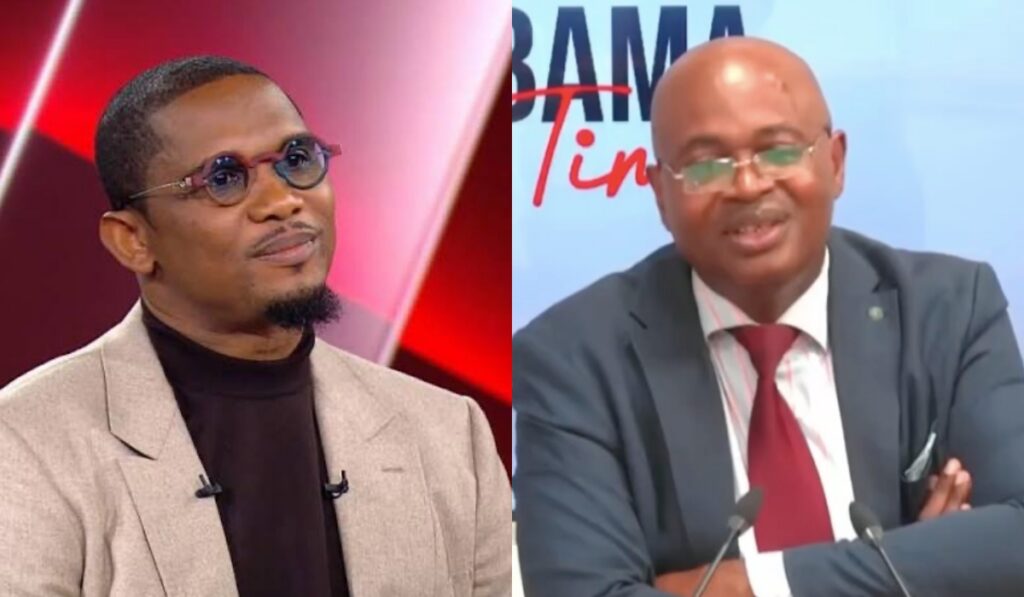
Football isn’t the issue itself. It remains a legitimate passion, a source of national pride, and a universal language that unites Cameroonians beyond political, ethnic, or social divides. Samuel Eto’o, admired for his legendary career, embodies this.
But football cannot serve as a curtain behind which institutional, economic, and social questions vanish—especially when our team is absent from the world stage.
What should we be discussing?
In a nation where government reshuffles are delayed for months, public debate shouldn’t be hijacked by football.
When Parliament convenes in extraordinary session to revise the Constitution and create a vice-presidential position—only for that role to remain vacant months after implementation—questions about our institutions deserve center stage.
When years pass without a Council of Ministers or Supreme Magistracy meeting, institutional normalcy must be scrutinized.
When ministers resign and are replaced by acting officials for extended periods, when parliamentarians and senior officials die without replacements, priorities lie elsewhere.
When a judge issues an arrest warrant while internal notes circulate instructing judicial police not to execute it, the rule of law—not FIFA rankings—should dominate conversations.
When a court-ordered provisional release is publicly framed as a forgery, public trust in our justice system should be the focus.
When roads crumble, public contracts remain unfulfilled, access to clean water and electricity is unreliable in many areas, youth unemployment persists, and household costs soar, football cannot be the primary topic of conversation.
Who benefits from this fixation?
Every time public debate centers almost exclusively on football controversies, other critical issues fade into the background. Institutional, economic, and social concerns lose visibility while unresolved problems persist.
Intellectuals, academics, journalists, and opinion leaders carry a particular responsibility here. Prioritizing sporting polemics over institutional crises risks favoring noise over reflection, emotion over analysis, and spectacle over substance.
This isn’t about abandoning football. It’s about prioritizing what truly matters.
When our institutions function fully, when justice inspires confidence, when roads are passable, when youth find employment prospects, and essential services meet public needs, we’ll have all the time we want to discuss football.
But today, making football the main topic of conversation amounts to ignoring our most urgent challenges. Continuing to debate a football system in crisis—pretending it still represents our greatest national success—ignores a dual reality: the decline of our football and the deeper difficulties our nation faces.
Cameroonians,
We deserve a public debate worthy of our challenges.
We deserve institutions that inspire confidence, credible justice, responsible governance, and a public sphere that enlightens citizens rather than distracting them from essential questions.
The history books will remember those who dared ask the right questions—far more than those who preferred debating tournaments Cameroon isn’t participating in or a football system still searching for renewal.»