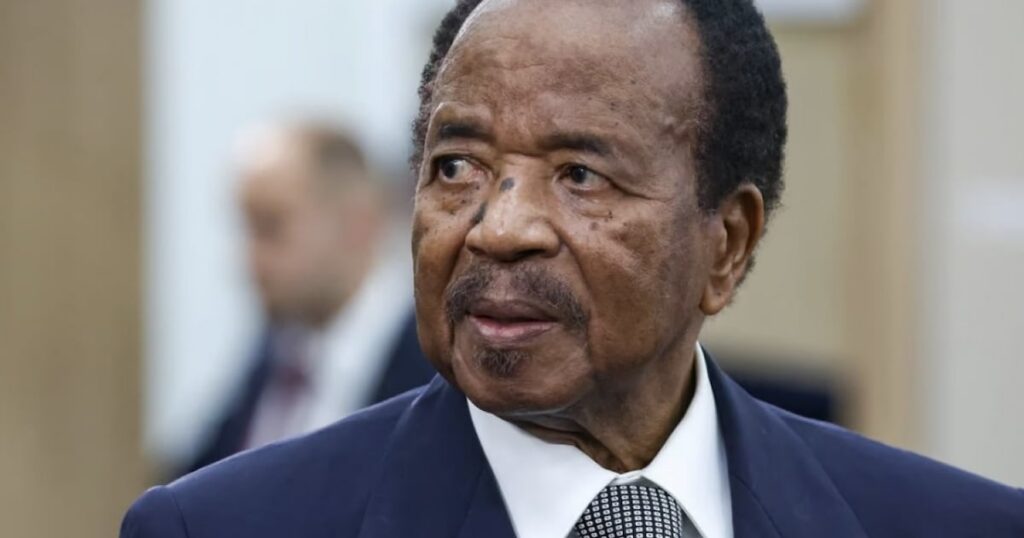
Paul Biya, Cameroon’s leader since 1982 and one of the world’s longest-serving presidents at 93, has been absent from the country for 48 days as of this Saturday. The president departed on 7 June for what official statements described as a ‘brief private stay in Europe’, accompanied by his wife, Chantal Biya.
His prolonged trips to Geneva have long fueled speculation about his health, though government officials have repeatedly denied hospitalization rumors. On 18 June, the Minister of Communication, René Emmanuel Sadi, issued a statement rejecting claims that the president was receiving treatment in a Swiss clinic.
opposition voices growing concerns over institutional paralysis
Opposition figures argue that Biya’s absence exposes a ‘glaring institutional void’. Mamadou Mota, Vice-President of the Movement for the Renaissance of Cameroon (MRC), voiced this criticism on Facebook, underscoring the lack of transparency surrounding the president’s whereabouts and the functioning of the state.
call for constitutional clarity on presidential incapacity
In mid-July, Patricia Tomaïno Ndam Njoya, leader of the Democratic Union of Cameroon (UDC), urged authorities to establish a ‘fair procedure for verifying temporary or permanent incapacitation’ of the head of state. Meanwhile, James Fame Ndongo, a senior member of the ruling party and Minister of Higher Education, dismissed concerns about a power vacuum, insisting that Biya ‘oversees key files remotely, guided by his closest advisors’.
This debate over presidential absence is not new. In late 2024, Biya spent around 50 days abroad, prompting similar discussions about governance. The Social Democratic Front (SDF) has gone further, describing Cameroon’s leadership as operating on ‘autopilot’—a phrase laced with frustration over what many see as systemic inertia.
Public fatigue is palpable. Viviane Ondoua Biwolé, a public management professor at the University of Yaoundé, notes, ‘People are exhausted by the wait. The current government has held power for eight years—an unprecedented stretch. Now, following an election marred by controversy, there’s a sense that renewal is overdue.’
Biya’s re-election to an eighth term in October 2025 sparked deadly protests, with the government acknowledging ‘several dozen’ deaths but offering no official toll. Opposition leaders challenged the results, and Western diplomats reacted with measured skepticism. Yet in his 31 December address, Biya pledged to form a new government ‘in the coming days.’ Seven months later, no such reshuffle has occurred.
The delays extend to local elections, repeatedly postponed, leaving municipal and legislative representatives in place far beyond their mandates. Meanwhile, recent institutional reforms—such as the May constitutional creation of a vice-presidential post and the March replacement of parliamentary leaders—have done little to quell uncertainty. Nearly three months after the reform, no vice-president has been appointed, stoking speculation about an impending succession crisis.
Rumors reached a peak in June when an individual delivered what they claimed was a presidential decree appointing a vice-president to the state radio headquarters in Yaoundé. The document bore official seals and a signature resembling Biya’s, but journalists quickly exposed it as a forgery, though not before amplifying doubts about the regime’s stability.
shadows of succession and internal rivalries
Analysts warn that Cameroon is grappling with a ‘more or less visible crisis at the highest levels of the state,’ with competing factions vying for influence. Stéphane Akoa, a political scientist, highlights growing tensions among the president’s inner circle, noting that ‘increasing leaks point to infighting between clans within his entourage.’
The First Lady, Chantal Biya, is frequently mentioned in these power struggles, with observers noting her growing role in state affairs. ‘Her name frequently surfaces in decisions and high-level appointments,’ Akoa explains, adding that the absence of a designated vice-president—whose absence in itself is constitutionally significant—leaves the Senate President, Aboubakary Abdoulaye, next in line to assume interim leadership in the event of presidential incapacity.