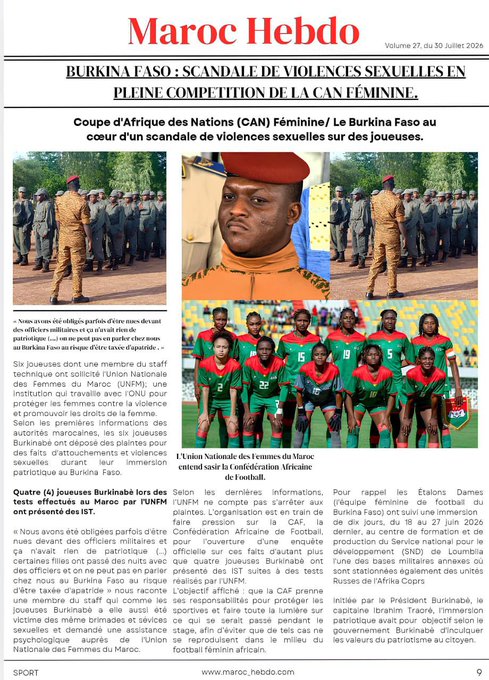
Under the banner of patriotism, military discipline, and national refoundation, the administration of Captain Ibrahim Traoré has intensified the militarization of Burkinabè society. Recent allegations of sexual abuse involving several members of the national women’s football team, reportedly occurring during a military-run training camp, have raised a critical question: how far can a government go when oversight mechanisms collapse and impunity becomes entrenched?
The facade of patriotism crumbles under grave accusations
The initiative was framed as a patriotic endeavor designed to instill national values before honing athletic skills. Members of the national women’s football team were dispatched to a military camp for what was billed as a ‘patriotic immersion training session’—an exercise meant to foster discipline, commitment, and sacrifice ahead of a continental competition.
Yet this carefully orchestrated public relations move now threatens to backfire spectacularly. According to a complaint filed in Morocco with the National Union of Moroccan Women, six players and one technical staff member allege they were subjected to sexual violence at the hands of military officers during their stay. If substantiated through an independent investigation, these claims would constitute severe violations of fundamental rights, exposing the dangers of a system where military authority operates with minimal civilian oversight.
From defense to domination: the creeping militarization of society
The controversy transcends the immediate allegations. It underscores a broader transformation in Burkina Faso’s governance structure. Since assuming power, Ibrahim Traoré has steadily expanded the military’s footprint beyond traditional defense roles, embedding it in sectors such as civic education, youth programs, cultural initiatives, political messaging, and even sports.
This shift reflects an explicit strategy: positioning the armed forces as the central pillar of national identity and cohesion. However, when civilian sectors are absorbed by military institutions, the safeguards of accountability, transparency, and civil oversight often erode. This systemic reorganization has triggered growing concern among human rights advocates, who warn that democratic checks and balances are steadily eroding.
Impunity thrives in the absence of accountability
A healthy democracy depends on a delicate balance between institutions. When the judiciary, independent media, civil society, and political parties face shrinking operational space, the ability to expose abuses diminishes accordingly.
In this climate, victims may hesitate to come forward, fearing professional retaliation, social ostracization, or even physical harm. The current case exemplifies this dilemma: available information suggests the complainants only pursued action after leaving Burkinabè territory.
This single detail raises profound questions about the reliability of domestic mechanisms designed to protect victims of abuse.
A climate of fear stifles dissent
Multiple factors contribute to today’s stifling environment:
- Criticizing military authorities is often equated with betraying the nation or tacitly endorsing armed groups.
- Journalists, activists, and civil society leaders report facing intimidation or coercive measures for challenging official narratives.
- Media restrictions curtail independent investigations and curb the flow of dissenting information.
- The overriding emphasis on security priorities often sidelines human rights concerns and victim protection.
In such conditions, public silence cannot be assumed to reflect consent. More often, it reflects the paralyzing fear of speaking out.
A crisis that transcends sports
This scandal extends well beyond the realm of football. It forces a reckoning with the role of military institutions in a nation at war and the boundaries that must guide their involvement in civilian life.
It also challenges the state’s capacity to ensure the safety of its citizens when they participate in programs under official authority.
Above all, it underscores a fundamental truth: counterterrorism, while legitimate, must never serve as justification for dismantling judicial guarantees, public freedoms, or accountability structures.
International intervention as a telling sign
The decision to file complaints with a foreign organization rather than within Burkina Faso sends a powerful signal. Regardless of future findings, this choice reveals a profound crisis of confidence in domestic justice and protection systems.
For the victims, seeking recourse abroad represents a desperate attempt to secure impartiality and serious attention. This externalization of the case could intensify pressure on Burkinabè authorities to permit a transparent, credible, and independent inquiry—one that identifies responsibility, shields victims, and, where necessary, delivers justice.
Conclusion: the high cost of governance without law
The allegations surrounding the patriotic immersion training camp serve as a stark reminder: no political project, no matter how ambitious, can endure without respect for the rule of law.
Patriotism cannot be invoked to justify the elimination of oversight mechanisms or to obstruct the pursuit of truth when grave human rights violations are alleged.
If confirmed, this case would mark a pivotal moment in evaluating Burkina Faso’s governance, laying bare the perils of unchecked power accumulation and the erosion of institutions meant to safeguard citizens.