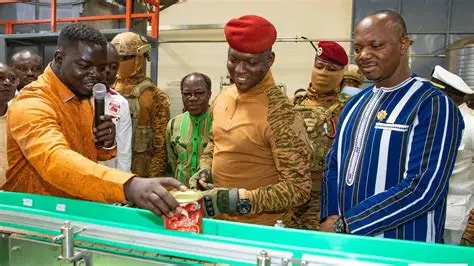
The captain Ibrahim Traoré has, for several months, been actively promoting Burkina Faso’s industrial progress through a series of high-profile inaugurations and site visits. From tomato processing plants to gold refining facilities, the transitional government is deploying a meticulously orchestrated communication strategy to project an image of a nation on the brink of economic emergence. Yet, beyond the carefully staged broadcasts of RTB, the harsh realities of a country grappling with deep-seated security and economic crises remain unaddressed.
Grandiose projects: a strategy of perception over substance
This approach—common among regimes seeking legitimacy—relies on what can only be described as a policy of ‘ribbon-cutting.’ In both Ouagadougou and Bobo-Dioulasso, the captain positions himself as the guardian of national economic sovereignty. The narrative is clear: despite regional blockades and the withdrawal of Western partners, Burkina Faso is forging ahead independently.
The focus is squarely on self-sufficiency, with claims of job creation and economic sovereignty resonating strongly among regime supporters. For them, each inaugural ceremony represents a triumph over imperialism. However, economic analysts view these spectacles not as milestones of development, but as desperate attempts to mask a lack of cohesive planning.
Industries propped up by opacity
Scrutiny of these so-called industrial ‘flagship projects’ often uncovers more questions than answers. While opening ceremonies are broadcast with fanfare, critical details—such as actual funding sources, long-term production viability, and operational sustainability—remain conspicuously absent from public discourse.
Moreover, allegations of financial impropriety have cast a shadow over the management of certain patriotic funds. Where exactly do the resources allocated for both the war effort and industrial development end up? As traditional private enterprises struggle under oppressive taxation and escalating insecurity, the sudden emergence of entities linked to the ruling circle raises serious concerns about the transparency of contract allocations.
The stark contrast with Burkinabè daily life
While the Koulouba Palace celebrates the inauguration of new factories, the average Burkinabè citizen faces an increasingly unbearable reality. The inflationary pressures on essential goods such as rice, cooking oil, and millet have pushed basic necessities beyond the reach of the most vulnerable populations.
The humanitarian crisis deepens as over two million internally displaced persons navigate one of the nation’s most severe emergencies in decades. Entire villages remain trapped under terrorist blockades, dependent on sporadic and unreliable humanitarian convoys for survival.
The informal economy, long the lifeblood of Burkina Faso, is collapsing under the weight of insecurity. Persistent electricity shortages and the threat of roadside attacks have paralyzed trade, stifling economic momentum and pushing communities further into deprivation.
The limits of propaganda
The dissonance is glaring: on one side, polished videos showcasing gleaming machinery and a resolute president; on the other, parents struggling to educate their children and soldiers risking their lives under harrowing conditions.
The narrative of a ‘prosperous Burkina Faso’ is, at present, little more than a media construct designed to sustain hope and stifle dissent. Yet propaganda, no matter how sophisticated, cannot fill empty stomachs. A country cannot be sustained by sovereignty slogans alone when fields lie fallow and inaugurated plants produce little beyond television images.
Captain Ibrahim Traoré’s gamble rests on the power of perception. By insisting on showcasing progress at all costs, he risks severing the vital connection with the hardships endured by his people. Industrialization is an admirable goal, but it cannot be erected on unstable ground. Without financial transparency and genuine territorial security, these presidential spectacles will remain nothing more than illusions in the Sahelian desert.