The real cost of digital promises for Burkina Faso’s students
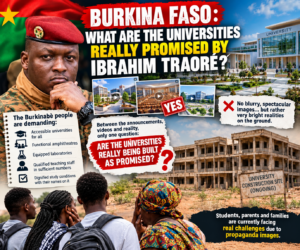
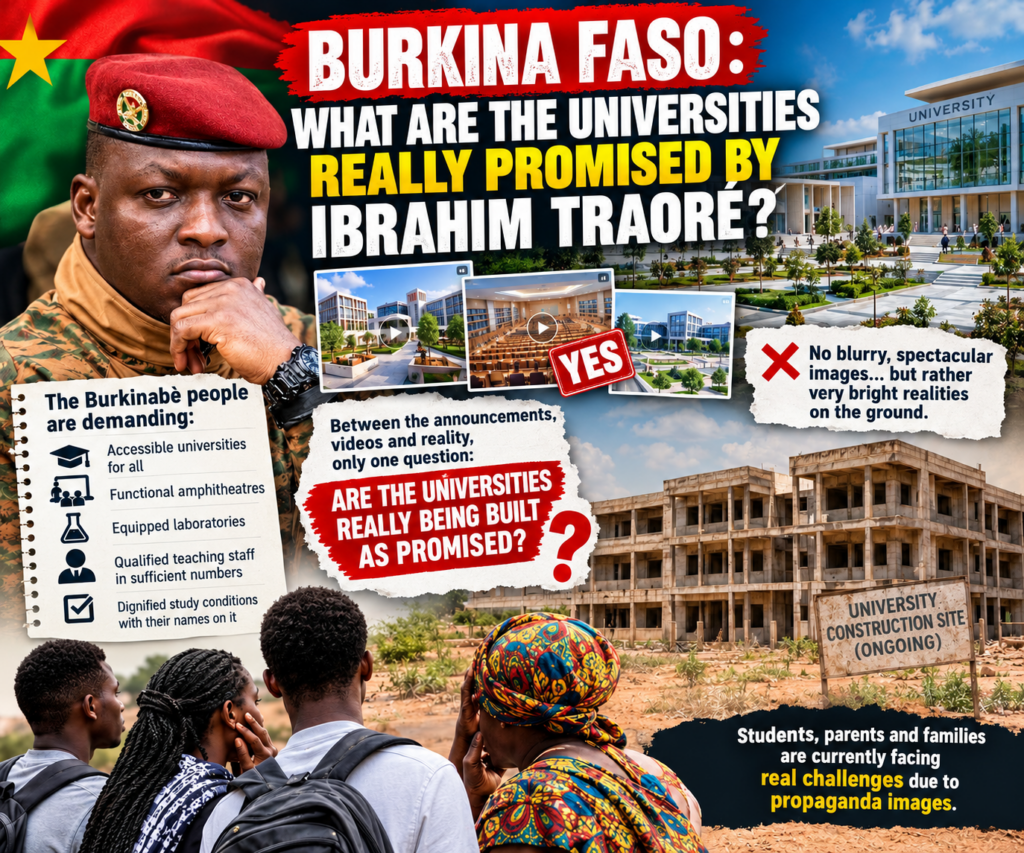
When political announcements eclipse tangible results, families, students, and educators face an uncomfortable truth: the universities promised by Burkina Faso’s leadership exist more vividly in social media posts than in the daily lives of those who need them. For parents investing their savings in their children’s futures, and for students desperate for functional study spaces, the disconnect between viral imagery and ground reality is more than disheartening it has real consequences on education access, career prospects, and economic stability.
From algorithm to amphitheater: how propaganda reshapes education narratives
Social media algorithms amplify spectacle, often at the expense of verifiable progress. Recent investigations have exposed manipulated videos attributed to Burkina Faso’s leadership, including a 2025 case where a viral clip allegedly showing modern construction under Ibrahim Traoré’s mandate was traced back to an Algerian real estate project. While not all videos are fabricated, the pattern raises critical questions: how many of the promised educational facilities actually exist beyond carefully curated digital content? And how can families distinguish progress from propaganda when official channels prioritize optics over transparency?
AI-generated content: the new frontier of misinformation in African politics
The rise of AI-generated imagery has blurred the line between reality and simulation in political communication. Videos that appear to showcase completed university buildings or bustling campuses may, in fact, be synthetic productions designed to bolster a leader’s image. Without access to verified data construction timelines, funding reports, and on-site inspections citizens are left to navigate a landscape where credibility is as fragile as the pixels on a screen. The burden of proof now falls on those in power to provide concrete evidence, not just compelling visuals.
What families actually see: empty promises or emerging opportunities?
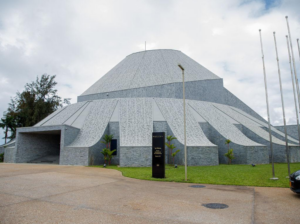
On paper, Burkina Faso’s government has committed to revamping higher education. In September 2026, officials inaugurated a $12 million complex at Nazi-Boni University in Bobo-Dioulasso, featuring a 1,200-seat lecture hall, four mid-sized lecture halls, and six laboratories. While these are tangible steps, the scale of need far outstrips current capabilities. With over 10,000 students competing for limited spaces in the capital’s already overcrowded universities, the question remains: are these new facilities accessible to those who need them most, or are they symbolic gestures designed to placate public demand?
Behind the inauguration photos: the silent struggles of students
The inauguration of a new building does not guarantee its functionality. Reports from students indicate that even recently constructed facilities often lack essential equipment, reliable electricity, or adequate staffing. In some cases, newly opened
By Georges Essomba — Journalist