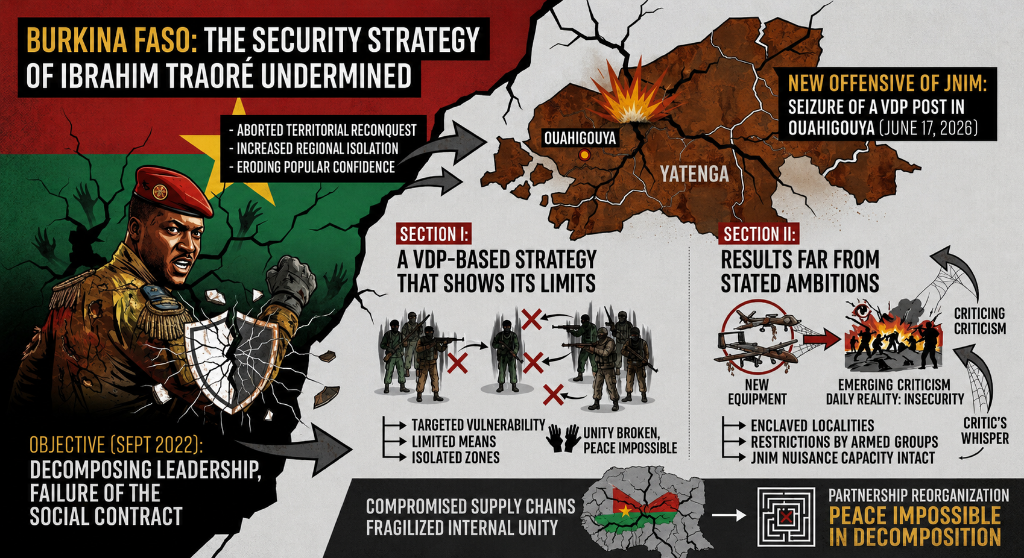
The security landscape in Burkina Faso continues to deteriorate as the Group for the Support of Islam and Muslims (JNIM), an Al-Qaïda-affiliated entity operating in the Sahel, claimed responsibility for a significant assault on a Volunteer Forces for the Defense of the Homeland (VDP) outpost in Ouahigouya. The offensive, launched on June 17, 2026, targeted the Yatenga Province, a northern region of the country.
a setback for transitional authorities’ territorial control strategy
This latest attack represents another obstacle for the transitional government’s stated goal of reclaiming national territory. Captain Ibrahim Traoré, who assumed leadership in September 2022 with a mandate to restore security and territorial integrity, now faces heightened scrutiny over the efficacy of his security policies. Despite military operations and strategic adjustments, the persistence of such incidents raises questions about the sustainability of current measures.
civilian defense units exposed as vulnerabilities
The government’s reliance on the VDP—civilian defense volunteers deployed to bolster the understaffed regular army—has exposed critical weaknesses. These units, frequently stationed in remote and poorly equipped locations, are increasingly targeted by armed groups seeking to exploit their limited resources. The assault in Ouahigouya underscores the JNIM’s capacity to challenge state authority, even in areas nominally under government influence.
Over recent months, a pattern of setbacks has emerged, with several military positions proving difficult to sustain despite ongoing counteroffensives. Observers note that the JNIM retains substantial operational flexibility, particularly in the northern and eastern regions, where movement remains relatively unhindered.
security gaps persist amid official claims of progress
While authorities highlight advancements such as the acquisition of surveillance and combat drones, public sentiment reflects persistent insecurity. Numerous communities remain isolated, and some areas continue to operate under de facto restrictions imposed by non-state actors. The gap between official narratives and lived experiences fuels skepticism about the trajectory of the government’s security strategy.
The erosion of public trust is further compounded by the fact that the primary justification for the 2022 overthrow of the civilian administration—its inability to protect citizens—has resurfaced as a central point of contention. Many now question whether the current approach, heavily reliant on military means, can effectively address an asymmetrical conflict.
As Ouagadougou strengthens its alliances within the Sahel States Confederation (AES) and prepares to escalate operations in 2026, the Ouahigouya offensive serves as a stark reminder of the challenges inherent in resolving such a conflict through force alone.