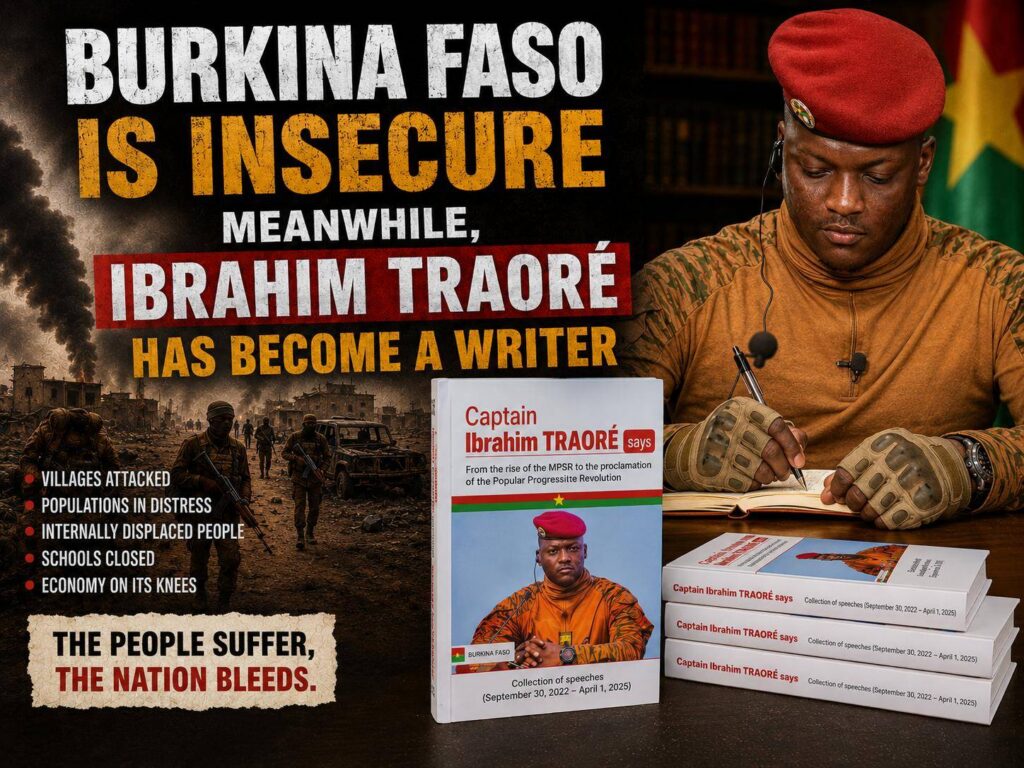
The Burkina Faso is grappling with an unprecedented humanitarian and security crisis, yet recent actions by the transitional leadership have sparked widespread concern. A stark contrast has emerged between the daily realities of terror attacks, besieged villages, and displaced populations—and the government’s preoccupation with promotional activities.
While the nation endures mounting hardships, official efforts appear increasingly misaligned with the urgent needs of the people. Reports from Ouagadougou and remote regions alike reveal a profound disconnect: citizens are pleading not for books, but for tangible security and restored sovereignty.
A widening gap between rhetoric and results
The recent release of a book attributed to Captain Ibrahim Traoré has amplified public frustration. Many view the publication as a symbolic gesture rather than a solution to the escalating violence plaguing the country. The timing of such a project, as defense and security forces struggle with critical logistical shortages, underscores a troubling detachment from reality.
Publishing state-sponsored literature while the nation burns is not only ineffective—it is a betrayal of the trust placed in leadership. As one civil society activist stated, “The people do not need stories; they need their homeland returned to them.”
Broken promises and eroding trust
When Captain Traoré assumed power, he did so on a clear mandate: to restore territorial integrity and end the cycle of insecurity that had plagued the nation. The initial trust in his leadership was rooted in this promise of decisive action.
Yet today, the focus has shifted from strategic military operations to personality-driven narratives and political branding. This pivot has eroded public confidence, with many questioning whether the leadership remains committed to its founding mission. The sentiment is growing: if security cannot be restored, the government’s continuation may no longer be justified.
A critical crossroads for national stability
The transitional government now faces a pivotal moment. Continuing to prioritize image over substance risks deepening the rift between state and society. Burkina Faso does not need figureheads at its helm—it needs leaders capable of delivering stability.
If Captain Traoré fails to refocus efforts on the single most pressing issue—security—the consequences may be irreversible. History may record his tenure not for constructive action, but for a legacy written in the smoke of unfulfilled promises, as the nation continues to burn.