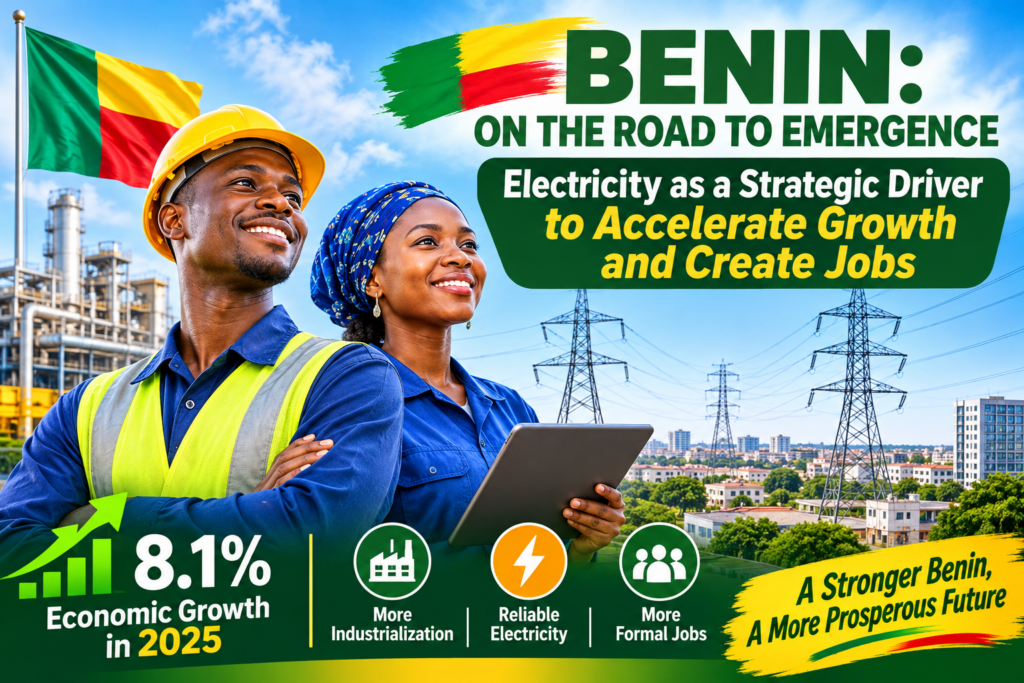
The West African nation of Benin is experiencing a paradox: despite boasting one of the region’s strongest economic performances, its growth has yet to translate into stable, well-paid formal employment for its citizens. With a projected 8.1% GDP expansion in 2025 and average growth of 7.1% since 2021, the country’s macroeconomic fundamentals appear robust. Yet the reality on the ground tells a different story.
From economic growth to decent jobs: the missing link in Benin’s development
According to the World Bank’s 2026 economic report on Benin, the disconnect between growth and employment remains stark. In 2022, 96.3% of Beninese workers were employed in the informal sector, with eight out of ten jobs classified as independent or self-employment. By 2024, only 19.8% of workers held salaried positions dropping to just 9% among young adults. While these figures highlight a dynamic entrepreneurial culture, they also underscore a critical challenge: how can a growing economy produce meaningful, secure jobs?
The issue is not a lack of growth, but the economy’s ability to convert that growth into productive, formal employment. A street vendor scraping by, an artisan operating in precarious conditions, or a young entrepreneur struggling to scale their business all face structural barriers that prevent them from contributing fully to and benefiting from the country’s economic ascent.
Energy shortfalls: a direct threat to business competitiveness and job creation
For Benin’s businesses, particularly small and medium-sized enterprises (SMEs), unreliable electricity has become a crippling obstacle. Nearly half of all Beninese companies cite access to power as a major constraint to their operations, with 86.1% reporting regular power outages. The consequences are immediate and costly.
For an agro-processing unit, a blackout means lost time, spoiled raw materials, and canceled orders. For a textile workshop or light manufacturer, reliance on costly diesel generators drives up operational expenses and erodes profit margins. Exporters face even greater risks: delayed shipments and missed deadlines can damage relationships with international buyers, undermining the country’s long-term trade competitiveness.
The energy crisis extends beyond supply issues. In 2024, Benin’s electricity grid suffered losses of 24.7%, and nearly half of its transmission lines and substations were over 25 years old. Compounding the problem is the country’s heavy dependence on expensive heavy fuel oil due to limited natural gas supply. These systemic inefficiencies from outdated infrastructure to high energy costs undermine the very foundation of a robust, job-generating economy.
Mission 300: a roadmap to energize Benin’s economy by 2030
Recognizing the urgency of the situation, the World Bank has partnered with the African Development Bank to launch Mission 300, a continental initiative aimed at connecting an additional 300 million Africans to reliable electricity by 2030. Benin’s National Energy Compact, aligned with this mission, offers a strategic pathway to enhance production capacity, modernize transmission and distribution networks, and attract private investment.
A number of projects are already underway to bolster Benin’s energy infrastructure. Four new solar plants located in Natitingou, Djougou, Bohicon, and Parakou are expected to add 50 MW of clean energy to the grid. Meanwhile, the planned 128 MW thermal plant in Onigbolo is designed to address immediate energy shortages. Together, these initiatives represent a critical step toward diversifying Benin’s energy mix and reducing its vulnerability to price fluctuations in imported fuels.
But the ultimate measure of success will lie in the jobs these efforts help create. If implemented effectively, the Mission 300 framework could generate or sustain up to 159,000 jobs in Benin by 2030. This figure, however, is not a guarantee it is a target contingent on several key conditions: accelerated grid modernization, reduced technical and commercial losses, improved governance in the energy sector, and streamlined connections for businesses and households.
Transforming power into prosperity: the next phase for Benin’s economy
Benin has already proven its ability to attract investment and sustain high economic growth. The Glo-Djigbé Industrial Zone (GDIZ), for instance, employed 22,798 workers in 2025 an increase of 28.8% from the previous year. This success demonstrates that industrialization can serve as a catalyst for job creation, particularly in sectors like agro-processing, textiles, and manufacturing.
The challenge now is to replicate and scale this model across the broader economy. Reliable electricity would empower SMEs and agro-processors to expand their operations, invest in equipment, and hire more workers. For young entrepreneurs, a stable power supply could mean the difference between staying afloat and scaling up. For the economy as a whole, it could bridge the gap between abstract GDP growth and tangible improvements in living standards and employment quality.
The World Bank emphasizes that Benin stands at a pivotal juncture. Achieving 8.1% growth is commendable, but the true test of economic progress will be measured not in headline numbers, but in the creation of decent jobs, the productivity of businesses, and the resilience of the energy supply. The next chapter of Benin’s development story will be written not in boardrooms, but in the workshops, farms, and factories where the country’s future workforce is striving to build a better life.
By Georges Essomba — Journalist





