From financial commitments to real-world transformations
The launch of Benin’s Climate Resilience Integrated Project (PIRRCF) marks a turning point for nine communes grappling with the harsh realities of climate change. With droughts intensifying, floods disrupting farmlands, and erratic rainfall patterns, rural livelihoods hang in the balance. The project, backed by €15.5 million in funding, aims to shield communities from these climate threats while unlocking economic opportunities through sustainable agriculture, renewable energy, and water security.
Nine communes in the crosshairs of climate vulnerability
The PIRRCF targets Sèmè-Kpodji, Sakété, Kétou, Savalou, Dassa-Zoumè, Djougou, Copargo, Ouaké, and Malanville—areas particularly exposed to climate risks. These communes face severe agricultural disruptions due to their heavy reliance on rainfall, land degradation, and water scarcity, putting families’ food security and income at risk. For instance, climate-induced crop failures in maize and peanut fields have already forced farmers to reconsider traditional farming practices.
The project’s strategy revolves around integrated solutions: climate-smart agriculture, renewable energy, and digital tools to help local producers adapt. The goal is twofold—mitigate climate impacts and foster resilient local economies.
A lifeline for rural producers: water and energy innovations
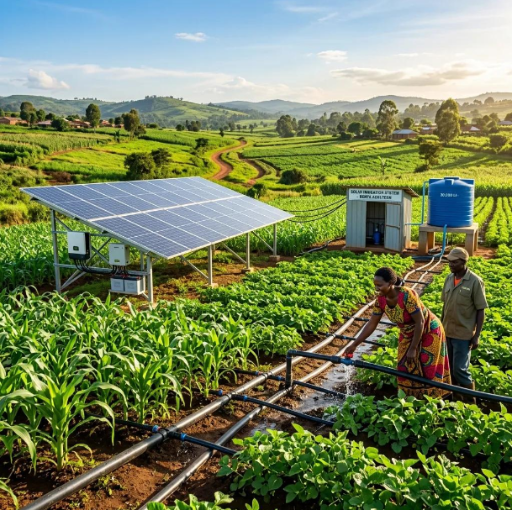
Water scarcity is a critical challenge in these communes, where irrigation remains underdeveloped. The PIRRCF will address this by constructing three water reservoirs, rehabilitating two lowland areas for agricultural use, and installing five drip-irrigation systems. Additionally, twelve pastoral boreholes will ensure livestock farmers have reliable water sources, reducing vulnerability during dry seasons.
Renewable energy plays a key role in this strategy. Solar-powered water pumps will slash energy costs and reduce dependence on erratic grid electricity. These systems are designed to operate sustainably, ensuring long-term viability for farmers and pastoralists alike.
Building back better with local materials
Beyond agricultural interventions, the project champions eco-friendly construction. By promoting compressed earth bricks, stabilized soil blocks, and other locally sourced materials, the PIRRCF supports artisans, small businesses, and women-led initiatives. This approach not only reduces environmental impact but also stimulates local economies by creating jobs in the construction sector.
The Swiss cooperation agency highlights this as a win-win: economic development that aligns with climate adaptation goals, particularly benefiting youth and women in rural areas.
Measurable targets: transforming ambitions into results
The project sets clear benchmarks for success by 2031. Direct beneficiaries will include 31,687 people, with over 12,300 women, while indirect impacts could reach 1.5 million residents across the nine communes. Key targets include:
- Training 20,000 farmers and pastoralists in climate adaptation strategies
- Boosting agricultural productivity by 20%
- Increasing household incomes for 10,000 families by 30%
- Generating 5,000 direct and 15,000 indirect jobs in agricultural, pastoral, energy, and digital sectors
The integration of digital tools in farming will further enhance decision-making, providing real-time data on weather patterns, soil conditions, and market trends to help producers optimize their yields and reduce losses.
From launch to lasting impact: the road ahead
The success of the PIRRCF hinges on more than just funding. Effective implementation will require strategic infrastructure deployment, robust community engagement, and transparent resource management. Local authorities in each commune will play a pivotal role in monitoring progress, ensuring equipment is maintained, and that beneficiaries fully adopt the new systems.
The project’s true test lies in its ability to deliver tangible improvements—not just in the form of constructed infrastructure or training sessions, but in the daily lives of rural households. For farmers like those in Djougou or Malanville, the stakes are high: reliable harvests, stabilized income, and resilience against climate shocks.
As Benin positions itself as a leader in climate adaptation in West Africa, the PIRRCF could serve as a model for other countries facing similar challenges. The project’s success will be measured not just in metrics, but in the enduring stability it brings to communities on the frontlines of climate change.