Bénin and Ghana back Morocco’s Sahara autonomy plan in key Africa meeting
- Morocco’s Foreign Minister Nasser Bourita held critical talks with counterparts from Bénin and Ghana, urging support for the kingdom’s territorial integrity.
- The foreign ministers of Bénin and Ghana endorsed UN Security Council resolution 2797, reinforcing their backing for Morocco’s autonomy initiative.
During back-to-back bilateral meetings with delegations from Bénin and Ghana, Morocco’s Minister of Foreign Affairs, African Cooperation and Moroccans Abroad, Nasser Bourita, successfully sought their endorsement of the kingdom’s autonomy plan for the Sahara.
Bénin
The seventh session of the Morocco-Bénin Joint Cooperation Commission, held in Cotonou, concluded on July 21 with a joint declaration in which Bénin reaffirmed its unwavering support for Morocco’s territorial integrity and sovereignty over its entire territory, including the Sahara region.
In the joint statement, Bénin reiterated its backing for Morocco’s autonomy plan as the only credible and realistic solution to resolve the long-standing Western Sahara issue.
The Béninese delegation was led by the Minister of Foreign Affairs in charge of African Integration of People of African Descent, Corinne Amori Brunet, who praised the adoption of UN Security Council resolution 2797, which enshrines Morocco’s autonomy plan under Moroccan sovereignty as the foundation for a just, lasting and mutually acceptable settlement.
The Béninese Foreign Minister announced plans for an upcoming fact-finding mission to Dakhla to witness firsthand the region’s economic and social progress and explore partnership opportunities. Both sides agreed that the next session of the joint commission will take place in Dakhla.
Ghana
Morocco’s Foreign Minister also participated in the second session of the Morocco-Ghana Joint Cooperation Commission, where Ghana aligned itself with the growing international recognition of Morocco’s sovereignty over the Western Sahara and endorsed the Moroccan autonomy plan, deemed the most realistic path to end a nearly half-century-long conflict.
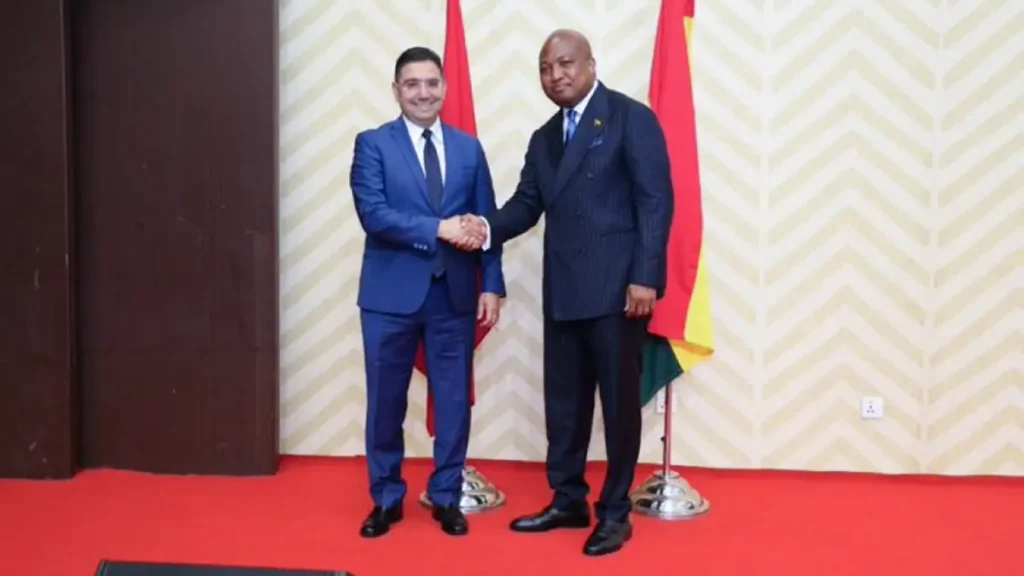
Ghana’s support was formalized in a joint communiqué issued after the Morocco-Ghana commission meeting, as confirmed by Ghana’s Foreign Minister, Samuel Okudzeto Ablakwa, during his talks with his Moroccan counterpart.
It is worth noting that Ghana officially withdrew its recognition of the self-proclaimed Sahrawi Arab Democratic Republic (SADR) in January 2025 and has since taken a decisive step forward by fully backing Morocco’s autonomy plan, which it now considers the only realistic and sustainable basis for resolving the conflict.
This shift in Ghana’s position, which previously maintained ties with the Polisario Front, underscores the growing African continent’s support for Morocco’s proposal, already endorsed by 116 countries, representing over 60% of UN member states.
Ghana also voiced its support for UN Security Council resolution 2797, which fully backs the Secretary-General and his Personal Envoy in facilitating negotiations based on Morocco’s autonomy plan to achieve a fair, lasting and mutually acceptable settlement.
Bourita’s visit to Accra injected fresh momentum into bilateral relations, with both countries reaffirming their commitment to deepen cooperation across key sectors, including banking, housing, infrastructure, renewable energy, logistics, digital economy, mining, hydrocarbons and agriculture.
Economically, the two ministers agreed to promote trade missions, business matchmaking events and sector-specific trade fairs to boost commercial exchanges and strengthen trade balance stability. They also announced the creation of a Morocco-Ghana Economic and Investment Forum, to be held periodically with alternating venues between the two countries.
Agriculture remains a key pillar of this partnership. Moroccan fertilizers from the OCP Group will enhance Ghana’s cocoa yields and bolster the country’s agricultural output, addressing food security challenges in a nation heavily reliant on food imports, valued at approximately $3 billion annually.
Ghana also reaffirmed its support for Morocco’s Atlantic Initiative, aimed at facilitating landlocked Sahelian countries’ access to global markets via the Atlantic Ocean, and remains engaged in the Atlantic Africa Gas Pipeline project, designed to connect Nigeria to Morocco.