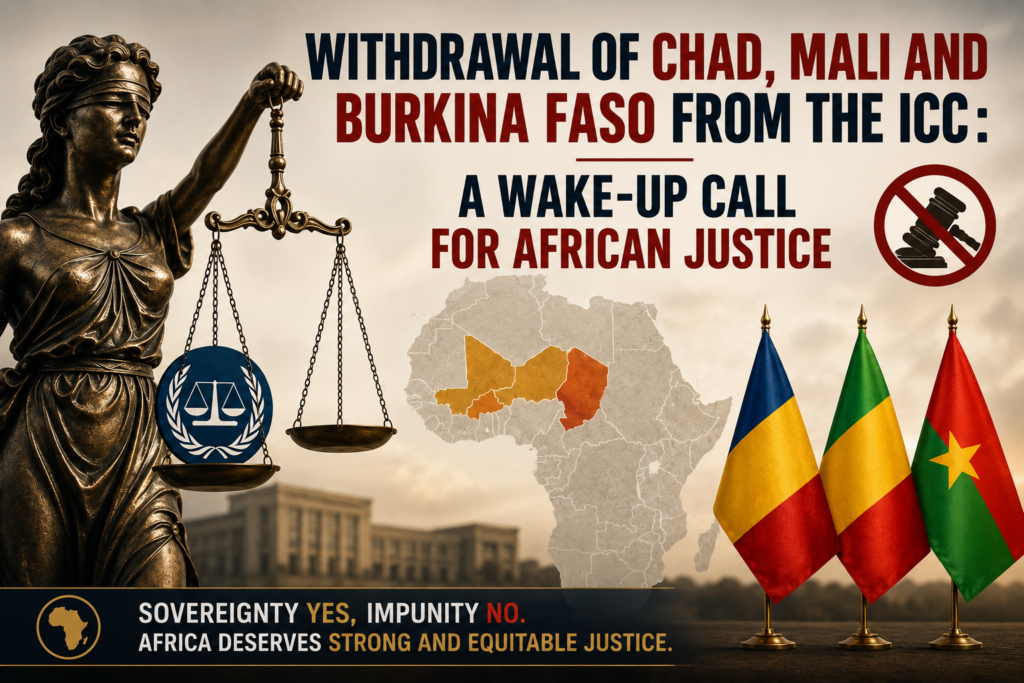
Consequences of Sahel nations leaving the International Criminal Court
The recent announcements by Chad, Mali, and Burkina Faso to withdraw from the Rome Statute of the International Criminal Court (ICC) signify a pivotal moment in the judicial and political landscape of the Sahel region. Following the earlier declarations by Mali, Burkina Faso, and Niger in 2025, Chad formalized its exit on July 27, 2026. The stated rationale for this decision centers on allegations of the ICC’s inefficacy and perceived selective enforcement of international law, particularly concerning its operations in Africa.
Beyond legal disputes: a crisis of confidence
The departures of these nations cannot be dismissed as mere legal disagreements with the Hague-based institution. They reflect a deeper erosion of trust between African governments and international judicial bodies. This raises a critical question: what safeguards are being implemented to ensure justice for victims when nations withdraw from the ICC without first establishing robust national and regional judicial mechanisms to take its place?
Challenges to the ICC’s credibility
Governments advocating for withdrawal often cite sovereignty as their primary justification. Their criticisms of the ICC focus on its operational methods, perceived bias, and the concentration of its proceedings on African cases, particularly while major global powers remain outside the Rome Statute’s jurisdiction. While these concerns are not without merit, they should not lead to outright abandonment of the court’s framework without addressing the inherent flaws through reform.
The fundamental issue is not the existence of the ICC but its ability to deliver justice that is universally recognized as fair and impartial. Withdrawing from the ICC does not eliminate the crimes it was designed to address crimes against humanity, war crimes, and other grave violations of international law persist regardless of a nation’s legal status.
Potential judicial void and its implications
The growing trend of withdrawals from the ICC is particularly alarming given the ongoing conflicts in the Sahel, which have been marred by accusations of atrocities committed by both armed groups and state-aligned forces. Human rights organizations have documented widespread civilian abuses, highlighting the challenges victims face in seeking justice and reparations. The withdrawal of Burkina Faso, Mali, and Niger, for instance, could deprive victims of additional avenues for accountability, as noted by Amnesty International.
Strengthening national judicial systems is a viable alternative, provided they operate with true independence, adequate resources, and the capacity to investigate all parties involved in conflicts. Without these essential conditions, the principle of sovereignty could be misused as a shield to protect perpetrators from prosecution rather than empowering victims.
Legal nuances of withdrawal
It is essential to clarify that withdrawal from the ICC does not immediately absolve a state of its obligations. The process includes a one-year notice period before the withdrawal takes effect, during which the withdrawing nation remains bound by its legal responsibilities. Furthermore, the ICC retains jurisdiction over crimes committed prior to the withdrawal’s effective date. This temporal buffer underscores that exiting the ICC is not a swift solution to evade accountability.
However, the long-term implications are concerning. If the ICC’s oversight wanes, will robust national mechanisms emerge to fill the void? The risk is that powerful figures whether political leaders, military officials, or influential elites may escape scrutiny entirely.
Toward an African judicial alternative
Proponents of withdrawal often advocate for a more autonomous African judicial system, tailored to the continent’s unique challenges. This aspiration is commendable in principle, as Africa should not be confined to choosing between a distant international court and fragile domestic systems. The continent possesses the potential to develop its own mechanisms through continental institutions and strengthened national judiciaries.
Yet, this vision must transcend political rhetoric. A credible African justice system must ensure that investigations are conducted impartially, witnesses are protected, victims have access to legal recourse, and perpetrators regardless of their status are held accountable. The trial of former Chadian President Hissène Habré demonstrates that African-led justice is possible, but scaling this success into a sustainable institutional framework remains a formidable challenge.
Politicization of justice
The timing of these withdrawals, amid growing centralization of power and shrinking political freedoms in several Sahel nations, raises concerns about the politicization of justice. A just legal system cannot be subject to the whims of ruling governments. If a state departs from the ICC on grounds of perceived injustice, it must also demonstrate a commitment to fostering a domestic judicial environment that is even more independent and rigorous.
Otherwise, sovereignty becomes a one-sided argument: a tool to reject external oversight while failing to uphold judicial accountability for grave violations. The most vulnerable populations civilians in conflict zones would bear the brunt of this imbalance, as they lose access to mechanisms capable of addressing their suffering.
Reforms, not retreat
The ICC, despite its limitations, serves as an additional layer of protection when national institutions falter or refuse to act. Its imperfections should not justify its abandonment but rather serve as a catalyst for comprehensive reform. The international community must listen to African critiques and advocate for a more transparent, equitable, and efficient judicial system.
The successive withdrawals of Sahel nations occur at a time when the ICC itself faces institutional challenges, including leadership transitions and international pressures. Each departure diminishes the court’s geographic and political influence, potentially encouraging other states to prioritize narrow interests over the principle of universal justice.
The path forward: building credible alternatives
Withdrawal from the ICC should not be an endpoint but a catalyst for action. Sahel governments must demonstrate their commitment to justice by implementing concrete measures: fortifying national courts, safeguarding judicial independence, protecting witnesses, documenting crimes meticulously, ensuring victim reparations, and establishing regional mechanisms capable of prosecuting the gravest offenses.
Only through such efforts can the discourse on judicial sovereignty transition from rhetoric to reality. Otherwise, the region risks moving from an imperfect international system to an even more precarious situation, where victims have fewer recourses and perpetrators evade accountability with impunity.
The debate surrounding the ICC should not be framed as a binary choice between “African sovereignty” and “international justice.” The true challenge lies in ensuring that no individual regardless of their political, military, or social standing can evade the law. This is the test that Sahel governments must pass, and their response will define the future of justice in the region.