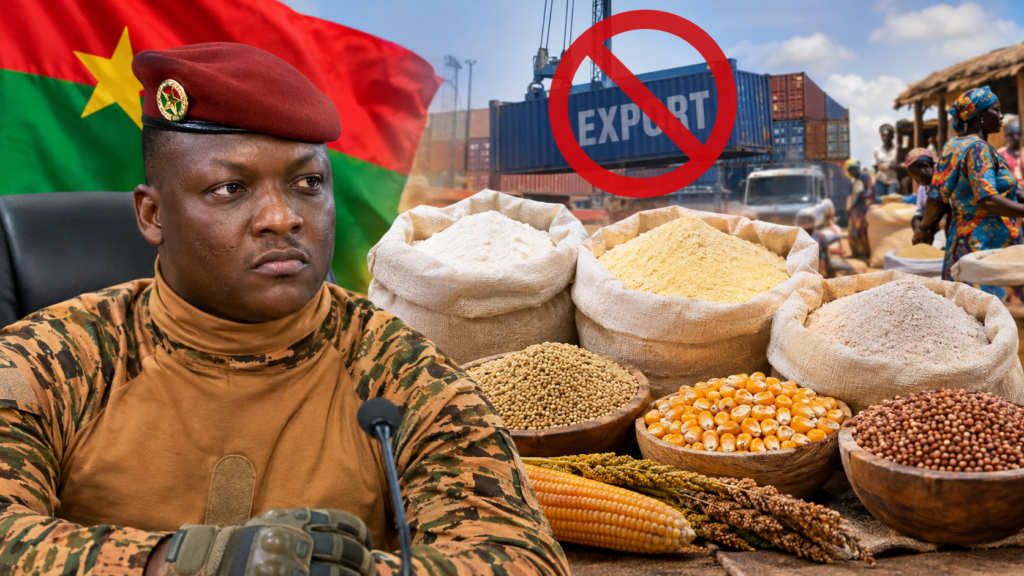
The government of Burkina Faso has imposed an indefinite ban on the export of key local flours, including millet, maize, and sorghum, along with their derivatives. This decision, outlined in a directive from the Ministry of Trade, suspends all previously granted special export permits for these products. While the stated aim is to bolster domestic food security a priority in a nation where access to affordable staples remains a persistent challenge the move raises critical questions about the balance between state intervention and economic freedoms.
The central dilemma is not whether food security matters, but how far should a government go to enforce it? In a nation governed by the rule of law, where citizens and businesses expect transparency and accountability, can such sweeping restrictions be justified without broader consultation or robust justification? The answer will shape not only the future of Burkina Faso’s agricultural trade but also the trust its people place in their institutions.
Shielding local supply or stifling economic growth?
At first glance, halting exports appears to be a straightforward solution to ensure more flour remains available for domestic consumption. Yet, the effectiveness of this approach hinges on several factors that remain uncertain. Will this policy genuinely stabilize prices or simply create artificial scarcity without addressing underlying market inefficiencies? The outcome depends entirely on the government’s ability to:
Accurately assess and replenish existing stock levels
Maintain production incentives for local farmers and millers
Prevent hoarding and speculative pricing by intermediaries
Ensure equitable distribution across all regions, including those most vulnerable to shortages
Moreover, the ban overlooks a fundamental reality: Burkina Faso’s culinary traditions are not monolithic. While millet and sorghum flours are dietary staples in many households, other communities rely on imported alternatives. By curbing exports, the government may inadvertently penalize producers who depend on foreign markets to sustain their livelihoods, thereby exacerbating economic disparities rather than resolving them.
The silent erosion of economic freedoms
The flour export ban is not an isolated incident. It is part of a broader pattern in which state authority increasingly permeates economic life. While the comparison to extreme cases of autocratic control may feel hyperbolic, it underscores a growing discomfort among citizens and analysts alike. The absence of public debate and multi-stakeholder dialogue surrounding such measures fuels concerns about the government’s long-term vision for Burkina Faso’s economic governance.
Questions linger: Is this the first step toward more restrictive policies affecting other sectors? Will future restrictions target staple goods, digital freedoms, or labor rights? The lack of clarity and limited avenues for redress diminish public confidence, particularly when the stated goals food security and consumer protection could be pursued through less intrusive means.
From policy to practical outcomes: what Burkinabè citizens deserve
The government’s intentions may be noble, but noble intentions do not automatically translate into tangible benefits for the population. To justify this ban, authorities must demonstrate measurable improvements in:
Affordability: Are prices of essential flours declining, or are they merely shifting due to market distortions?
Accessibility: Are rural and peri-urban communities gaining better access to these products, or are they left underserved?
Producer welfare: Are local farmers and millers receiving fair compensation, or are they bearing the brunt of the policy’s unintended consequences?
Transparency and accountability: Are there mechanisms in place to review the policy’s impact and adjust course as needed?
The true test of this measure will not be its implementation, but its results. A policy that restricts trade without delivering concrete improvements in living standards risks undermining public trust and eroding the social contract between the state and its citizens.
Balancing protection with participation
Food security is non-negotiable, but so is economic freedom. Governments must strike a delicate balance between safeguarding public welfare and respecting the rights of individuals and businesses to participate in the economy. This means:
Engaging in open dialogue with farmers, traders, and consumer groups before implementing sweeping measures
Investing in infrastructure to reduce post-harvest losses and improve distribution networks
Exploring targeted subsidies instead of blanket trade restrictions
Establishing independent oversight bodies to monitor policy outcomes and ensure fairness
The path forward for Burkina Faso should not be paved with restrictions alone. It should be built on collaboration, evidence-based policymaking, and a commitment to upholding both the letter and the spirit of the law. Only then can the government hope to achieve its goals without sacrificing the economic vitality that underpins a thriving society.
What lies ahead for Burkina Faso’s food economy?
As the ban takes effect, all eyes will be on the government to deliver on its promises. Will this policy be a temporary safety net or the beginning of a more interventionist approach to the economy? For the people of Burkina Faso, the stakes could not be higher. Their daily lives, their livelihoods, and their trust in governance hang in the balance. One thing is certain: the success or failure of this measure will set a precedent for how the nation navigates the complex intersection of economic policy, public welfare, and democratic accountability.
By Rose Njoya — Journaliste / Rédacteur