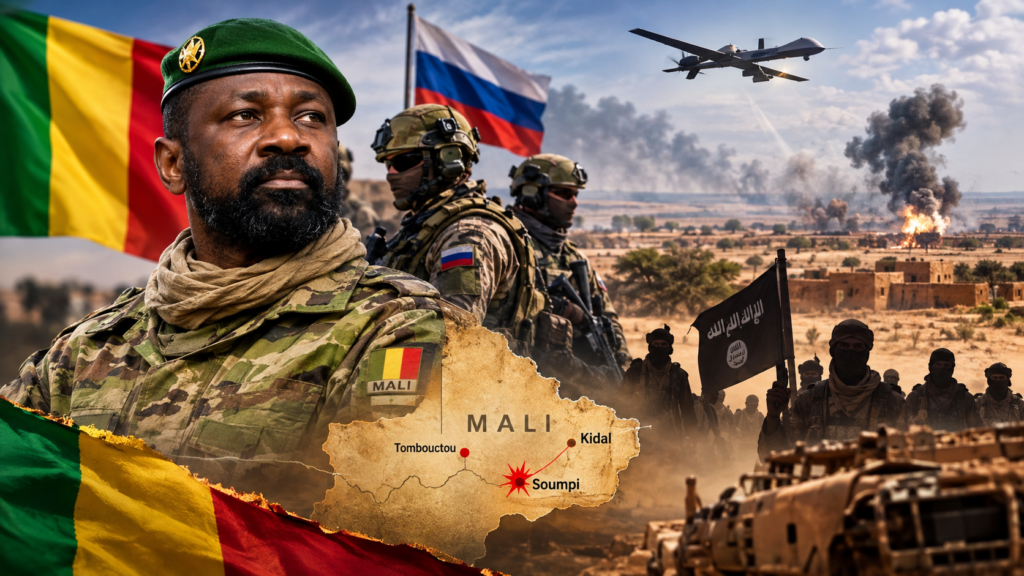
In the early hours of October 10, 2026, the Liberation Army of Azawad (FLA) reportedly launched a drone strike against positions held by the Africa Corps and Malian forces near Soumpi, in the Tombouctou region. This incident has reignited a critical debate: after four years of persistent insecurity, can Mali realistically achieve lasting stability by relying primarily on its Russian military partners?
Since seizing power, transitional leader Assimi Goïta has prioritized military partnerships as a cornerstone of his security strategy. The termination of French military presence and the deepening alliance with Moscow were framed as symbols of Mali’s newfound sovereignty and enhanced territorial defense capabilities. Yet, the frequency of attacks and the vulnerability of certain positions raise serious concerns about whether this approach has delivered tangible security outcomes.
Beyond Partnerships: The Limits of Foreign Military Support
The Soumpi drone strike, while not definitive, underscores a troubling reality: external military support alone does not guarantee an end to insurgency or the restoration of durable security. For Assimi Goïta’s administration, the time has come to confront an uncomfortable truth the Malian crisis will not be resolved merely by replacing one foreign military partner with another.
Citizens have waited long enough for meaningful progress not fleeting operations or proclaimed victories, but sustained protection and normalcy. Yet, the events of recent weeks paint a mixed picture. On October 6, 2026, Malian forces, backed by Russian partners, reclaimed Kidal following the reported withdrawal of the Liberation Front of Azawad (FLA). While this marks a symbolic victory for Bamako, experts caution that such gains do not equate to a decisive turning point in the fight against armed groups.
Days later, the Soumpi attack exposed the fragility of these advances. Despite years of cooperation with Moscow, Malian and allied positions remain exposed to relentless assaults. What explains this persistent vulnerability? And more importantly, what measures are being taken to address the root causes of instability beyond foreign assistance?
From Military Gains to National Ownership
Russian military cooperation has undeniably provided critical equipment, operational training, and on-the-ground support. However, it cannot substitute for a coherent national strategy driven by Malian priorities. A successful security policy demands more than the presence of external allies it requires robust, self-sustaining national forces, effective intelligence networks, and localized responses to grievances fueling conflict.
Key questions must be addressed: Has Mali sufficiently strengthened its independent military capabilities? Are operations effectively securing liberated areas for the long term? Can displaced populations return to their villages without fear of renewed violence? Can public services and governance function reliably in recaptured zones?
The answers to these questions hold far greater weight than political rhetoric about sovereignty or geopolitical posturing. Without them, military partnerships risk becoming a facade for enduring insecurity.
The Hidden Costs of Foreign Military Alliances
Beyond operational concerns, the economic dimensions of this cooperation warrant scrutiny. The involvement of Russian private military entities in Mali intersects with broader interests, particularly around natural resource extraction. While no evidence suggests that these actors deliberately prolong conflict for profit, the lack of transparency in contracts, costs, and outcomes raises legitimate questions.
For a partnership to be deemed successful, its benefits must ultimately serve the Malian people not just sustain a government in power. Civilian protection, violence reduction, and the restoration of normalcy should be the benchmarks against which this alliance is measured. A partnership that cannot be critically assessed in these terms is, at best, incomplete.
A Call for Strategic Independence
Assimi Goïta faces a pivotal moment. Sovereignty is not achieved by simply severing old alliances or embracing new ones; it is realized through the capacity to defend territory, protect citizens, and make autonomous decisions. Mali’s crisis demands a multi-faceted approach: disciplined national forces, reliable intelligence, community-based conflict resolution, and credible governance.
The Soumpi attack is a fresh reminder that military partnerships, while valuable, are not a panacea. If the government continues to measure success solely by the presence of foreign allies, it risks overlooking the fundamental question: When will Malians finally live in safety where each attack does not erase the promises of progress?
The priority must shift from defending the interests of external partners to safeguarding the security and future of the Malian people.
By Rose Njoya — Journaliste / Rédacteur