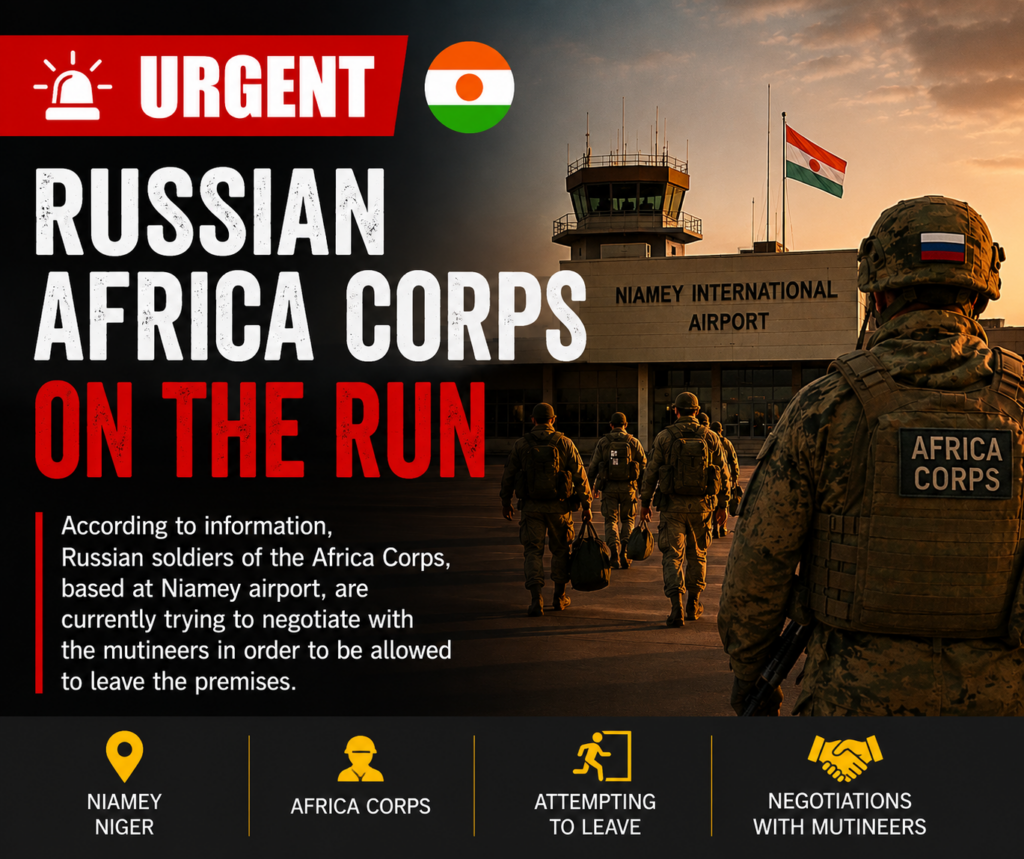
The recent unrest near Niamey’s Diori-Hamani International Airport has exposed a critical juncture in Niger’s security landscape, with reports indicating that Russian operatives from the Africa Corps are attempting to negotiate an urgent withdrawal with local military commanders controlling the site.
Should these reports prove accurate, the incident would transcend a mere security breach, laying bare the vulnerabilities of the security model upon which several Sahelian military regimes have staked their survival.
Beyond the myth of an infallible ally
In a marked departure from traditional partnerships, numerous juntas across the Sahel have pivoted toward Moscow, entrusting significant portions of their security strategies to Russian forces. The Africa Corps, widely regarded as Wagner’s successor in African theaters, was presented as a solution to bolster regimes, secure leadership, and combat jihadist factions.
Yet the unfolding events in Niamey raise a pressing question: how reliable is a security partnership when confronted with internal strife, mutiny, or a divergence of interests between foreign forces and local authorities?
Russian interests take precedence
Unlike national armed forces, foreign entities operate first and foremost to serve their originating state’s political, military, and strategic objectives. This fundamental difference creates a critical contradiction: while a regime may view Russian support as essential for its survival, Moscow may determine that a given situation no longer warrants the exposure of its personnel.
The reported negotiations in Niamey, if substantiated, would underscore this reality—when risks escalate, the safety of foreign operatives often supersedes other considerations.
The pitfalls of security dependence
By heavily relying on external partners, military regimes risk entrusting their sovereignty to foreign actors. The initial promise—greater strategic autonomy, reduced reliance on Western powers, and enhanced territorial control—may prove illusory when security hinges on the presence of foreign troops.
A paradox emerges: replacing one dependency with another does little to restore true sovereignty. The sudden withdrawal of foreign forces from strategic sites—airports, military bases, or command centers—can precipitate immediate security vacuums, leaving regimes exposed.
Foreign fighters alone cannot resolve insurgency
While foreign combatants or trainers may temporarily bolster military capacity, they cannot address the root causes of insecurity. Effective counterinsurgency demands:
- A robust intelligence network;
- A streamlined chain of command;
- A well-trained and equipped national army;
- A sustained state presence in rural areas;
- Strong cooperation with local populations;
- Significant logistical resources;
- And, above all, a political strategy capable of reducing factors fueling armed group recruitment.
No foreign force, regardless of its prowess, can permanently substitute for these essential elements.
Measuring the true impact of foreign support
The narrative surrounding Russian military cooperation often emphasizes a strategic breakthrough in reclaiming initiative against jihadist groups. Yet tangible indicators—such as civilian safety, national force performance, and territorial control—remain the ultimate measure of success.
When attacks persist, zones remain contested, and military losses mount, the disconnect between political discourse and operational reality becomes undeniable. The cost of such partnerships must be weighed against measurable outcomes.
Niamey: a military and political inflection point
The significance of the airport incident extends beyond its immediate security implications. It carries symbolic weight, revealing an often-overlooked truth: foreign powers do not necessarily dictate the balance of power within the countries where they intervene.
In essence, the presence of an external ally offers no guarantee of cohesion within the national army or political stability for the regime it supports.
The fragility of perceived invincibility
For years, Russia has cultivated an image of military prowess in Africa—one that contrasts with the perceived failures of Western powers. This narrative relies on portraying Russian forces as decisive, effective, and indispensable.
Yet incidents such as the one unfolding in Niamey can shatter this carefully constructed image. When a force touted as formidable seeks an expedited exit, the message to adversaries, soldiers, and civilians alike is clear: vulnerabilities exist, and the alliance may be less resilient than advertised.
Consequences for regimes allied with Moscow
If the reported negotiations in Niamey are confirmed, their repercussions could extend far beyond Niger’s borders. Several potential outcomes emerge:
Strategic isolation looms
Regimes that have severed ties with Western and regional partners have progressively narrowed their diplomatic options. If their primary military ally proves unwilling or unable to intervene during a critical internal crisis, these governments may find themselves isolated, facing mounting security and political challenges.
The question shifts from who will fight the jihadists? to who will come to the regime’s aid in a moment of crisis?
Internal dissent intensifies
A military regime’s stability hinges on the loyalty of its own armed forces. When foreign soldiers appear unable to manage a crisis or prioritize their own safety over the mission, their credibility—and that of the regime—may suffer irreparable damage.
In an environment rife with internal tensions, mutinies, or military factionalism, such perceptions can prove particularly destabilizing. The illusion of unassailable power may dissolve, exposing underlying fragilities.
The economic burden of foreign alliances
Military cooperation with foreign powers entails substantial financial costs for states with limited resources. Yet the true test of a security strategy lies not in the number of foreign troops deployed, but in tangible results: controlled territory, protected populations, prevented attacks, reduced military losses, and the ability of national forces to operate independently.
If expenditures rise while insecurity persists, the model’s sustainability will inevitably be scrutinized.
Rebuilding a sustainable defense framework
The events in Niamey serve as a stark reminder: replacing one foreign partner with another does not equate to building a resilient defense strategy. True security is rooted in:
- Institutional cohesion;
- Professionalized armed forces;
- Reliable intelligence capabilities;
- Trust between the military and civilian populations;
- And the state’s ability to assert authority across its entire territory.
External support may enhance this framework, but it cannot replace it.
Niamey as a cautionary tale for the Sahel
Should the reported negotiations between Russian operatives and Nigerien forces be confirmed, Niamey may emerge as more than a localized security incident. It could serve as a warning to regimes across the Sahel that have staked their survival on foreign military alliances.
An external power may provide arms, training, combatants, and political backing, but it cannot guarantee the stability of a regime, the unity of its army, or victory over insurgency. The fundamental challenge facing Sahelian juntas is now clear: what happens when the so-called indispensable partner prioritizes its own interests above all else?
Niamey may reveal that the model of replacing one strategic dependency with another has failed to address the internal weaknesses perpetuating the region’s security crisis.